
From West Bank Raids to Caracas Protests: Why Global Flashpoints Are Multiplying
From Israeli raids in the West Bank to post-colonial legislation in Algeria, local conflicts and political tensions are escalating globally. An analysis of the underlying trend and its impact on global security.
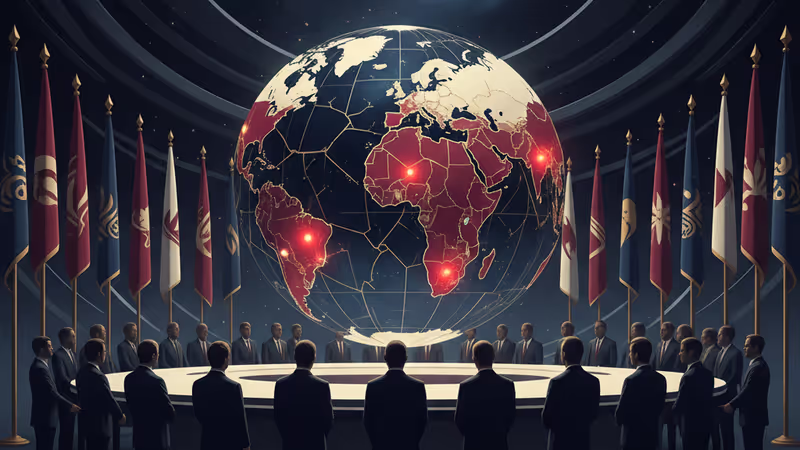
While superpowers focus on grand strategy, the world is fracturing from the ground up. A string of seemingly disconnected events—from an Israeli raid in the West Bank to anti-Trump protests in Caracas—paints a stark picture of rising local instability with global consequences.
Tinderboxes Ready to Ignite
In the Middle East and Africa, long-simmering conflicts are boiling over once more. According to Al Jazeera, Israeli forces recently injured dozens in a raid on the occupied West Bank, a grim reminder of how unresolved disputes can quickly escalate into violence. Meanwhile, in Sudan, people sheltering in displacement camps say they simply 'pray for peace,' exposing the devastating human cost of state failure and civil war.
The Heavy Weight of History
The ghosts of the past are actively shaping present-day politics and igniting new tensions. In Algeria, a proposed bill seeks to criminalize the era of French colonial rule, a move that could redefine its relationship with Paris. In South Asia, a Hindutva protest at the Bangladesh High Commission over the lynching of a Hindu man shows how religious and nationalist conflicts are spilling across borders. Half a world away in Caracas, motorcyclists held a protest against former U.S. President Donald Trump, demonstrating how the legacy of a single political figure can continue to fuel international resentment.
New Alignments, Old Problems
As the global order shifts, new blocs are forming while old conflicts create new economic pain. The Sahel states in West Africa are holding summits to forge their own security and political paths, with a notable presence of young people signaling a potential shift in future power dynamics. Conversely, conflict in Thailand is squeezing the economy of neighboring Cambodia, a clear example of how regional instability has direct, cross-border economic consequences.
This content is AI-generated based on source articles. While we strive for accuracy, errors may occur. We recommend verifying with the original source.
Related Articles
Brazil is preparing to waive visa requirements for Chinese tourists and business travelers, with an announcement expected in early 2026. The move aims to deepen ties with its largest trading partner, China.

Algeria's parliament has unanimously passed a law declaring France's 132-year colonial rule a 'crime' and demanding an official apology and reparations, escalating diplomatic tensions.

As 2025 draws to a close, a stark analysis suggests the Russia-Ukraine war could continue for another 12 to 18 months. PRISM examines the current stalemate and the global implications of a long-term conflict.

A rare report on Chinese state TV shows the PLA conducting wargame simulations of battles in the Gulf of Mexico, near Cuba and Mexico, signaling a potential expansion of its global military ambitions.
Brazil is preparing to waive visa requirements for Chinese tourists and business travelers, with an announcement expected in early 2026. The move aims to deepen ties with its largest trading partner, China.
Algeria's parliament has unanimously passed a law declaring France's 132-year colonial rule a 'crime' and demanding an official apology and reparations, escalating diplomatic tensions.
As 2025 draws to a close, a stark analysis suggests the Russia-Ukraine war could continue for another 12 to 18 months. PRISM examines the current stalemate and the global implications of a long-term conflict.
A rare report on Chinese state TV shows the PLA conducting wargame simulations of battles in the Gulf of Mexico, near Cuba and Mexico, signaling a potential expansion of its global military ambitions.