
Pepsi’s Navy, A Botched Press Conference, and Other Historical Facts That Sound Fake (But Aren’t)
From PepsiCo briefly owning the world's 6th largest navy to a press conference error that brought down the Berlin Wall, discover historical facts so strange they sound completely made up.
History often gets a bad rap—a dry recitation of dates, battles, and long-gone figures. But when you peel back the formal layers, you find a chaotic, often hilarious, and deeply human story. A recent thread on Reddit unearthed a collection of these stranger-than-fiction moments, reminding us that the past is anything but boring.
The Mistakes That Changed the World
On November 9, 1989, East German official Günter Schabowski fumbled his way through a press conference. When asked when new, relaxed travel regulations would take effect, he shuffled through his notes and stammered, "As far as I know... effective immediately, without delay." He was wrong, but it didn't matter. Thousands of East Germans swarmed the Berlin Wall, overwhelming the guards and effectively ending the Cold War with a single, accidental phrase.
In the medical field, a pioneering breakthrough was initially seen as a fireable offense. According to one user, Dr. Min Chiu Li, the first doctor to cure a cancer patient with chemotherapy, was fired for "experimenting" on patients. The dismissal happened before anyone realized his patient was, in fact, cured, highlighting the thin line between reckless experimentation and visionary science.
When Geopolitics Got Weird
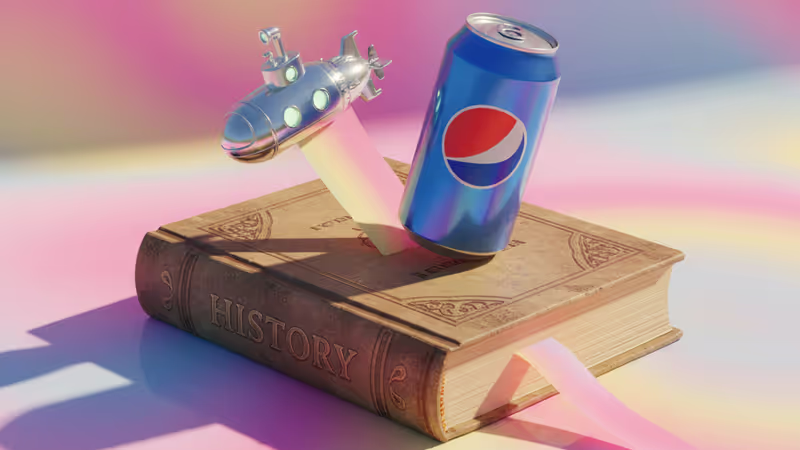
In 1989, PepsiCo found itself in command of the world's sixth-largest navy. Due to the Soviet Union's non-convertible currency, Pepsi struck a bizarre deal, trading its cola syrup for a fleet of 17 submarines, a cruiser, a frigate, and a destroyer. The company’s president reportedly told the U.S. National Security Advisor, "We are disarming the Soviet Union faster than you are." The vessels, of course, were sold for scrap.
Some historical loose ends take millennia to tie up. The Punic Wars between Rome and Carthage ended with the destruction of Carthage in 146 B.C. However, a formal peace treaty was never signed. That is, until 1985, when the mayors of Rome and Tunis (modern-day Carthage) met to sign a symbolic treaty, officially ending the conflict 2,131 years after it concluded.
The Personal Stories Behind the Headlines
The connections between famous figures can be just as surprising. When actress Julia Roberts was born, her parents couldn't afford the hospital bill. The person who paid it was Martin Luther King Jr. His gesture was a thank-you to the Roberts family, who ran one of the few integrated theater schools in Georgia and had accepted King's own children as students.
In 1952, after the death of Israel's first president, the country offered the position to Albert Einstein. The celebrated physicist politely declined, stating in his letter that while he was deeply moved, he lacked the "natural aptitude and the experience to deal properly with people and to exercise official functions."
These anecdotes reveal a crucial truth: history isn't a deterministic engine moving in a straight line. It's profoundly shaped by human error, bizarre coincidences, and personal relationships. Understanding this 'glitch factor' is key to navigating today's unpredictable geopolitical and technological landscapes, reminding us that the most significant shifts can come from the most unexpected sources.
This content is AI-generated based on source articles. While we strive for accuracy, errors may occur. We recommend verifying with the original source.
Related Articles

Think you know the Christmas story? Discover 5 surprising myths about the nativity, from the three wise men to the winter birth, that are challenged by historical and biblical evidence.

Feeling 'awvish'? Suffering from a 'kiffle'? Dive into 10 forgotten English words for winter sickness, from a 'meldrop' on your nose to the 'alysm' of being stuck in bed.

From its surprising origin as a tool to quiet church-goers to its status as a multi-billion unit holiday staple, discover the fascinating history and surprising facts behind the iconic candy cane.

Ever wonder about the origin of Santa's 'ho ho ho'? Discover the surprising history of the iconic laugh, which evolved from an expression of derision and triumph to the Christmas catchphrase we know today.