
Why Santa Says 'Ho Ho Ho' — Its Origins Are More Mischievous Than Merry
Ever wonder about the origin of Santa's 'ho ho ho'? Discover the surprising history of the iconic laugh, which evolved from an expression of derision and triumph to the Christmas catchphrase we know today.
Santa's iconic 'ho ho ho' is universally recognized as a belly laugh of pure joy. But its origins are far more complicated and a little less jolly. According to the Oxford English Dictionary (OED), the phrase has a long history rooted not in mirth, but in derision and triumph.
The OED notes that a double or triple 'ho' was used to express "derisive laughter" as far back as the late 12th century. A single 'ho' could signal surprise, triumph, or even taunting. While Santa doesn't taunt, his annual act of benevolent mischief—slipping into homes undetected—certainly merits a triumphant 'ho' or three.
The phrase began to connect with Father Christmas in the late 19th century. An 1877 story by John Brownjohn features a boy setting a trap for Santa and exclaiming, "Ho! ho! ho! We’ll soon know if a body may see him." Ten years later, a Kansas newspaper ad written from Santa's perspective had him declaring, "Ha! Ha! Ha! Ho! Ho! Ho! Didn’t Look for Me so Soon, Did You!"
However, it was music that truly cemented 'ho ho ho' in the public consciousness. Benjamin Russell Hanby’s 1866 song, now known as "Up on the Housetop," originally featured the line "O! O! O! Who wouldn’t go." By the early 20th century, songbooks had replaced the 'o's with 'ho's. Gene Autry’s famous 1953 recording of the song, officially titled "Up on the House Top (Ho! Ho! Ho!)," sealed the deal.
The transition wasn't immediate. In Disney's 1932 animated short 'Santa’s Workshop,' Santa very clearly exclaims "Ha! Ha! Ha!" But by the mid-20th century, the association was strong enough that when the Jolly Green Giant needed a jingle in the early '60s, producers chose a booming 'ho ho ho.' Today, Santa Claus has the undisputed last laugh.
PRISM Insight: The evolution of 'ho ho ho' is a prime example of how cultural symbols are forged by media reinforcement over many years. A phrase's original meaning can be completely overwritten by its repeated association with a character or idea, demonstrating how pop culture actively shapes and redefines language itself—a process now accelerated by modern internet memes.
This content is AI-generated based on source articles. While we strive for accuracy, errors may occur. We recommend verifying with the original source.
Related Articles
From its surprising origin as a tool to quiet church-goers to its status as a multi-billion unit holiday staple, discover the fascinating history and surprising facts behind the iconic candy cane.
Dutch artist Ard Gelinck creates stunning photomontages of actors hanging out with their younger selves in iconic roles, offering a powerful trip down memory lane.
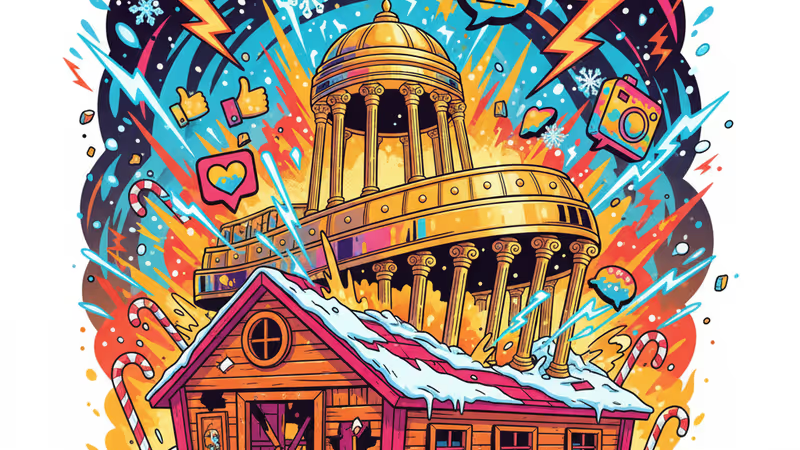
The Late Show with Stephen Colbert runs a satirical cartoon where Donald Trump cancels Christmas, sending ICE to the North Pole to build a ballroom over Santa's workshop.
Don't let unwanted presents gather dust. Lifestyle expert Elaine Swann shares 5 cardinal rules for regifting gracefully without hurting feelings or looking cheap.