
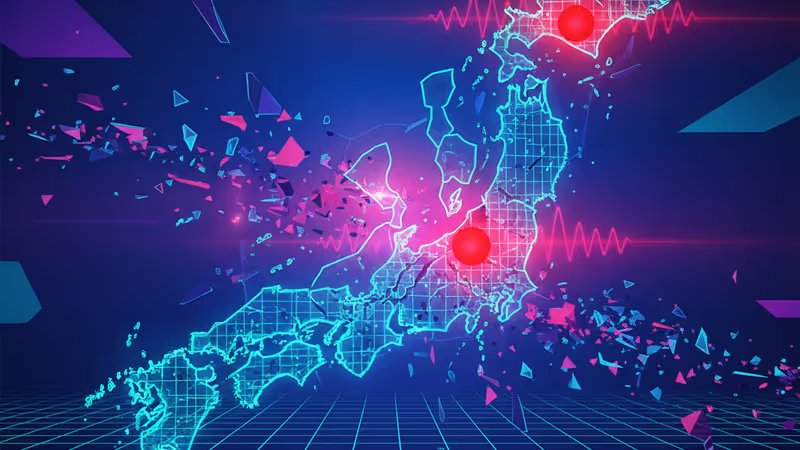
Japan Under Siege: Cyberattacks Paralyze Asahi, Leak Data of 2.3 Million from ASKUL & Huis Ten Bosch
A wave of cyberattacks hits Japan, impacting giants like Asahi, ASKUL, and Huis Ten Bosch. The breach exposed data of over 2.3 million people and caused a 20% sales drop for Asahi, signaling a new era of operational sabotage.
A wave of sophisticated cyberattacks has struck major Japanese corporations, disrupting operations at beverage giant Asahi and exposing the personal data of nearly 2.3 million people. The incidents at office supplier ASKUL and theme park Huis Ten Bosch highlight a troubling escalation in cyber threats targeting the nation's commercial infrastructure.
According to reports this month, ASKUL Corporation confirmed on December 12th that a cyberattack in October resulted in a data breach affecting over 730,000 individuals. On the same day, news broke of a potential leak at the Huis Ten Bosch theme park in Nagasaki, possibly compromising the personal information of more than 1.54 million customers and employees.
The attack on Asahi Group Holdings demonstrates a critical shift in tactics. Instead of just stealing data, the attackers crippled the company's core systems, leading to a staggering **20%+ year-over-year decline** in beer business sales for November. It's a stark reminder that cyberattacks can inflict direct, bottom-line damage comparable to a physical disaster, grinding production and sales to a halt.
These back-to-back security failures have sent a shockwave through Japanese industry. The attackers aren't just targeting customer databases; they're hitting the operational technology (OT) that powers manufacturing and logistics. Japanese authorities and the affected companies are currently investigating the full scope of the damage and attempting to identify the threat actors behind the coordinated assaults.
PRISM Insight: This series of attacks on Japanese firms reveals the dark underbelly of digital transformation. Threat actors are evolving, moving beyond data exfiltration to sabotage the digital nervous system of a company—its production lines and supply chains. It's a brutal wake-up call that cybersecurity is no longer just an IT issue; it's a fundamental pillar of business continuity that must be addressed at the board level.
This content is AI-generated based on source articles. While we strive for accuracy, errors may occur. We recommend verifying with the original source.
Related Articles
Japan's Air Self-Defense Force is adopting VR flight simulators from Kanematsu as part of a national defense spending increase, signaling a shift to next-gen pilot training technology.

OpenAI's new GPT-5.2-Codex is its most advanced coding model, featuring long-horizon reasoning, large-scale code transformation, and enhanced cybersecurity features.
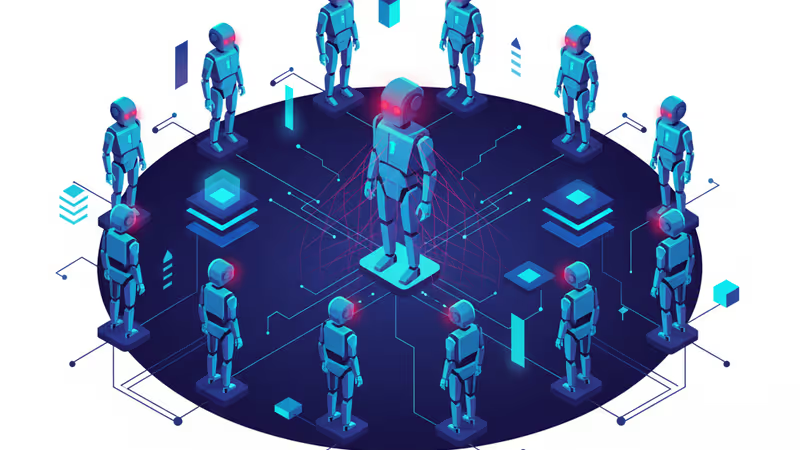
A critical flaw in humanoid robots allows a single voice command to trigger a network-wide takeover. Chinese researchers demonstrated the vulnerability, highlighting a new era of physical threats from AI agent exploits.

Japan's H3 rocket failed to deliver the Michibiki No. 5 geolocation satellite into orbit on Monday after a second-stage engine failure. The setback deals a blow to JAXA's plan for a sovereign navigation system to enhance GPS.