
US Crypto Bill Pushed to 2026: Three Key Portfolio Risks Investors Can't Ignore
US crypto bill delay into 2026 extends regulatory uncertainty. Discover the key risks and strategic portfolio adjustments savvy investors must consider now.
The Lede: Clarity Delayed, Uncertainty Solidified
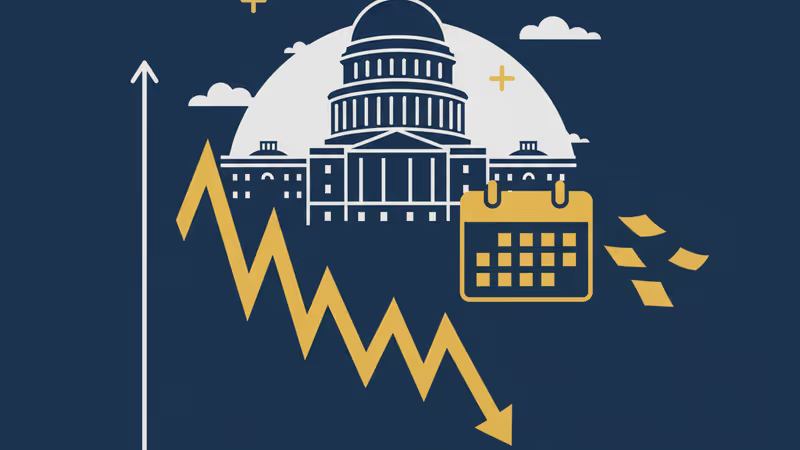
Washington has officially punted on comprehensive crypto legislation until at least 2026, as the Senate Banking Committee confirmed it will not hold a markup hearing on the much-anticipated market structure bill this year. While the delay was anticipated by insiders, its confirmation sends a chilling message to the market: the era of "regulation by enforcement" is not ending anytime soon. For investors, this legislative gridlock isn't just political noise; it's a core market dynamic that directly creates both significant risk and niche opportunities.
Key Factors Driving the Deadlock
- Legislative Calendar Crunch: Congress's immediate priority upon return will be a January 30 government funding deadline, leaving a very narrow window for complex legislation.
- Midterm Election Pressure: As 2026 progresses, focus will shift entirely to the midterm elections, making bipartisan compromise on a contentious issue like crypto highly improbable.
- Bipartisan Sticking Points: Deep divisions remain on core issues, including financial stability safeguards, market integrity, and politically charged ethics concerns.
- The Dual-Regulator Problem: The bill's central goal is to delineate authority between the SEC and CFTC, a complex turf war that continues to be a major point of negotiation.
The Analysis: A Power Vacuum the Regulators Are Eager to Fill
Washington's Holding Pattern Solidifies the Status Quo
This delay is more than a simple scheduling issue; it represents a strategic failure to provide a competitive framework for digital assets in the United States. Historically, legislative inaction on emerging technology cedes leadership to more agile jurisdictions. The current political climate, with a looming government funding fight and the siren song of midterm election campaigns, creates a perfect storm for legislative paralysis. The industry's hope for a clear rulebook, which would unlock institutional capital and foster domestic innovation, has been firmly placed on ice. The primary beneficiary of this delay is the status quo: a murky legal environment where litigation risk remains the single largest business expense for crypto firms operating in the U.S.
The Two-Track Reality: Agencies Won't Wait for Congress
While lawmakers deliberate, federal agencies are aggressively filling the legislative void. This creates a confusing and often contradictory two-track regulatory reality. The SEC, under its current leadership, continues to pursue its mandate through enforcement actions and public statements, as evidenced by its recent series of crypto-focused roundtables. Simultaneously, the CFTC is making its own moves, greenlighting licensed institutions for spot crypto trading and providing relief to certain market participants. This piecemeal approach, while providing pockets of clarity, does not substitute for a cohesive federal framework. For businesses and investors, it means navigating a treacherous landscape where compliance depends on which agency asserts jurisdiction on any given day.
PRISM Insight: Portfolio Strategy in a Regulatory Fog
For sophisticated investors, legislative paralysis is a variable to be traded, not just lamented. The extended uncertainty directly impacts asset valuation and risk models. Here are the key strategic implications for your portfolio:
1. The Flight to (Relative) Clarity
The primary casualty of this delay are tokens residing in the gray area between a commodity and a security. Assets like Bitcoin, which have a broad consensus of being a commodity under the CFTC's purview, will likely command a 'regulatory premium'. Expect a widening performance gap between Bitcoin and a broad basket of altcoins that remain in the SEC's crosshairs. Portfolio allocation may increasingly favor assets with the strongest case for commodity status.
2. The 'Regulatory Moat' Advantage
Ironically, a lack of clear rules benefits the largest, best-capitalized players. Companies like publicly-traded exchanges with robust legal and compliance departments can navigate the ambiguity better than startups. This uncertainty acts as a barrier to entry, stifling competition and potentially entrenching incumbents. Investors should watch the stock performance of these public companies, as they may prove to be defensive holds in a chaotic U.S. market.
3. Jurisdictional Arbitrage Becomes a Core Thesis
Capital and talent will continue to flow to jurisdictions offering clear, forward-looking regulations. The U.S. delay makes markets in Europe (under MiCA), the Middle East, and parts of Asia more attractive for both building and investing. Investors should consider gaining exposure to projects and companies that are either headquartered outside the U.S. or have a significant, well-defined international strategy to mitigate their U.S. regulatory risk.
The Bottom Line
The Senate's decision to delay the crypto market structure bill is a material event for investors. It guarantees that regulatory headlines from the SEC and CFTC will remain primary market-moving catalysts through 2026. The prudent strategy is to de-risk portfolios from assets with unclear U.S. legal standing, recognize the defensive advantage of well-capitalized public crypto firms, and actively seek opportunities in international markets where regulatory clarity is a feature, not a bug.
相关文章
美國參議院將關鍵加密市場結構法案推遲至2026年,監管不確定性加劇。PRISM深度分析對投資組合的影響、潛在風險與機遇。

OPEC+意外每日減產200萬桶,推升油價。PRISM獨家分析此舉對通膨、央行政策及投資組合的深遠影響,並提供具體策略建議。

最新美國CPI數據高於預期,聯準會降息時程可能延後。PRISM深度分析對投資組合的影響,並提供下半年的具體佈局策略。

XRP價格在成交量暴增246%的情況下失守1.93美元。我們的深度分析揭示了這對投資者意味著什麼,以及大型參與者下一步的可能動向。