
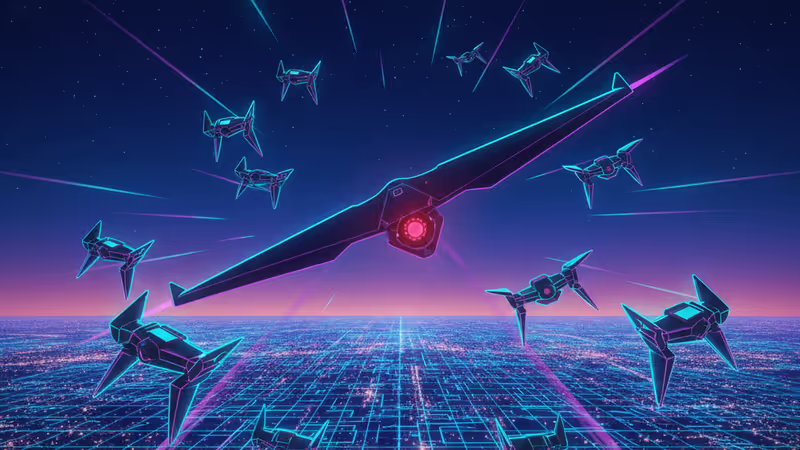
Ukraine's $1,000 Drones Are Slaying Russian Missiles, Rewriting the Rules of Air Power
Ukraine is deploying inexpensive interceptor drones, some costing just $1,000, to counter Russian aerial attacks. This strategy is rewriting the economics of air defense and shaping the future of warfare.
Ukraine is rapidly deploying fleets of inexpensive interceptor drones to counter Russia's sophisticated aerial attacks, fundamentally altering modern air defense strategy. These homegrown systems are neutralizing high-altitude suicide drones at a fraction of the cost of conventional missiles, providing a critical shield for the nation's cities and energy infrastructure.
According to reports from the Associated Press, these systems have progressed from prototype to mass production within months in 2025. Field technicians are now seen swiftly assembling the equipment, a sign of Kyiv's strategic shift toward affordable, mass-produced defensive weapons that can be replaced far more easily than their expensive counterparts.
The New Economics of War
The economic advantage is proving decisive. Interceptors like the Sting, produced by the volunteer-driven startup Wild Hornets, and the new Bullet from General Cherry, can cost as little as $1,000. Pilots operate them with viewing displays or first-person-view (FPV) goggles, accelerating rapidly to collide with enemy drones.
They're targeting Russian drones, predominantly the Iranian-designed Shahed, which cost anywhere from $10,000 to $300,000 each. "We are inflicting serious economic damage," said Andrii Lavrenovych, a strategic council member at General Cherry.
A High-Stakes Innovation Race
This defensive shift is part of an ongoing innovation battle. Russia has been developing numerous variants of its triangle-winged Shahed aircraft, equipping them with jammers, cameras, and even turbojet engines to fly faster and higher. A Ukrainian unit commander, known only by the call sign "Loi," stated, "The enemy does not sleep, and neither do we."
However, defense analysts caution that these interceptors aren't a panacea. Federico Borsari, an analyst at the Center for European Policy Analysis, calls them a "cornerstone of modern counter-unmanned aerial systems" but warns, "It would be a mistake to see them as a silver bullet." Their effectiveness, he explains, hinges on a wider ecosystem of sensors, rapid command and control systems, and skilled operators.
本内容由AI根据原文进行摘要和分析。我们力求准确,但可能存在错误,建议核实原文。
相关文章
烏克蘭正透過成本僅1000美元的國產攔截無人機,有效反制俄羅斯昂貴的自殺式無人機攻擊。本文深入剖析這場改變現代空防戰略的成本效益革命。

【2025最新】美國手機「吃到飽」方案真的無限量嗎?本文深度比較T-Mobile、Verizon、AT&T三大電信商的資費、網速與附加服務,助您做出明智選擇。

CBS總編輯試圖封殺自家節目《60分鐘》一則關於薩爾瓦多監獄酷刑的報導,不料影片反而在網路上瘋傳。此事件引發了對媒體審查與資訊透明度的激烈辯論。

三星發表2026年全新電競螢幕Odyssey 3D G90XH,搭載全球首創的6K解析度與裸眼3D技術。32吋IPS面板、即時眼球追蹤與高達330Hz的刷新率,將帶來革命性的遊戲體驗。
烏克蘭正透過成本僅1000美元的國產攔截無人機,有效反制俄羅斯昂貴的自殺式無人機攻擊。本文深入剖析這場改變現代空防戰略的成本效益革命。
【2025最新】美國手機「吃到飽」方案真的無限量嗎?本文深度比較T-Mobile、Verizon、AT&T三大電信商的資費、網速與附加服務,助您做出明智選擇。
CBS總編輯試圖封殺自家節目《60分鐘》一則關於薩爾瓦多監獄酷刑的報導,不料影片反而在網路上瘋傳。此事件引發了對媒體審查與資訊透明度的激烈辯論。
三星發表2026年全新電競螢幕Odyssey 3D G90XH,搭載全球首創的6K解析度與裸眼3D技術。32吋IPS面板、即時眼球追蹤與高達330Hz的刷新率,將帶來革命性的遊戲體驗。