
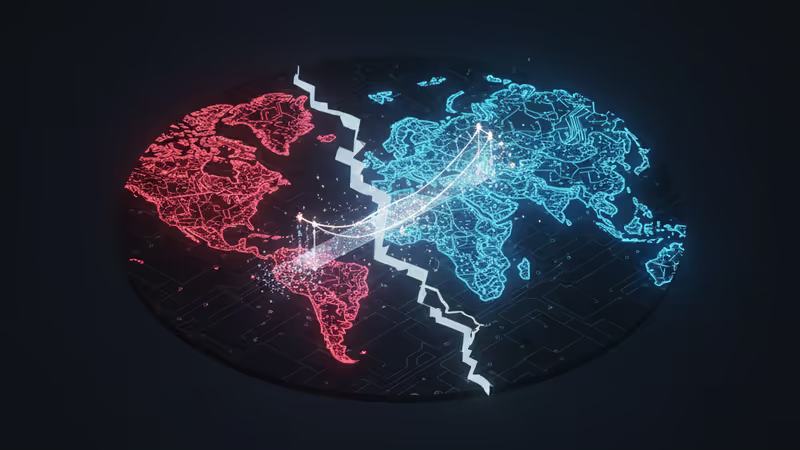
TikTok's US Deal: A Blueprint for the Splinternet, Not a Peace Treaty
TikTok's US deal isn't just about one app. It's a blueprint for the splinternet, creating a new, costly era of geopolitical compliance for all global tech.
The Lede: Beyond the Headlines
The reported agreement between TikTok and the U.S. government is far more than a corporate reprieve; it’s a landmark event codifying the fragmentation of the global internet. For executives and investors, this isn't the end of the TikTok saga. It’s the beginning of a new, complex, and costly era of geopolitical compliance. This deal establishes a precedent for how foreign technology, particularly from China, will be allowed to operate within Western digital borders—creating a blueprint for what we call the 'Geopolitical Compliance Stack'.
Why It Matters: The Second-Order Effects
This isn't a simple fix; it's a structural shift with wide-ranging implications:
- For the Social Media Landscape: Competitors like Meta and Snap no longer face the prospect of TikTok's outright ban, a scenario that would have sent 150 million US users scrambling for alternatives. Instead, they now face a competitor saddled with immense operational overhead and government scrutiny. The new competitive vector isn't just features—it's trust, data residency, and regulatory navigation.
- For Global Tech Operations: The 'Project Texas' model—housing US user data on US-based servers (Oracle) with oversight from a US-governed entity—is now the minimum price of admission for high-risk foreign tech firms. Expect this to be replicated, forcing global companies to architect for data isolation and regional compliance from day one, killing the dream of a single, seamless global platform.
- For US-China Relations: The agreement represents a tactical de-escalation. It moves the conflict from a public, politically charged ban to a private, technical compliance battle. However, it institutionalizes suspicion, creating a permanent mechanism for U.S. oversight into a Chinese-owned entity that can be tightened or weaponized depending on the geopolitical climate.
The Analysis: From Blunt Force to Surgical Entanglement
We've moved from the Trump administration's threat of a simple, blunt ban to a far more sophisticated—and arguably more intrusive—solution. The initial standoff was a binary choice: exist in the US or not. The new model, brokered by the Committee on Foreign Investment in the United States (CFIUS), is one of conditional existence.
The core challenge has always been the dual nature of TikTok: a culturally dominant entertainment app built on a black-box algorithm owned by a Chinese parent, ByteDance. The fear isn't just data access; it's the potential for algorithmic manipulation to shape discourse and opinion. This agreement attempts to solve the data problem through localization with Oracle, but the algorithm problem remains the true Gordian Knot. Can the U.S. subsidiary truly operate independently if its core recommendation engine is developed in Beijing? This deal is a high-stakes bet that it can be firewalled.
PRISM Insight: The Rise of the 'Compliance Discount'
For investors, the existential risk of a TikTok ban is now repriced, but it’s not eliminated. It has been replaced by 'compliance risk'. We will now see a 'compliance discount' applied to valuations of any tech company operating across the US-China digital divide.
This discount reflects the massive, ongoing costs of maintaining separate infrastructure, legal teams, and oversight boards, as well as the persistent risk of political winds shifting and rendering the entire structure insufficient. The key takeaway for investors is that a company's 'Geopolitical Compliance Stack' is now as important as its tech stack. The lack of one is a material risk.
PRISM's Take: A Pragmatic But Fragile Truce
This agreement is not a victory for the open internet. It is a pragmatic compromise that avoids the political fallout of banning a beloved app while creating an unprecedented level of government entanglement in a private media company. It effectively creates a 'digital conservatorship' where TikTok can operate, but under constant supervision.
The fundamental tension remains: a global platform powered by Chinese innovation must now wear a US-made regulatory straitjacket. This structure is a marvel of legal and technical engineering, but it's inherently fragile. Any future security breach, perceived algorithmic bias, or escalation in US-China tensions could cause the entire arrangement to collapse. This isn't the end of the story; it's the beginning of a messy, long-term experiment in digital sovereignty, and the results will define the next decade of global technology.
相关文章
深度分析TikTok與美國政府的協議,探討「德州計畫」對數據主權、Meta競爭及美中科技戰的深遠影響。

TikTok美國業務分拆協議塵埃落定。PRISM深度解析新合資公司結構、演算法在地化趨勢,以及對投資者與行銷人員的關鍵影響。
Snapchat推出全新Quick Cut影片編輯器,旨在降低創作門檻,直接挑戰TikTok和Reels。這場創作者工具的戰爭將如何演變?

南韓啟動150兆韓元國家增長基金,目標鎖定AI、半導體與電池。本文深度解析其在全球科技競賽中的戰略意圖、投資機會與潛在風險。