
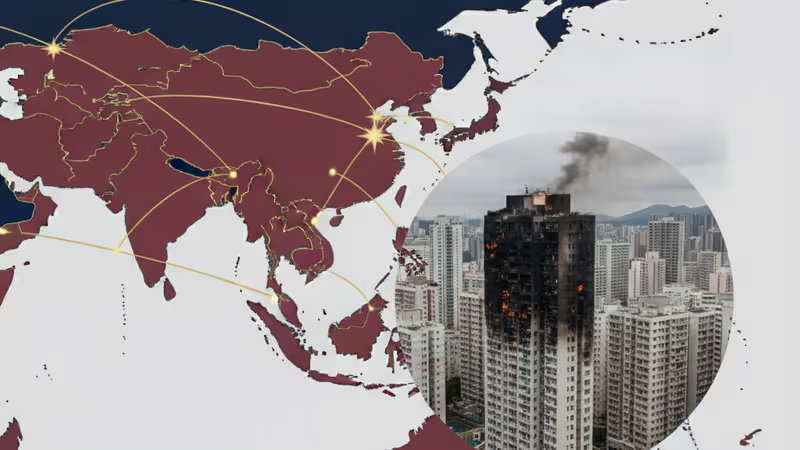
After the Fire: Hong Kong's Housing Crisis Is the Deeper Tragedy
A fire in Hong Kong's Tai Po district killed 159, but the real tragedy it exposes is the city's chronic housing crisis, a systemic failure impacting its economy, politics, and social stability.
A devastating fire in Hong Kong's Tai Po district has claimed at least 159 lives and left a community shattered, but its true impact extends far beyond the immediate tragedy. The blaze at the Wang Fuk Court public housing complex has cast a harsh light on the city's chronic housing crisis, a deep-seated issue that shapes its politics, economy, and social fabric. This isn't just a story about a disaster; it's a case study on the systemic vulnerabilities of one of the world's most vital cities.
For survivors, the loss is devastatingly personal, compounded by the fact that the fire tore through a public housing complex where most had bought their homes with government subsidies. While the Hong Kong government and NGOs have pledged support, the path forward is fraught with uncertainty. The most obvious solution—relocating them to other public housing—collides with a stark reality: as of September 2025, the average waiting time for a subsidized rental unit was already around five years. Survivors don't just need a place to go; they need a place to live.
Hong Kong's public housing program has its origins in another disaster. A 1953 Christmas Day fire in a squatter settlement left over 50,000 people homeless, prompting the government to build resettlement blocks and create what would become the Housing Authority. Today, the program is a cornerstone of the city's social safety net, sheltering over 2 million people—about 30 percent of Hong Kong's population. For many, it's the only buffer against a relentlessly unaffordable private market.
Yet the system is under immense strain. The government has long battled issues like tenants who exceed income limits, while thousands remain without permanent homes. The Social Welfare Department reported 1,564 registered “street sleepers” as of 2022, a figure that NGOs believe is a significant undercount.
This housing insecurity is a source of systemic instability. According to China’s state-run Xinhua news agency, discontent over “problems relating to housing and land supply” was a key grievance fueling the 2019 street protests. Economically, the Chinese General Chamber of Commerce has stated that inadequate land supply “has become the biggest bottleneck to Hong Kong’s continued economic growth.” For an entire generation of young people, home ownership seems like an impossible dream.
While the Tai Po fire loomed large over Hong Kong's 2025 Legislative Council election, it's a mistake to frame the tragedy as a primary driver of the political outcome. The low voter turnout—under 32 percent—reflects a broader, pre-existing dissatisfaction with governance, in which the housing crisis has long been a central part. The fire didn't create new discontent; it painfully amplified what was already there.
本内容由AI根据原文进行摘要和分析。我们力求准确,但可能存在错误,建议核实原文。
相关文章

敘利亞阿勒坡爆發致命衝突;加薩擁有2000年歷史的古蹟清真寺遭毀;奈及利亞130名被綁學童獲釋。PRISM為您解析全球多點爆發的危機。

韓國前總統尹錫悅因戒嚴案遭羈押,法院將於12月23日審理是否延長羈押期。特檢團隊指控其策動無人機事件作為戒嚴藉口,本案考驗韓國司法獨立與民主韌性。

美國聯邦法官裁定,川普政府援引1798年《外國敵人法》將委內瑞拉人驅逐至薩爾瓦多,此舉違反正當法律程序。判決對利用過時法律處理現代移民問題的做法提出質疑。

儘管美國斡旋的停火協議生效,以色列軍隊仍在加薩地區發動攻擊,造成巴勒斯坦平民死亡。人道援助受阻,聯合國呼籲解除所有限制,當地危機加劇。