
The Robotaxi Race Isn't About Cars, It's About Trust: Waymo's Quiet Victory and What Comes Next
Waymo is dominating the robotaxi market, but the real story is the strategic battle against Amazon's Zoox and Tesla. Our expert analysis explains why.
The Lede: The Robotaxi Market Splits in Two
While 2025 may be remembered as the year robotaxis went mainstream, the real story isn't one of universal progress. Instead, the market fractured into two distinct realities: Waymo's rapidly scaling, multi-city public utility, and everyone else's promising, yet heavily constrained, experiments. The decade-long race for technical feasibility is largely over. The new, far more complex battle for public trust, regulatory dominance, and economic viability has just begun, and the competing strategies of the key players offer starkly different blueprints for the future of urban mobility.
Why It Matters: More Than Just a New Taxi
For investors and executives, viewing this as a simple replacement for Uber is a critical error. The rise of autonomous vehicles is the physical manifestation of AI in our cities—a foundational shift that will reshape multi-trillion dollar sectors. The implications are enormous:
- Urban Planning: Successful AV deployment could render parking garages obsolete, redesign city centers, and redefine the value of suburban real estate.
- Labor Markets: The entire gig economy, built on human drivers, faces an existential threat, creating significant socio-economic and political challenges.
- Adjacent Industries: The automotive, insurance, logistics, and even fast-food industries will be fundamentally altered by a system of transportation that is potentially cheaper, safer, and always-on.
The strategic divergence between Waymo, Amazon's Zoox, and Tesla isn't just corporate competition; it's a clash of philosophies on how to build and deploy this future.
The Analysis: Three Companies, Three Futures
Waymo's 'Boring' Playbook is Winning the Ground War
Alphabet-owned Waymo is not winning with flashy hardware or bold proclamations. It's winning with a methodical, almost boring, ground game. Its expansion from three to five active markets—with 26 more in the pipeline—is a masterclass in navigating the complex web of local regulation and building public familiarity. While rivals are still proving their tech, Waymo is dealing with second-order problems like teen accounts and optimizing freeway routes—the kind of issues a mature service faces.
Alphabet CEO Sundar Pichai's projection that Waymo will be "meaningful in our financials" by 2027-28 signals a crucial transition from a costly R&D project ('Other Bets' lost $1.43B in Q3) to a viable business. Waymo's strategy is clear: become the trusted, reliable, and officially sanctioned infrastructure for autonomous mobility before anyone else achieves meaningful scale.
The Hardware Gambit: Amazon's Zoox Bets on a Reinvented Wheel
Amazon's Zoox is playing a different, higher-stakes game. By designing a bespoke vehicle with no steering wheel and carriage-style seating, it's not just automating a car; it's building a new category of transportation. This is a classic Amazon long-term play: focus on the ultimate customer experience, even if it means a slower, more capital-intensive path to market.
However, the fact that Zoox's initial public rides are free is the most telling detail. It underscores the immense regulatory hurdle it still faces. While its purpose-built vehicle may be the superior end-product, it requires specific exemptions that Waymo, using modified Jaguar I-PACEs, doesn't. Zoox is betting that a revolutionary user experience will eventually overcome these regulatory moats and justify its massive R&D investment.
Tesla's Reality Distortion Field: The 'Robotaxi' That Isn't
Tesla entered the fray in 2025 with a "Robotaxi-branded service" that, crucially, still relies on human safety drivers. This is not a direct competitor to Waymo; it's a branding exercise and a public data-gathering operation for its Full Self-Driving (FSD) beta. Elon Musk's long-standing promise of a million-strong robotaxi fleet remains unfulfilled, and his recent acknowledgement of Waymo "paving the path" on regulation is a tacit admission of his rival's lead in the real-world deployment race.
Tesla's strategy represents a fundamental philosophical difference: a bet on a generalized, vision-based AI that can eventually drive anywhere, versus Waymo's geofenced, HD-map-reliant approach that works reliably within defined domains. For now, Tesla is selling the future, while Waymo is selling a ride.
PRISM Insight: Metrics That Matter
For Investors: The most important metric is no longer 'autonomous miles driven.' The new key performance indicator is 'paid, fully autonomous commercial rides.' On this metric, Waymo's lead is not just significant; it's practically monopolistic in the U.S. market. The market continues to value Tesla on the *promise* of a future software solution, while Waymo is beginning to demonstrate the *revenue* of a functioning logistics and transportation network.
For Technologists: The robotaxi race is a live-fire test of competing AI development philosophies. Waymo's geofenced, methodical approach proves that highly reliable AI can be deployed at scale for specific tasks. Tesla's FSD represents the pursuit of a more generalized intelligence, a much harder problem that has yet to cross the threshold for full, unsupervised autonomy. The success or failure of these approaches will have profound implications for how AI is developed and deployed in other high-stakes industries.
PRISM's Take
The robotaxi war of the 2020s will not be won by the company with the most futuristic vehicle or the boldest CEO. It will be won by mastering the unglamorous trifecta of regulatory diplomacy, scalable operations, and public trust. While Tesla continues to sell a vision and Zoox builds for a perfect future, Waymo is executing in the messy present. It is quietly, methodically, and relentlessly building the foundational infrastructure of our autonomous future, one city block at a time.
相关文章
2025年自動駕駛計程車市場分析:Waymo憑藉務實策略遙遙領先,而特斯拉的全自動駕駛承諾仍未兌現。深入探討背後的技術路線與投資意涵。
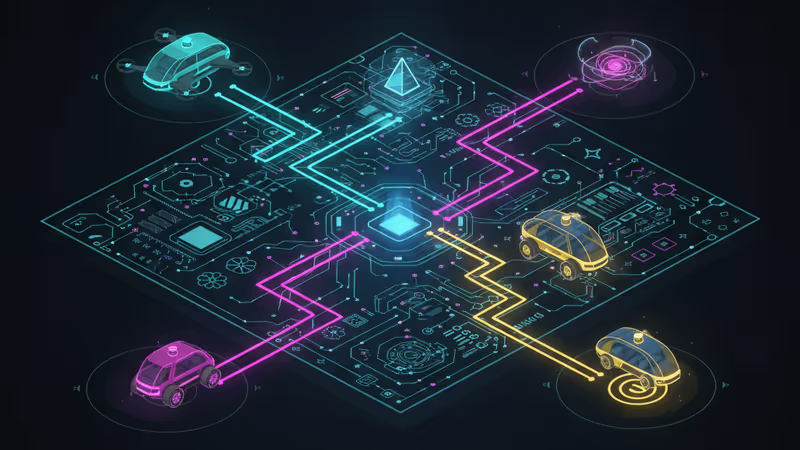
2025年,自動駕駛計程車從科幻走向現實。Waymo擴張,Zoox革新,Tesla追趕。PRISM深度解析三大巨頭的戰略、財務挑戰與投資前景。
2025年,自動駕駛計程車從科幻走向現實。Waymo擴張,Zoox革新,Tesla追趕。PRISM深度解析三大巨頭的戰略、財務挑戰與投資前景。

特斯拉在德州展開全無人駕駛測試,象徵其Robotaxi野心邁出關鍵一步。但事故數據與專家質疑揭示了其在安全、監管和競爭方面仍面臨巨大挑戰。