
‘Doomsday Glacier’ Is Tearing Itself Apart, New Study Shows Startling Feedback Loop
A new study reveals Antarctica's 'Doomsday Glacier' is caught in a self-destructive feedback loop. Cracks are accelerating its flow, which in turn creates more cracks, speeding its path to collapse.
Antarctica's Thwaites Glacier, known as the “Doomsday Glacier” and one of the biggest unknowns in predicting global sea-level rise, is caught in a dangerous feedback loop, actively accelerating its own collapse. A new study from the International Thwaites Glacier Collaboration (ITGC) presents a detailed, alarming record of how the glacier's crucial eastern ice shelf is tearing itself apart from the inside out.
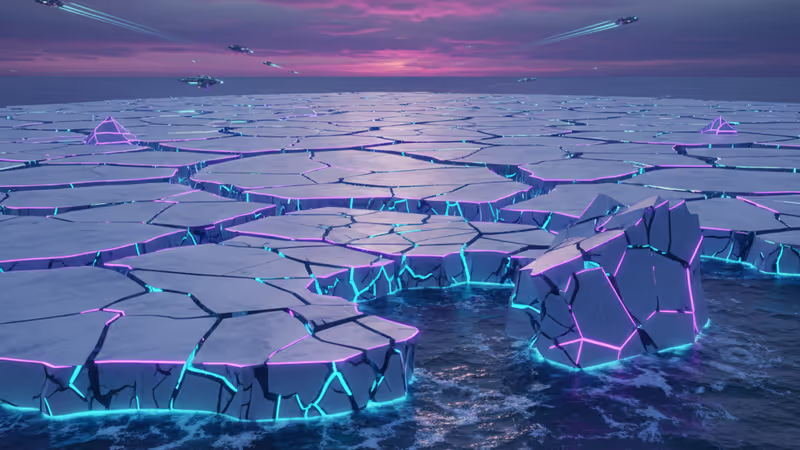
Researchers analyzing two decades of observational data (2002-2022) discovered that as cracks riddle the ice, the glacier's flow speeds up. This acceleration, in turn, generates even more cracks, creating a vicious cycle. According to the study, this process has effectively severed the ice shelf's connection to a stabilizing undersea ridge, transforming it from an anchor into a point of weakness.
A System Under Stress: The Damage in Numbers - **Total Crack Length**: Increased from ~**165 km** in 2002 to ~**336 km** in 2021. - **Ice Structure Change**: Instead of a few long cracks, the shelf is now fractured by numerous smaller ones, doubling the total fissure length and indicating widespread structural decay. - **Collapse Propagation**: During the winter of 2020, structural damage was observed propagating upstream at a rate of approximately **55 kilometers per year**.
The study reveals the weakening happened in distinct phases. First, long cracks grew along the direction of ice flow. Then, a swarm of shorter, cross-flow cracks emerged, shattering the shelf's integrity. GPS devices placed on the ice between 2020 and 2022 directly recorded this feedback loop in action, confirming that weakening in one area rapidly destabilizes the ice far upstream.
The researchers warn this pattern could be a playbook for how other Antarctic ice shelves collapse. The complete disintegration of Thwaites holds enough ice to raise global sea levels by about 65 centimeters (over 2 feet). This new evidence of a self-reinforcing collapse suggests that existing timelines for its demise may be too conservative.
PRISM Insight: The Thwaites Glacier is a real-time demonstration of a climate tipping point moving from theory to observation. This feedback loop shows how Earth's systems can shift into a state of non-linear, accelerated change, outpacing the linear projections of older climate models. It's a critical warning that the consequences of climate change may not only be severe but could also arrive far more suddenly than anticipated, challenging our infrastructure and economic stability.
本内容由AI根据原文进行摘要和分析。我们力求准确,但可能存在错误,建议核实原文。
相关文章

Microsoft Visio Professional 2021 永久授權版限時特價 9.97 美元(原價 249.99 美元)。無需訂閱,一次性購買即可擁有強大的專業圖表繪製工具。

索尼(Sony)WH-1000XM5 降噪耳機在亞馬遜和百思買重返248美元的歷史低價,較原價優惠38%。本文分析其與新款XM6的比較,闡明為何XM5是當前性價比最高的選擇。

Alphabet旗下Waymo宣布進軍日本,將於2026年4月在京都推出全無人駕駛計程車服務。這是該公司首次大規模海外擴張,初期將部署100輛Jaguar I-PACE。本文分析其技術挑戰與市場佈局。

由Retro團隊打造的「Splat」應用,利用生成式AI技術,能將您相機中的任何照片變為兒童著色頁。本文詳解其功能、價格方案,並探討AI在家庭創意活動中的應用趨勢。