
The Legacy of Trump's Department of Government Efficiency: A 2025 Autopsy
A deep dive into the Trump administration's 2025 attempt to create a Department of Government Efficiency. We analyze its goals, the fierce controversy it ignited, and its lasting impact on the future of U.S. governance.
In 2025, the Trump administration's push to establish a Department of Government Efficiency became one of its most consequential and polarizing initiatives. The ambitious effort, aimed at radically streamlining the federal bureaucracy, sparked a fierce political battle and ultimately yielded a mixed legacy of limited successes and significant pushback.
The administration's rationale was straightforward: to consolidate redundant functions, cut wasteful spending, and reduce the burden on taxpayers by shrinking a federal government it deemed bloated. Proponents argued this would speed up decision-making and deliver more effective services to the American public.
The initiative was widely seen as a direct implementation of ideas from 'Project 2025', a comprehensive transition plan developed by conservative groups. This roadmap was designed to enable a new conservative administration to assert control over the federal apparatus, with 'government efficiency' as a central theme.
However, the proposal met with immediate and stiff resistance. Democrats, federal employee unions, and watchdog groups decried it as an attack on civil service protections and an attempt to politicize government functions under the guise of 'efficiency.' The controversy intensified as the plan included measures to significantly curtail the authority of agencies like the Environmental Protection Agency (EPA) and the Department of Education.
"This isn't a reform for efficiency," one policy analyst from a think tank wrote at the time. "It's a power grab designed to centralize authority in the executive branch, bypassing the checks and balances of congressional oversight and judicial review."
After months of political wrangling, legislation to formally create the new department failed to pass Congress. Instead, President Trump used executive orders to enact partial reforms, merging some smaller agencies and reassigning functions within certain departments. According to the Office of Management and Budget (OMB), these actions resulted in an estimated $15 billion in savings in 2025, a figure that, while substantial, fell far short of the administration's initial projections.
本内容由AI根据原文进行摘要和分析。我们力求准确,但可能存在错误,建议核实原文。
相关文章

從加薩、敘利亞到記者遇害,一系列紀錄片揭示了「永久戰爭」與資訊戰的殘酷現實。當真相被噤聲,全球衝突將如何演變?
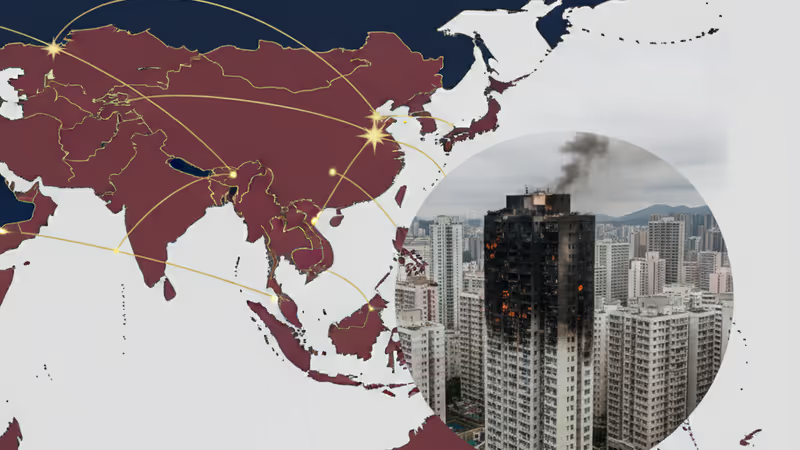
香港大埔區公共屋邨大火造成159人死亡,這場悲劇不僅令倖存者頓失家園,更揭示了香港輪候公屋需時五年等深層次的房屋危機。本文分析其對政治、經濟及社會的廣泛影響,探討香港治理面臨的挑戰。

美國眾議院軍事委員會主席亞當·史密斯直言,川普政府對委內瑞拉的石油封鎖,其首要目標是推翻馬杜洛政權,而非官方宣稱的外交目的。此番言論引發對美國外交制裁真實意圖的廣泛討論。

曾被視為馬來西亞政治邊陲的砂拉越,正迅速崛起為綠色經濟強權。本文深入剖析砂拉越如何利用半島政治的碎片化,鞏固內部領導,並透過能源與高科技戰略,重塑馬來西亞的權力版圖。