
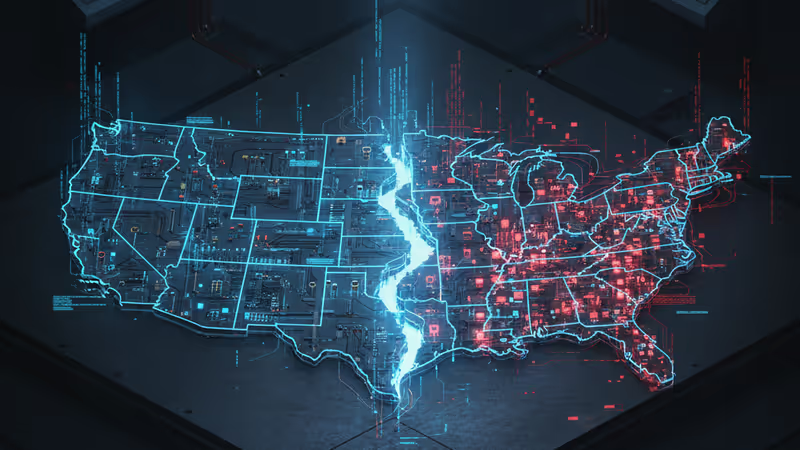
The AI Civil War: Trump's Executive Order Ignites a States' Rights Battle for America's Tech Future
President Trump's executive order on AI isn't just policy—it's a high-stakes gamble to crush state regulations. We analyze the legal risks and what it means for Big Tech.
The High-Stakes Gambit
President Trump's new executive order on artificial intelligence is not merely a policy document; it's a declaration of war against state-level regulators and a high-stakes bet on federal supremacy. By seeking to override state laws in California, Colorado, and elsewhere, the White House is forcing a constitutional showdown that will define the next decade of American innovation. For tech leaders, investors, and policymakers, the core issue is no longer just about AI ethics, but about who holds the power to write the rules for our technological future: a unified federal government or a patchwork of pioneering states.
Why This Is More Than a Legal Squabble
While the immediate headlines focus on the order's questionable legality, the second-order effects are far more significant. This executive action is a direct response to a federal vacuum. With Congress gridlocked, states like California and Colorado have become the de facto national regulators on tech issues, from data privacy (CCPA) to AI safety. Big Tech, and its powerful venture capital backers like Andreessen Horowitz, see this trend as an existential threat—a compliance nightmare of 50 different rulebooks that could strangle emerging technologies in the cradle.
This order is their Hail Mary pass. It’s designed to do two things:
- Create a legal shield, however temporary and shaky, for AI companies to challenge state-level enforcement.
- Force Congress's hand by escalating the issue into a full-blown federalism crisis, making a national AI framework an urgent necessity rather than a Beltway talking point.
Analysis: A Dangerous Precedent Meets Political Reality
The Echo of Past Tech Battles
We've seen this playbook before. From early battles over internet sales tax to the privacy wars that led to California's CCPA effectively setting a national standard, states have consistently led regulation when Washington D.C. failed to act. The Trump administration's move to preemptively crush this state-led approach using executive power, rather than legislation, is a significant and aggressive escalation. Critics like Sen. Amy Klobuchar and legal experts are right to question its constitutionality; an executive order cannot simply nullify state law, a principle the courts are likely to uphold.
The 'Compete with China' Paradox
The administration's primary justification—that a patchwork of state laws hinders US competitiveness against China—is a powerful but deeply flawed narrative. As California State Sen. Scott Wiener pointed out, this argument rings hollow when the same administration authorizes the sale of Nvidia's most advanced AI chips to Chinese entities. This reveals the central tension: the White House is torn between a desire for geopolitical dominance and a commitment to deregulation demanded by its corporate allies. The executive order prioritizes the latter, using the China threat as politically convenient cover for a move that directly benefits companies like Google and OpenAI.
PRISM Insight: The Investment and Innovation Fallout
For investors and AI developers, this executive order injects a massive dose of regulatory uncertainty into the market. The immediate future is not a clear runway for innovation, but a litigious fog of war.
- For AI Startups: The dream of a single, permissive national standard remains distant. For now, the smartest move is to continue building for compliance with the strictest existing laws (i.e., California and Colorado). This order is a political statement, not a get-out-of-jail-free card. Ignoring state regulations on the assumption this EO will hold is a catastrophic business risk.
- For Investors: The legal challenges to this order are now a material risk factor for any AI-focused portfolio. The key metric to watch isn't technological progress alone, but the outcome of court cases in the 9th and 10th Circuits. A federal loss would solidify the power of states and entrench the fragmented regulatory landscape the tech industry fears most.
Ultimately, the White House advisor Sriram Krishnan’s goal of pushing back on “'doomer' laws” reveals the ideological core of this move. It’s a philosophical battle between the tech-libertarian view of permissionless innovation and the consumer protection-first approach championed by states and advocacy groups.
PRISM's Take
This executive order is a political bluff, not a durable legal strategy. It is destined to be tied up in court, and it will likely lose. However, 'winning' in court may not be the administration's primary goal. The true objective is to manufacture a crisis that forces a gridlocked Congress to finally pass a national AI law—one that Big Tech has a heavy hand in drafting.
The administration is betting that the chaos and legal uncertainty created by the order will be so damaging that lawmakers will have no choice but to intervene with a unified, industry-friendly solution. It’s a cynical but potentially effective strategy that sacrifices constitutional norms for legislative expediency. This isn't about protecting America from China; it's about protecting Big Tech from California.
相关文章

OPEC+意外每日減產200萬桶,推升油價。PRISM獨家分析此舉對通膨、央行政策及投資組合的深遠影響,並提供具體策略建議。

最新美國CPI數據高於預期,聯準會降息時程可能延後。PRISM深度分析對投資組合的影響,並提供下半年的具體佈局策略。

XRP價格在成交量暴增246%的情況下失守1.93美元。我們的深度分析揭示了這對投資者意味著什麼,以及大型參與者下一步的可能動向。

狗狗幣(DOGE)在交易量激增下暴跌5.5%,跌破關鍵支撐。本文深度分析這究竟是散戶的恐慌性拋售,還是機構投資者正在伺機入場的信號。