
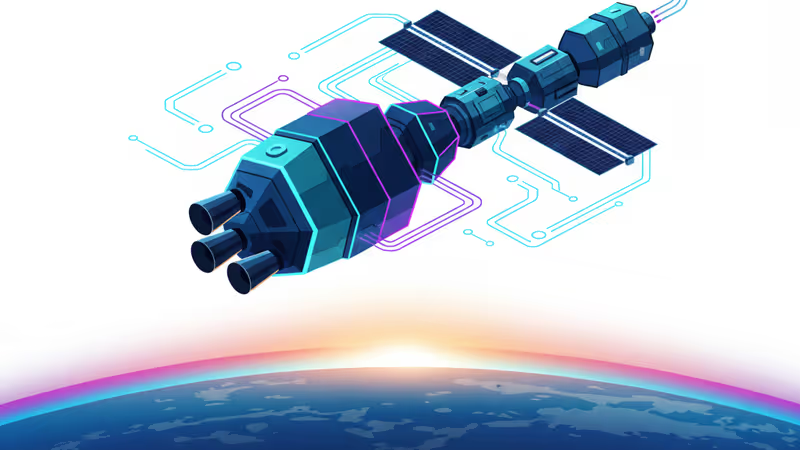
Stranded: How Boeing's Starliner Failure Left NASA Astronauts in Orbit for 9 Months
An in-depth look at the critical malfunctions on Boeing's Starliner that stranded two NASA astronauts on the ISS for nine months, forcing a rescue mission by rival SpaceX.
Two astronauts, launched aboard Boeing's much-delayed spacecraft in June 2024 for what was meant to be a week-long mission, were ultimately forced to return to Earth nine months later aboard a rival SpaceX Dragon capsule. A series of critical malfunctions on the Starliner made it too risky for the return journey, leaving the crew stranded on the International Space Station (ISS) and raising serious questions about Boeing's role in human spaceflight.
A Cascade of Failures En Route
The first crewed flight of the , carrying astronauts Butch Wilmore and Suni Williams, was a milestone over a decade in the making. But trouble began during its trip to the ISS. Engineers detected multiple, pernicious and, more alarmingly, several of the spacecraft's began to fail due to overheating.
The situation became critical as the capsule approached the station. For a short time, Starliner commander Wilmore lost the ability to control the spacecraft's movements. While engineers on the ground managed to recover most thruster functions to allow for a successful docking, the vehicle's reliability was now in serious doubt.
The Long Wait and a Rival's Rescue
After evaluating the thruster and leak issues, officials determined it was too risky to bring Wilmore and Williams home in the compromised Boeing capsule. Their planned one or two-week stay turned into a nine-month orbital marathon while the agency figured out a new ride home.
The solution came from Boeing's chief competitor. Last March, the two astronauts flew back to Earth aboard a spacecraft, a scenario that underscored the severity of the Starliner's problems. A subsequent safety advisory panel found that this uncertainty about the vehicle's health had also permeated NASA's own workforce during the crisis.
The Starliner incident is more than a technical failure; it's a critical stress test of NASA's Commercial Crew Program. It starkly contrasts Boeing's troubled development with SpaceX's operational dominance, raising serious questions about vendor reliability and the future of competition in human spaceflight.
本内容由AI根据原文进行摘要和分析。我们力求准确,但可能存在错误,建议核实原文。
相关文章
在與SpaceX的激烈競爭中領導聯合發射聯盟(ULA)超過十年後,執行長托里·布魯諾突然宣布辭職。其任內雖成功推出火神火箭,但公司仍面臨市佔率下滑的挑戰。
波音Starliner首次載人任務因推進器故障與氦氣洩漏等嚴重問題,導致兩名NASA太空人受困國際太空站長達九個月,最終須由SpaceX的飛龍號太空艙接回地球。
SpaceX的勁敵聯合發射聯盟(ULA)執行長托里·布魯諾在位12年後宣布辭職。在新一代「火神」火箭剛投入使用之際,此番人事變動將如何影響白熱化的全球太空競賽格局?本文深入分析。
2025年太空發射市場迎來劇變。藍色起源New Glenn成功挑戰SpaceX,而中國商用火箭崛起,重塑全球競爭格局。PRISM深度解析。