
Pregnancy on a Chip: Scientists Recreate Implantation in Lab, Unlocking Secrets of IVF Failure
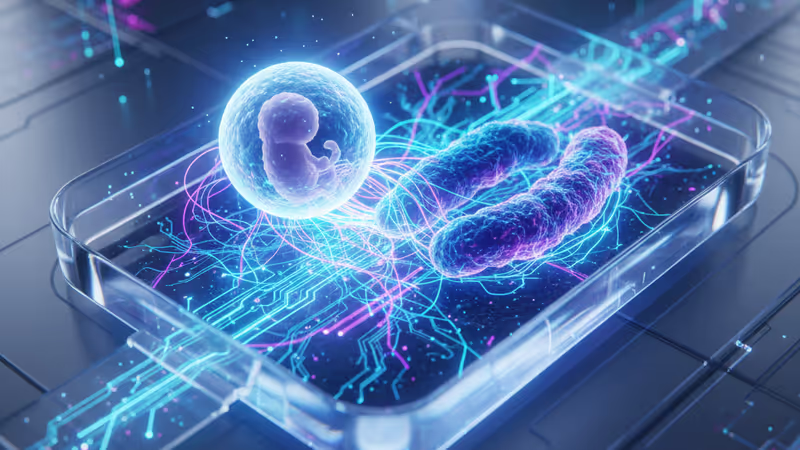
Scientists have successfully recreated the first moments of human pregnancy on a lab chip, merging embryos with uterine organoids. This breakthrough could solve the mysteries of IVF failure and opens new ethical frontiers.
It’s the moment pregnancy officially begins: a ball-shaped embryo burrows into the uterine lining, forming the first tendrils of a future placenta. But this isn't happening inside a human body. It's unfolding on a microfluidic chip in a Beijing laboratory, giving scientists an unprecedented front-row seat to one of biology's most mysterious processes.
In a trio of papers published this week by Cell Press, research teams from China and a US-European collaboration report the most accurate lab-based models of early human pregnancy to date. By merging human embryos from IVF centers with 3D uterine organoids, they've successfully recreated implantation in vitro. This breakthrough could finally shed light on why IVF treatments so often fail and pave the way for new therapies.
Opening the 'Black Box' of Implantation
Until now, implantation has been a complete 'black box' because it occurs hidden deep within the uterus. "We’ve always hoped to understand human embryo implantation, but we have lacked a way to do so,” explains Hongmei Wang, a developmental biologist at the Beijing Institute for Stem Cell and Regenerative Medicine, who co-led one of the studies.
The solution, as described in all three papers, was to build a stand-in for the uterus. Scientists grew endometrial cells into organoids, which self-assemble into complex 3D structures that mimic the uterine lining. "You have an embryo and the endometrial organoid together," says Jun Wu of the University of Texas Southwestern Medical Center, a contributor to both Chinese reports. "That’s the overarching message of all three papers."
A New Frontier for IVF Treatment
Implantation failure is one of the biggest hurdles in IVF treatment. Many cycles fail simply because the embryo never attaches to the uterine wall. This new lab model offers a way to study—and potentially solve—that problem. "Considering that implantation is a barrier [to pregnancy], we have the potential to increase the success rate if we can model it in the laboratory," says Matteo Molè, a biologist at Stanford University involved in the European collaboration.
Commercial applications are already emerging. Startups like Simbryo Technologies in Houston plan to offer personalized IVF predictions. The idea is to take a biopsy from a patient's uterine lining, grow an organoid, and test if blastoids can implant. If they don't, it could signal that the patient's uterus isn't receptive, identifying the cause of infertility.
The Beijing team took it a step further, using their system for drug discovery. They created organoids from women who had experienced repeated IVF failures and screened 1,119 approved drugs. They found several chemicals had a positive effect, including avobenzone, a common sunscreen ingredient, which increased the implantation rate of blastoids from 5% to around 25% in these samples.
The Road to an Artificial Womb?
The current organoid system is still a simplified model, lacking crucial components like immune cells and a blood supply. The Beijing group is now working to add blood vessels and tiny pumps to their chip, creating a rudimentary circulation system. This raises the possibility of growing embryos in the lab longer than the ethically-mandated 14-day limit that all current experiments adhere to.
Some see this research as an early step toward ectogenesis—developing a baby entirely outside the body. However, researcher Jun Wu urges caution. "This technology is certainly related to ectogenesis," he says. "But I don’t think it’s anywhere near an artificial womb. That’s still science fiction."
This isn't just about infertility treatment; it's a fundamental shift from observing biology to engineering it. 'Life on a chip' moves beyond replacing animal models to create scalable platforms for drug discovery, personalized medicine, and fundamental research that was previously impossible. Biology is finally getting its own version of tech's rapid 'design-build-test-learn' cycle.
本内容由AI根据原文进行摘要和分析。我们力求准确,但可能存在错误,建议核实原文。
相关文章

亞馬遜宣布其AI助理Alexa+將於2026年整合Expedia、Yelp等四大服務平台,用戶可透過語音對話直接預訂飯店、預約服務。此舉標誌著AI助理正朝向「超級應用平台」發展。

二次創業家Nick Donahue在關閉前公司Atmos後,推出AI住宅設計平台Drafted。僅需數千美元,數分鐘即可生成客製化設計圖,挑戰傳統建築業。本文剖析其商業模式、融資背景與市場潛力。

紐約州通過指標性的AI安全法案(RAISE法案),但科技公司與學術機構卻投入數萬美元廣告經費進行反對。本文深入剖析其背後角力。

聖誕節禮物還沒買?別擔心!本文為您精選電影、遊戲、學習、健康等各類數位禮物與訂閱服務,是您最後一刻的完美送禮方案,即時傳達心意。
亞馬遜宣布其AI助理Alexa+將於2026年整合Expedia、Yelp等四大服務平台,用戶可透過語音對話直接預訂飯店、預約服務。此舉標誌著AI助理正朝向「超級應用平台」發展。
二次創業家Nick Donahue在關閉前公司Atmos後,推出AI住宅設計平台Drafted。僅需數千美元,數分鐘即可生成客製化設計圖,挑戰傳統建築業。本文剖析其商業模式、融資背景與市場潛力。
紐約州通過指標性的AI安全法案(RAISE法案),但科技公司與學術機構卻投入數萬美元廣告經費進行反對。本文深入剖析其背後角力。
聖誕節禮物還沒買?別擔心!本文為您精選電影、遊戲、學習、健康等各類數位禮物與訂閱服務,是您最後一刻的完美送禮方案,即時傳達心意。