
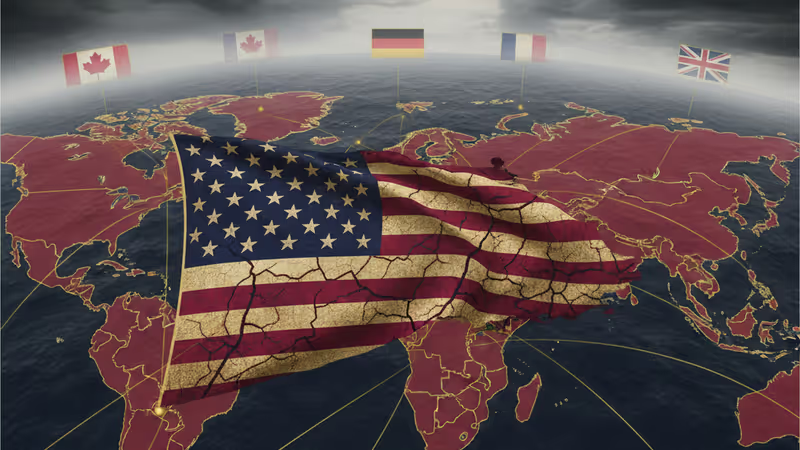
US Allies' Confidence Crumbles: Poll Shows Trump's America Seen as a 'Negative Force'
A new POLITICO-Public First poll shows a dramatic shift in perception among key U.S. allies like Canada, Germany, and France, who now view America as an unreliable and negative global force under President Trump.
Unreliable, a source of global problems, and a negative force on the world stage—this is the stark assessment of the United States held by large shares of its closest allies, according to a new international poll. The findings, from POLITICO-Public First polling, reveal the deep impact of President Donald Trump's sweeping foreign policy overhaul on transatlantic and North American relations.
A Transatlantic Trust Deficit in Numbers
The polling data paints a grim picture of America's standing. Pluralities in Germany and France, and a majority of Canadians, now say the U.S. is a negative force globally. In the United Kingdom, views are more mixed, but a significant 35% share that dim assessment.
Furthermore, near-majorities in all four allied nations believe the U.S. tends to create problems for other countries rather than solve them. When asked whether Washington supports or challenges its allies, a majority of Canadians and just under half of respondents in Germany and France say it challenges them. In the U.K., roughly 4 in 10 agree, while more than a third say the U.S. cannot be depended on in a crisis.
Allies Recalibrate Amid Trump's Doctrine
During his first year back in office, Trump has blurred traditional lines of global alliances. He recently described Europe as a “decaying” group of nations in a POLITICO interview, and his sweeping National Security Strategy argued the continent has lost its “national identities and self-confidence.” This skepticism from allied leaders is likely seeping into public sentiment, according to Matthew Kroenig of the Atlantic Council’s Scowcroft Center.
Public opinion in democracies often reflects elite opinion... you do have politicians in these countries expressing skepticism about the United States and about the Trump administration, and that's being reflected in the public opinion polling.
— Matthew Kroenig, Atlantic Council
In response, allied nations are recalibrating their policies.
- Germany: Chancellor Friedrich Merz has secured a historic spending overhaul, unlocking hundreds of billions of euros for defense, driven by wavering U.S. support for Ukraine and questions over Washington's commitment to NATO.
- France: President Emmanuel Macron is using Trump's unpredictability to bolster arguments for greater European strategic autonomy, a long-held French ambition.
- United Kingdom: Prime Minister Keir Starmer is attempting a delicate balancing act—finalizing a U.K.-U.S. trade deal while coordinating a European response on Ukraine, all without angering the White House.
- Canada: Relations have seen the sharpest deterioration amid a punishing trade war. Flavio Volpe of the Automotive Parts Manufacturers' Association noted, "People lost their jobs... and billions of dollars in Canadian capital evaporated."
A Nation Divided: American Perceptions of Its Global Role
In contrast to their allies, Americans view their own country more favorably. Overall, 51% see the U.S. as a positive force globally. However, these numbers mask a deep partisan divide.
According to Public First polling, almost half of voters who backed former Vice President Kamala Harris (47%) say the U.S. is a negative force, compared with just 13% of Trump voters. Conversely, three in four Trump voters (77%) say the U.S. is a positive force.
This shift among Democrats is recent and dramatic. Polling from October of last year found strong majorities of both Democrats (71%) and Republicans (69%) viewing America's historical role positively. One year later, while the Republican figure remains high, the Democrat figure has plummeted to 58%. Seb Wride, head of polling at Public First, notes this means "around 1 in 8 Democrats changing their views on the role the U.S. has played in its entire history, in just one year."
The poll's numbers signal more than diplomatic discontent; they reveal a fundamental erosion of trust in America's role as a global stabilizer. As allies like Germany and France accelerate their push for 'strategic autonomy,' the long-term risk is a more fragmented West, less capable of unified responses to challenges from powers like Russia and China.
本内容由AI根据原文进行摘要和分析。我们力求准确,但可能存在错误,建议核实原文。
相关文章
川普白宮幕僚長蘇西·威爾斯的獨家專訪揭示了一個由個人關係和不可預測性主導的新權力中心。這對全球穩定與地緣政治意味著什麼?
日本財務大臣片山表示下年度預算將創歷史新高。在豬肉、房地產價格上漲的通膨壓力下,東京電力公司決定重啟柏崎刈羽核電廠。本文分析日本經濟面臨的政策挑戰。
美國軍方證實,週一在東太平洋對一艘疑似毒品走私船隻發動攻擊,造成一人死亡。此事件為美國在該地區高強度緝毒行動的一部分,同時也引發外界對軍事力量介入執法行動的界線與適當性的討論。

日本政府公布草案,計畫自2027財年起實施新的外籍勞工制度,並設定首兩年約42.6萬人的上限。此舉旨在應對勞動力短缺,同時回應社會疑慮。