
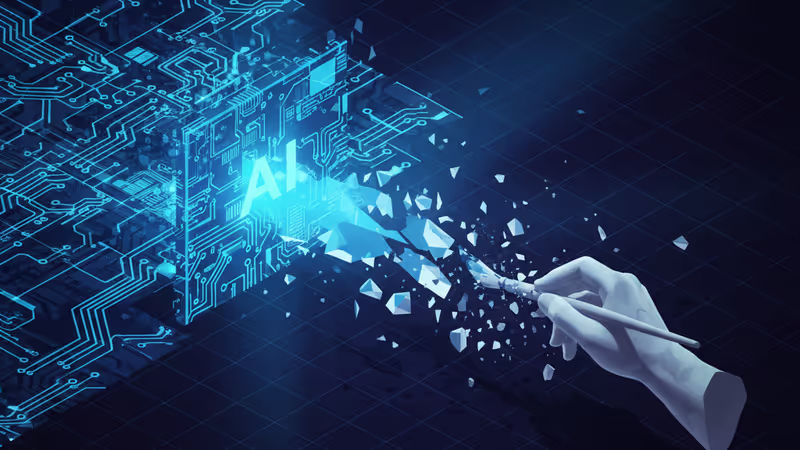
OpenAI's New Image Model Isn't Just Faster—It's a Strategic Assault on the Creative Enterprise
OpenAI's new GPT-Image-1.5 model is more than a speed upgrade. It's a strategic move to dominate the enterprise AI space. Our analysis explains why.
The Lede: Speed as a Weapon
OpenAI just announced a significant upgrade to its image generation model within ChatGPT, now available as GPT-Image-1.5 in its API. While the headlines will focus on the 4x speed boost and enhanced precision, the real story isn't about better pictures. It's a calculated strategic move to shift AI imagery from a novelty art tool into an indispensable, high-velocity utility for developers and businesses. OpenAI is sacrificing the esoteric artistry of rivals like Midjourney for something far more valuable in the long run: scalable, integrated, enterprise-grade infrastructure.
Why It Matters
This update is more than a simple feature bump; it's a tremor that redefines the competitive landscape. The AI image generation market is bifurcating, and this move clarifies OpenAI's position.
- The Battle for Workflow, Not Walls: While Midjourney continues to dominate the high-end, artistic generation space (think digital art for display), its closed ecosystem and lack of an API are significant weaknesses. OpenAI is exploiting this by building a horizontal platform. GPT-Image-1.5 is designed to be embedded everywhere, from marketing automation platforms to design software, making it the 'good enough' engine that's always at hand.
- The Economics of Scale: A 4x speed increase isn't just a user convenience; it's a fundamental change in unit economics. Faster generation means lower computational cost (inference cost), making it commercially viable to generate images at a massive scale. This unlocks applications previously too expensive to consider, like real-time personalized ad creatives or dynamic e-commerce product shots.
- Lowering the Skill Floor: The emphasis on "more precise edits" and "consistent details" signals a move away from the arcane art of 'prompt engineering.' The goal is to make professional-quality image creation accessible to marketers, product managers, and developers without them needing to become AI whisperers. This drastically expands the total addressable market.
The Analysis: From Magic Trick to Power Tool
To understand the gravity of this release, we must look at the evolution of the market and the competitive dynamics at play.
Historical Context: The End of the 'Wow' Era
The first wave of AI image generation, led by DALL-E and early Midjourney, was about producing surreal, shocking, and beautiful images that demonstrated the technology's potential. It was a magic show. We've now entered the second act: the era of utility. The market is maturing from asking "Can it do this?" to "How can I reliably integrate this into my product and business?" Consistency, speed, and API access are the new battlegrounds, and OpenAI is planting its flag firmly on this territory.
Competitive Dynamics: A Differentiated War
OpenAI isn't trying to out-Midjourney Midjourney. It's playing a different game entirely.
- vs. Midjourney: Midjourney is the boutique art studio, producing stunning, bespoke pieces. OpenAI's GPT-Image-1.5 is the high-volume manufacturing plant. By making its model available via API, OpenAI empowers a thousand other companies to build creative tools, while Midjourney remains a destination tool.
- vs. Stable Diffusion: Stable Diffusion's power lies in its open-source flexibility and fine-tuning capabilities, attracting a deeply technical user base. OpenAI is competing on simplicity and integration. It's betting that the majority of the market wants a powerful, turnkey solution integrated into a platform they already use (ChatGPT) and can easily build upon (the API).
PRISM Insight: The API is the Real Product
The most critical element mentioned in the source is the immediate availability of the new model in the API as GPT-Image-1.5. For developers and business leaders, this is the entire story.
OpenAI is aggressively building a comprehensive AI utility stack. With best-in-class models for text (GPT-4), code, and now high-speed imagery, it offers a single, unified API for the core components of modern AI applications. This creates an incredibly powerful moat. Why would a startup or enterprise juggle multiple AI APIs—one for text, another for images—when OpenAI provides a top-tier, integrated solution? This simplifies development, reduces vendor complexity, and locks developers into the OpenAI ecosystem.
The promise of "consistent details" is also a game-changer for businesses. A major hurdle for commercial use has been the inability to maintain brand identity or character consistency across multiple generations. If GPT-Image-1.5 solves this, it removes a massive barrier to adoption for marketing, advertising, and entertainment industries.
PRISM's Take
OpenAI's GPT-Image-1.5 is a trojan horse. While the public sees a faster image generator inside ChatGPT, the strategic objective is the domination of the B2B and developer AI market. By prioritizing industrial-grade speed, reliability, and API-first integration over niche artistic perfection, OpenAI is betting that the future of generative media isn't in a standalone app, but as a foundational, invisible layer powering a million other applications. This isn't just an update; it's a declaration that the war for AI platform supremacy is heating up.
相关文章
OpenAI悄悄撤回ChatGPT的自動模型路由器功能。這項決定揭示了AI產品在使用者體驗、成本與市場競爭之間的微妙平衡。我們的深度分析揭示了背後的真正原因。
OpenAI 運用 GPT-5 加速濕實驗室生物研究,這項突破不僅展示 AI 的巨大潛力,也引發對雙重用途風險的嚴肅探討。深度分析其對產業與競爭格局的影響。
OpenAI推出FrontierScience基準,重新定義AI能力。PRISM深度分析這如何改變AI競爭格局、投資風向及邁向「AI科學家」的未來。
西班牙對外銀行 (BBVA) 與 OpenAI 合作,為12萬名員工部署 ChatGPT 企業版。這項合作預示著金融業 AI 轉型的新時代,將重塑客戶體驗與營運效率。