
Nintendo Switch 2 Controllers: A Strategic Input Evolution Amidst Lingering Concerns
PRISM analyzes Nintendo Switch 2's new Joy-Con 2 controllers: ergonomic upgrades, mouse controls, and the lingering drift issue. What does this mean for gaming's future?
The Lede: Input Innovation as Nintendo's Core Strategy
For a company that has historically differentiated itself more through ingenious input methods than raw processing power, the Nintendo Switch 2's controller lineup offers a crucial barometer of its future direction. The upgrades to the iconic Joy-Con 2 and the continued emphasis on a diverse ecosystem of peripherals aren't merely incremental improvements; they represent Nintendo's calculated bet on how players will engage with games in the coming decade. For any executive tracking the evolving landscape of interactive entertainment, understanding these hardware choices is paramount to deciphering Nintendo's enduring market resilience and future growth vectors.
Why It Matters: Redefining Interaction and Ecosystem Value
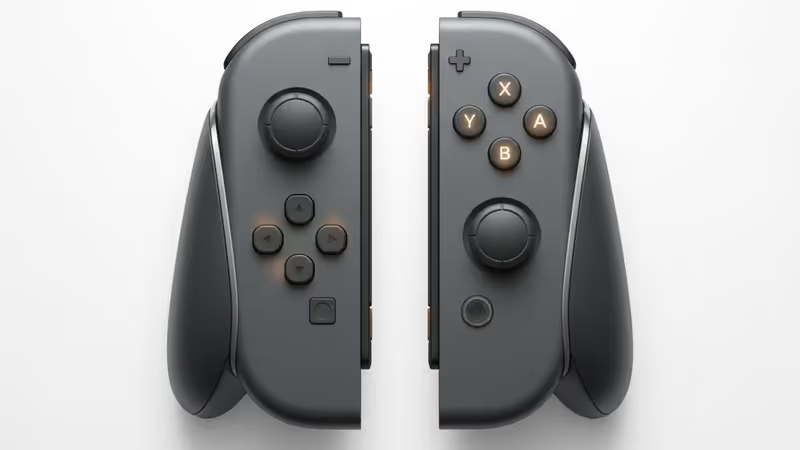
The updated Joy-Con 2 controllers, with their increased ergonomics and the introduction of point-and-click mouse functionality, signal a significant expansion of potential gameplay mechanics. This isn't just about playing existing games better; it's about enabling entirely new genres and interaction paradigms for a console already lauded for its versatility. The 'HD Rumble 2' haptics further deepen immersion, aligning with a broader industry trend towards more tactile and nuanced feedback. However, Nintendo's decision to forgo Hall effect or TMR technology for thumbstick drift prevention – a persistent issue that plagued the original Switch and tarnished consumer trust – stands out as a critical omission. This choice carries implications not just for user satisfaction but also for the long-term cost of ownership and the sustainability of the brand's reputation for quality.
The Analysis: Balancing Legacy, Innovation, and Known Flaws
Nintendo's controller strategy has always been a blend of the familiar and the revolutionary. From the NES D-pad to the Wii Remote's motion controls and the original Joy-Cons' hybrid versatility, input has been the company's innovation engine. The Joy-Con 2 continues this legacy, evolving the form factor with a 14 percent size increase and larger buttons, directly addressing comfort complaints from the original's smaller design, particularly for adult hands. The dedicated 'C' button and more prominent individual SL/SR buttons further refine the modular play experience.
The integration of mouse-like controls is perhaps the most intriguing development. While comfort remains a question mark for extended use in this mode, it opens the door to PC-style cursor-based interfaces, precision targeting, and potentially even non-gaming applications within the Switch ecosystem. This could broaden the appeal beyond traditional gaming, hinting at a more versatile, quasi-computing device.
Yet, the elephant in the room remains the thumbstick drift. Despite magnetic connections being cited as a potential conflict with Hall effect sensors, this explanation feels like a compromise rather than a solution. Competitors and third-party manufacturers have successfully integrated drift-resistant technologies into a variety of controllers. Nintendo's reluctance to tackle this head-on with an internal solution suggests either a technical hurdle they deem too costly, or a strategic decision to prioritize other features, leaving a significant pain point unaddressed for a premium-priced controller. This omission creates a clear opportunity for the booming third-party controller market, as seen with offerings from PowerA and Snakebyte, which can step in to fill the reliability gap.
PRISM Insight: The Ecosystem as a Moat, Input as the Key Differentiator
Nintendo's approach reinforces its strategy of building a robust, diversified ecosystem around unique interaction rather than competing directly on raw graphical fidelity. The availability of upgraded Joy-Cons, a dedicated Pro Controller, and backward compatibility with accessories from the original Switch ensures a broad appeal, catering to casual players, esports enthusiasts, and retro gaming aficionados alike. This extensive ecosystem of playstyles and peripherals acts as a powerful moat, fostering deep user loyalty and encouraging multiple purchases per console. The 'mouse' functionality, in particular, could be an early indicator of Nintendo exploring new application categories beyond pure gaming, potentially expanding their software-as-a-service offerings or integrating more deeply with media consumption, leveraging the device's hybrid nature.
PRISM's Take: Calculated Risks and Unfinished Business
The Nintendo Switch 2's controllers embody a characteristic blend of bold innovation and cautious conservatism. The ergonomic improvements, enhanced haptics, and the genuinely intriguing mouse control functionality represent a forward-thinking evolution of Nintendo's core design philosophy, poised to enrich the player experience and potentially open new creative avenues for developers. These are intelligent, strategic moves that underscore Nintendo's commitment to interactive uniqueness.
However, the failure to integrate Hall effect technology to definitively address thumbstick drift is a significant misstep. It's a missed opportunity to truly perfect the user experience and could become a long-term reputation burden, forcing consumers into expensive replacements or third-party alternatives. While the magnetic connection might present engineering challenges, the consumer expectation for durable, reliable input at this price point is non-negotiable. Moving forward, Nintendo must either openly acknowledge and address this persistent flaw or risk ceding a critical aspect of user trust and satisfaction to its competitors and the burgeoning third-party accessory market. The future of gaming input hinges not just on what new things a controller can do, but also on how reliably it can do the basics.
相关文章
遊戲發行商意外洩漏 Switch 2 新卡帶規格,暗示任天堂正透過創新實體媒體,解決成本與容量問題,鞏固其在數位時代的獨特市場地位。
遊戲發行商的意外洩漏,揭示了任天堂 Switch 2 可能採用多尺寸卡帶策略,以平衡成本與日益增長的遊戲容量,鞏固其在數位時代的實體市場地位。

PRISM深度解析:在經濟壓力下,科技媒體如何從純硬體轉向實用、高價值的預算禮品推薦,洞察消費者行為與產業轉型。

深度解析AI與雲端運算如何重塑全球科技人才格局、職涯路徑與企業戰略。PRISM提供企業與個人的行動建議,掌握未來科技脈動。