
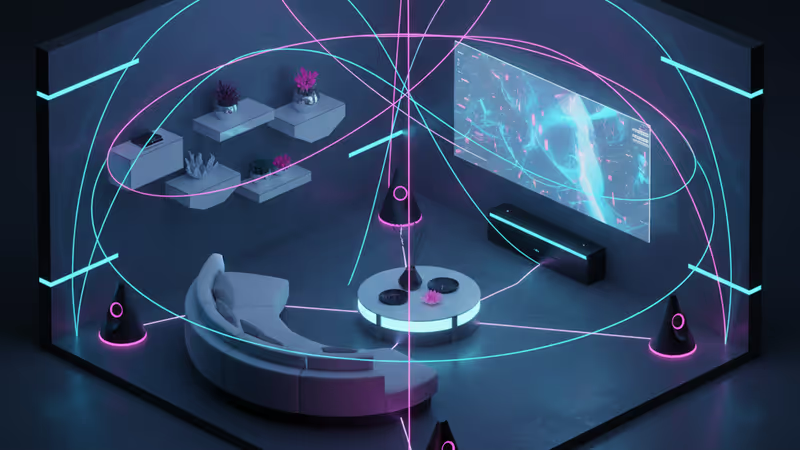
LG's FlexConnect Soundbar Isn't Just a Sonos Killer—It's Redefining the Living Room
LG's new H7 soundbar with Dolby Atmos FlexConnect challenges Sonos's dominance by making true immersive audio accessible for any room layout. An analysis.
The Lede: The End of the 'Perfect' Room
LG's announcement of the H7 soundbar, the first to feature Dolby Atmos FlexConnect, is far more than another entry in the crowded home audio market. This is a strategic move to dismantle the two biggest barriers in high-end home theater: speaker placement rigidity and proprietary ecosystem lock-in. For executives and consumers tired of compromising their living room aesthetics for optimal sound, LG is signaling a new era where the room adapts to the tech, not the other way around. This isn't about a better speaker; it's about a smarter soundscape, powered by the same silicon brains running their flagship TVs.
Why It Matters: The Immersive Audio Revolution Gets Real
The true impact of this development extends beyond a single product, signaling seismic shifts in the consumer electronics landscape:
- Democratization of Atmos: For years, Dolby Atmos in the home has been a qualified success, often limited by the listener's ability to perfectly place speakers. FlexConnect obliterates this requirement. By using the TV's processor to intelligently map the room and calibrate audio to wherever you place your speakers, it makes truly immersive, object-based sound accessible to the millions living in apartments and non-symmetrical spaces.
- The TV as the Command Center: By integrating the Alpha 11 Gen 3 chip—the same processor in its high-end OLEDs—LG is cementing the television as the central processing hub for the entire home entertainment experience. This deep hardware synergy creates a powerful competitive moat that software-first companies like Sonos cannot easily replicate. Your TV is no longer just a display; it's the brain.
- An Open Standard vs. The Walled Garden: This is a direct assault on the proprietary ecosystems of Sonos and Apple. While Sonos has masterfully built its brand on a seamless but closed system, LG is betting that a powerful, licensed standard from Dolby will ultimately win. It's a classic platform play: empower an ecosystem, don't just build a product.
The Analysis: A New Battlefield in the Audio Wars
The evolution of home audio has been a relentless march toward simplicity and quality. Wires gave way to soundbars, which gave way to wireless systems. Dolby Atmos raised the quality ceiling but reintroduced complexity. FlexConnect is the next logical—and disruptive—step in this evolution.
Consider the competitive dynamics:
- Sonos: The undisputed leader faces its first significant architectural threat. Sonos's strength is its user-friendly software and multi-room prowess. Its weakness? Rigidity. You place Sonos speakers where Sonos says to. LG and Dolby are betting that ultimate flexibility is the new premium feature.
- Samsung: Samsung’s Q-Symphony technology, which syncs TV and soundbar speakers, is a similar concept but remains a proprietary feature. LG's use of the Dolby brand gives FlexConnect broader industry legitimacy and a trusted mark of quality that could spur wider adoption.
- TCL: While TCL was first to market with FlexConnect in its TV speakers, LG's implementation in a modular, soundbar-centric system is a far more significant commercial move. It targets the core of the home theater market, not a niche feature.
PRISM Insight: The Pivot to Computational Audio
The real story here is not the Peerless Audio drivers; it's the processor and the microphones. Dolby Atmos FlexConnect is a triumph of computational audio. Just as computational photography allowed smartphone cameras to transcend the limits of their small lenses, computational audio allows speaker systems to transcend the acoustic limits of a physical room. The system 'listens' to its environment and remaps the sound stage in real-time. This is a software and silicon game. The key enabling technologies are advanced DSPs (Digital Signal Processors) and sophisticated microphone arrays. The companies that master this stack will define the next decade of audio.
PRISM's Take: A Calculated, Long-Term Strike
LG's move is both intelligent and audacious. By leveraging a powerful partner in Dolby and its own silicon prowess, the company is redefining the value proposition of a home theater system from one of 'component quality' to 'system intelligence'. Announcing this for CES 2026 is a deliberate, long-lead strategy, designed to freeze the market, signal a paradigm shift to competitors, and build developer and consumer anticipation.
The ultimate success of the H7 Sound Suite will hinge on flawless execution—it must be as simple and reliable as its rivals. But the strategy is sound. LG is not just trying to win a battle against Sonos; it's aiming to change the rules of the war. The perfectly curated, acoustically treated home theater is dead. The era of the intelligent, adaptive living room has begun.
相关文章
LG發表搭載旗艦晶片的Dolby Atmos FlexConnect音響系統,以模組化設計與智慧空間校準技術,挑戰Sonos與三星,預告家庭劇院的AI驅動新時代。

SpaceX在2015年從災難性失敗到歷史性成功僅用六個月。我們的深度分析揭示這如何永遠改變了太空產業的經濟與競爭格局。

川普媒體與核融合公司TAE合併,旨在解決AI的能源危機。此舉將政治影響力與硬核科技結合,為深度科技融資開創高風險新模式。

F1 2026年新規範將徹底改變賽車。告別DRS,迎向主動空力與能源管理的新戰局。PRISM深度解析其對產業的影響與未來趨勢。