
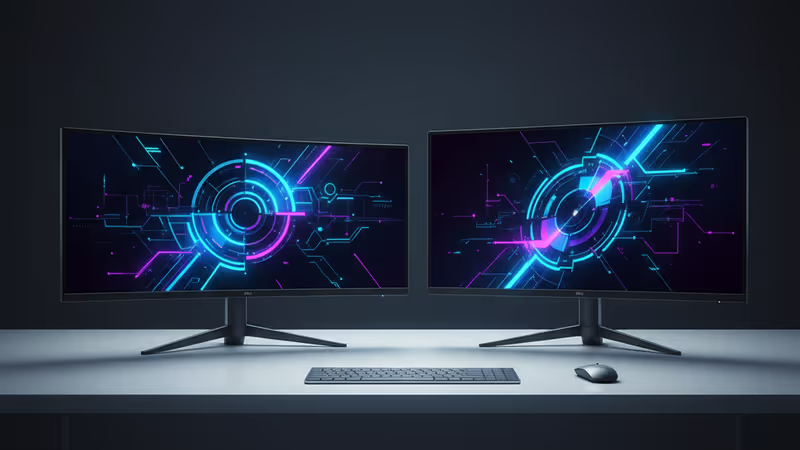
The Ultimate Monitor Buying Guide for 2025: How to Choose Between 4K, OLED, and Ultrawide
Our complete 2025 guide to buying a new monitor. Learn how to choose like a pro by understanding panel tech (OLED, Mini-LED, IPS), 4K resolution, PPI, ultrawide aspect ratios, and more.
Is your monitor the weakest link in your setup? In 2025, the screen you stare at all day is more than just a passive display—it's the centerpiece of your productivity and entertainment. With 4K resolution becoming the new standard and advanced panel technologies like OLED and Mini-LED rapidly becoming more affordable, the choices can be overwhelming. This PRISM guide will demystify the specs and help you find the perfect monitor for your needs.
Panel Wars: OLED vs. Mini-LED vs. IPS
A monitor's soul is its panel. Today's market is a three-way race. The most common technology is still IPS (In-Plane Switching), known for its solid color accuracy and affordability. Newer versions like 'IPS Black' have boosted contrast ratios to nearly 2,000:1, closing the gap with higher-end tech.
The king of the premium market is OLED (Organic Light-Emitting Diode). Its self-lit pixels deliver perfect blacks and essentially infinite contrast. Once a luxury item costing well over $1,000, OLED gaming monitors can now be found for as low as $500. The old fear of burn-in has been largely mitigated by features like automated pixel refreshes and extended three-year warranties from most manufacturers.
Positioned between OLED and IPS is Mini-LED. This technology uses hundreds or thousands of tiny LEDs as a backlight, divided into 'dimming zones' to control contrast locally. It can achieve higher peak brightness than OLED, making it great for HDR content. However, performance can vary significantly, as the quality depends heavily on the number of zones and the manufacturer's control algorithm.
Size vs. Resolution: The Pixel Density Puzzle
Sharpness isn't just about resolution. The true measure is pixel density, or PPI (Pixels Per Inch), which accounts for both screen size and resolution. A 4K monitor looks much sharper at 27 inches than it does at 32 inches. For office work and content creation, a good rule of thumb is to aim for a density of over 100 PPI.
| [object Object] | [object Object] | [object Object] | [object Object] |
|---|---|---|---|
| [object Object] | [object Object] | [object Object] | [object Object] |
| [object Object] | [object Object] | [object Object] | [object Object] |
| [object Object] | [object Object] | [object Object] | [object Object] |
| [object Object] | [object Object] | [object Object] | [object Object] |
Beyond the Rectangle: Aspect Ratios and Curves
The traditional 16:9 aspect ratio is no longer the only option. Ultrawide monitors with a 21:9 ratio are a popular alternative to dual-screen setups for multitasking and provide a wider field of view in games. For the ultimate immersive experience, super ultrawide displays boast a massive 32:9 ratio.
Wider monitors almost always feature a curve to enhance immersion. This is measured with a rating like 1800R (the curve of a circle with an 1800mm radius). A smaller number means a more aggressive curve. An extreme 800R curve is great for gaming but can cause distortion in productivity tasks, so it's crucial to match the curve to your primary use case.
本内容由AI根据原文进行摘要和分析。我们力求准确,但可能存在错误,建议核实原文。
相关文章
2025年最完整的電腦螢幕選購指南。從OLED、Mini-LED面板技術,到4K解析度與像素密度(ppi)的關係,再到超寬、曲面螢幕的優劣,PRISM為您深入分析,助您挑選出最適合的螢幕。

選購電視時,別再被QLED、OLED、Mini-LED等複雜規格迷惑。PRISM深度分析為何獨立評測和影像處理器才是您真正該關注的重點。

Valve 停產 $399 Steam Deck LCD 256GB 版本,最低入門價提高至 $549 OLED 版。深入分析 Valve 的產品策略轉變、掌機市場競爭與未來趨勢。

三星推出55至115吋 Micro RGB 電視,正式將次世代顯示技術帶入主流市場。這項突破是否將終結 LG OLED 的長期統治?PRISM 深度解析。
2025年最完整的電腦螢幕選購指南。從OLED、Mini-LED面板技術,到4K解析度與像素密度(ppi)的關係,再到超寬、曲面螢幕的優劣,PRISM為您深入分析,助您挑選出最適合的螢幕。
選購電視時,別再被QLED、OLED、Mini-LED等複雜規格迷惑。PRISM深度分析為何獨立評測和影像處理器才是您真正該關注的重點。
Valve 停產 $399 Steam Deck LCD 256GB 版本,最低入門價提高至 $549 OLED 版。深入分析 Valve 的產品策略轉變、掌機市場競爭與未來趨勢。
三星推出55至115吋 Micro RGB 電視,正式將次世代顯示技術帶入主流市場。這項突破是否將終結 LG OLED 的長期統治?PRISM 深度解析。