
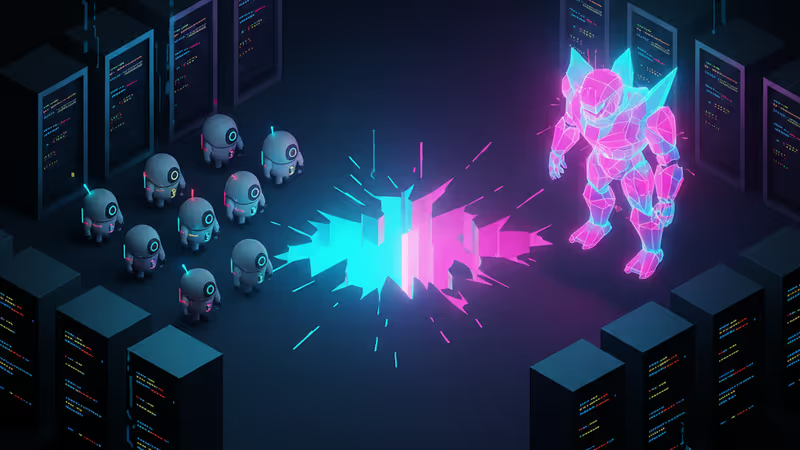
Google's Gemini Delay: Why Replacing Assistant is a Symptom of a Deeper AI Civil War
Google's delay in replacing Assistant with Gemini reveals deep technical challenges and strategic risks in the AI race against Apple. Here's the real story.
The Lede: More Than a Missed Deadline
Google pushing its mandatory Gemini transition for Android into 2026 is far more than a simple timeline adjustment. For any executive watching the AI space, this is a critical signal. It reveals the immense, and likely underestimated, technical and user-experience chasm between a reliable, task-oriented utility like Google Assistant and a powerful, probabilistic generative AI like Gemini. This isn't just a product delay; it's a public lesson in the brutal reality of integrating next-gen AI into a mature ecosystem with billions of users.
Why It Matters: The Second-Order Effects
The strategic ripple effects of this delay will be felt across the industry:
- Ecosystem Fragmentation: For the next 18+ months, Android will be a two-assistant platform. This creates user confusion, muddies the value proposition, and presents a fragmented landscape for developers who must decide which AI to target.
- Competitive Opening for Apple: This delay is a gift to Apple. While Google attempts a risky, full-replacement strategy, Apple's more cautious 'Apple Intelligence' approach—integrating AI features into Siri and the OS rather than replacing them wholesale—gains more time to mature and win user trust on a platform of perceived stability and privacy.
- Partner Anxiety: Major hardware partners like Samsung, which are betting heavily on AI features for devices like the Galaxy S25, now face a longer period of uncertainty. A shifting software foundation from their primary OS partner is a significant business risk.
The Analysis: The Battle of Reliability vs. Capability
This delay is a direct result of a fundamental conflict in AI architecture. Google Assistant, built on years of search and knowledge graph data, is largely deterministic. You ask for a timer, you get a timer. It's a predictable, reliable tool. Gemini is a probabilistic powerhouse, capable of creative and complex tasks, but it lacks the baked-in, instantaneous reliability for the simple commands that form the bedrock of voice assistant usage.
Google is discovering in real-time that you cannot simply paper over a utility with a generative model. The challenge is to fuse Gemini's creative capabilities with Assistant's core, bulletproof functionalities without introducing latency, hallucinations, or complexity for basic tasks. The statement about needing a "seamless transition" is corporate-speak for "we haven't solved the core problem of making our new AI do the old AI's boring, essential job reliably enough."
PRISM Insight: The 'Great AI Integration' Phase is Here
We are officially moving past the initial hype cycle of large language models and into the 'Great AI Integration' phase. This era is defined not by model size or benchmarks, but by the messy, expensive, and time-consuming engineering required to embed these technologies into legacy products safely and effectively.
The investment implication is clear: the gold rush extends beyond foundational model builders. The critical, and perhaps undervalued, players are the companies providing the 'plumbing' for this integration—model optimization platforms, testing and validation frameworks, and hybrid AI systems that can intelligently route a user's query to either a deterministic or a generative engine. Google's struggle validates the need for this entire sub-sector of the AI stack.
PRISM's Take: A Necessary Dose of Reality
This delay should not be viewed as a failure, but as a necessary and mature admission of complexity. A rushed, half-baked rollout to replace a core Android function would have been a self-inflicted wound, eroding user trust and handing a massive advantage to rivals. Google is learning a hard lesson in public: replacing a globally-scaled digital assistant is less like a software update and more like performing open-heart surgery on your flagship product. The 2026 timeline is a tacit acknowledgment that the patient's anatomy is far more complex than the surgeons initially anticipated.
相关文章
Resolve AI以250倍營收的驚人估值完成A輪募資。PRISM深度解析其多階段投資結構、AIOps賽道,以及企業自主維運的未來。
Google將Gemini全面取代Assistant的時程延至2026年。這不僅是技術挑戰,更是在與蘋果Siri和微軟Copilot的AI助理競賽中,一次關鍵的戰略延遲。

OpenAI悄悄撤回ChatGPT的自動模型路由器功能。這項決定揭示了AI產品在使用者體驗、成本與市場競爭之間的微妙平衡。我們的深度分析揭示了背後的真正原因。
Google翻譯打破硬體限制,Gemini驅動的即時翻譯將支援所有耳機。PRISM深度解析此舉如何挑戰蘋果的封閉生態,預示AI服務的未來。