
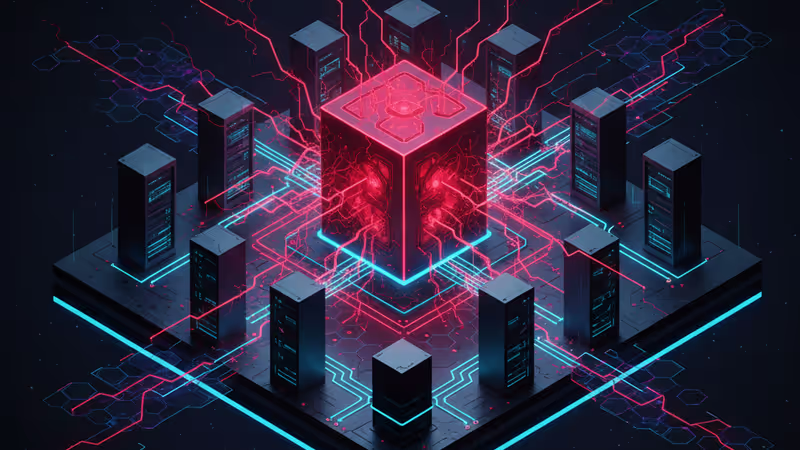
Cybersecurity in 2025: The Year the Threat Came From Inside the Building
2025's biggest security failures weren't just external hacks. A new era of state-sanctioned insider threats and systemic risk has begun. Here's our analysis.
The Lede: Why You Should Care
For years, cybersecurity has been a battle fought at the perimeter. In 2025, that perimeter collapsed entirely. The year’s most catastrophic digital failures were not merely about sophisticated external attacks from state actors or criminal gangs—though those certainly escalated. The defining crisis was a fundamental breakdown of trust and governance, proving that the most devastating threat isn't the hacker outside the firewall, but the chaos welcomed inside the gates. For leaders, the lesson is stark: your greatest vulnerability is no longer a missing patch, but a broken culture.
Why It Matters: A Systemic Crisis of Trust
The events of 2025 signal a paradigm shift with profound second-order effects. We’re moving beyond isolated data breaches into an era of systemic integrity failure, impacting the foundational pillars of government and commerce.
- Erosion of Institutional Trust: The DOGE debacle wasn't a hack; it was a sanctioned internal raid on citizen data. When a government entity, driven by a private-sector “disruptor” ethos, willfully bypasses its own security protocols, it tells the world that the rules no longer apply. This legitimizes recklessness and fatally undermines public trust in the state's ability to act as a responsible data steward.
- Weaponization of Core Enterprise Software: The Clop ransomware group's exploitation of Oracle’s E-Business Suite wasn't just a data theft. It was a strategic strike against the central nervous system of global business. By compromising a single software suite, the attackers gained leverage over dozens of corporate giants, demonstrating that the enterprise software you depend on is also your largest single point of failure.
- The Personalization of Corporate Risk: Clop's tactic of targeting senior executives with their own stolen data is a psychological escalation. The attack moves from a corporate balance sheet problem to a personal crisis for the decision-makers, creating immense pressure to pay ransoms and circumvent proper incident response protocols.
The Analysis: The Collision of Ideology and Infrastructure
Historically, we categorize threats: state-sponsored espionage (the Chinese Treasury breach), cybercrime-for-profit (Clop), and insider threats (Snowden). 2025 demonstrated a chaotic convergence of all three, with the rise of a new, more dangerous category: the sanctioned insider threat.
Unlike Edward Snowden, who acted against the system, the DOGE operatives, led by Elon Musk, acted with perceived top-down authority. The mantra of “Government Efficiency” was used as a battering ram against the very federal protocols designed to prevent abuse. This incident creates a terrifying precedent, blurring the line between mandated innovation and gross misconduct. It poses a new dilemma for CISOs and legal counsel: how do you defend against a threat that has a C-level sponsor and a political mandate?
Simultaneously, the Oracle breach reveals the brittleness of our global tech infrastructure. For two decades, Oracle has been a bedrock of enterprise operations. That reputation for stability made it a trusted, unquestioned part of the tech stack. Clop exploited that very trust. The slow response from Oracle underscores a dangerous complacency among legacy tech giants, whose massive, complex codebases are becoming an indefensible attack surface. This isn't just another vulnerability; it's a vote of no-confidence in the foundational software that powers global PLC's.
PRISM Insight: The Zero Trust Mandate Extends to People
The investment fallout from 2025 will reshape security budgets. The focus will pivot aggressively from perimeter defense to internal resilience. The key trend is the extension of the “Zero Trust” security model beyond networks and into personnel and governance. This means:
- Investment in Governance, Risk, and Compliance (GRC): Tools that can audit and enforce internal protocols in real-time will see a surge in demand. The new priority is ensuring that even privileged users cannot bypass established rules.
- Rise of Verifiable Credentials: Expect accelerated development of systems where access to sensitive data requires multi-party, cryptographically-verified approvals, making a DOGE-style internal free-for-all technologically impossible.
- A Bear Market for Legacy Monoliths: The Oracle incident will force a painful re-evaluation of monolithic, on-premise enterprise software. Boards will now question the systemic risk of relying on a single, aging codebase, likely accelerating migration to more modern, distributed, and microservice-based architectures.
PRISM's Take
2025 was the year the “move fast and break things” ethos of Silicon Valley was imported into the heart of government, with predictable and catastrophic results. It proved that culture is the ultimate security control. No firewall, EDR, or AI-powered threat detection can protect an organization that has declared war on its own rules.
The hard-won lesson is that true resilience is not about building higher walls, but about fostering an unbreakable culture of governance and accountability. The most important security question for any leader to ask now is not “Are we patched?” but “Do we have the discipline to follow our own protocols, especially when it's inconvenient?” In 2025, the answer was a resounding no, and the consequences are still unfolding.
相关文章
Impulse Space 的 Mira 飛行器正引領一場太空物流革命。深度分析軌道轉移飛行器 (OTV) 的市場格局、投資潛力與未來趨勢。
Waymo自駕車在奧斯汀逆向行駛,這不只是一次技術失誤,更暴露了整個產業面臨的信任危機與「長尾問題」。PRISM深度解析其深遠影響。

2025年太空發射市場迎來劇變。藍色起源New Glenn成功挑戰SpaceX,而中國商用火箭崛起,重塑全球競爭格局。PRISM深度解析。
OpenAI的紅色警報揭示了AI競賽的殘酷現實。從數據中心的地緣政治風險到機器人技術的突破,PRISM深度解析AI霸權的未來戰場。