

Codex Is Building Codex: OpenAI Signals the 'Singularity' of Software Development
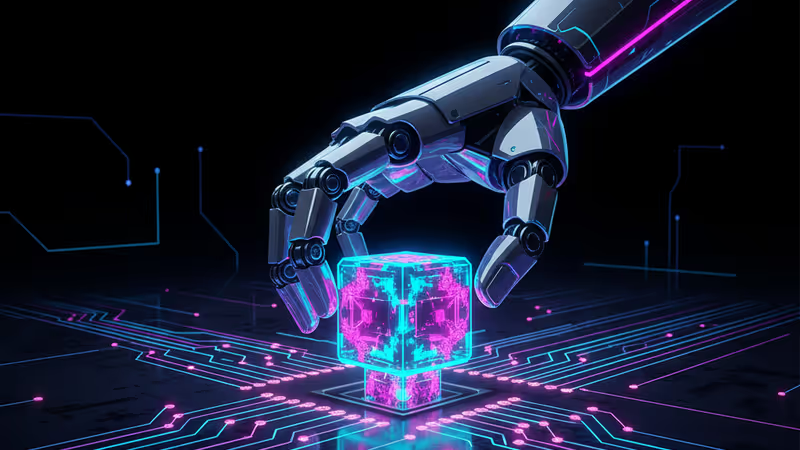
OpenAI reveals its AI coding agent, Codex, is now primarily built by itself. This marks a critical shift towards autonomous software development, with massive implications for productivity, security, and the future of coding.
The Lede: The Point of No Return
OpenAI just confirmed what many in the industry have quietly speculated: its AI coding agent, Codex, is now largely responsible for building and improving itself. An OpenAI product lead stated, "the vast majority of Codex is built by Codex." This isn't just a clever case of 'dogfooding'; it's a paradigm shift. We are witnessing the emergence of recursive self-improvement in a commercial software product. For every developer, CTO, and investor, this signals that the theoretical future of autonomous software development has arrived, and it will fundamentally reshape the tech landscape faster than anyone is prepared for.
Why It Matters
This development transcends a simple productivity boost. It represents a potential exponential curve in software capability. When a tool can improve its own architecture, fix its own bugs, and write its own new features, the traditional, linear timeline of development cycles is obliterated. This creates a powerful feedback loop: a smarter Codex builds an even smarter Codex, accelerating progress at a non-human pace.
The second-order effects are profound:
- Competitive Moat: Companies that achieve this recursive loop, like OpenAI claims to have, gain a nearly insurmountable advantage. Competitors are no longer just racing against a team of human engineers; they're racing against an AI that works 24/7 to compound its own intelligence.
- Redefining the Developer: The role of the human software engineer is irrevocably changing. The focus will shift from writing line-by-line code to high-level architectural design, system verification, and acting as a sophisticated 'AI supervisor'.
- Systemic Risk: A self-improving system also introduces the risk of self-propagating flaws. A subtle bug or security vulnerability introduced by the AI could be replicated and baked into future versions, creating complex and potentially undetectable systemic weaknesses.
The Analysis: From Assistant to Architect
From AI Co-Pilot to Autonomous Agent
For the past few years, the industry has grown comfortable with AI 'co-pilots' like GitHub's tool, which offer suggestions and complete snippets of code. This is a linear enhancement. What OpenAI describes with Codex is a phase transition. The tool is moving from a passive assistant to an active, autonomous agent capable of handling entire tasks like feature implementation and bug fixes. This is the difference between a calculator that helps a mathematician and a machine that formulates its own theorems. This move from generative AI (creating content) to agentic AI (taking action) is the single most important trend in the industry today.
The Ultimate Competitive Feedback Loop
Historically, the concept of a program that can rewrite itself is known as 'bootstrapping'—a simple compiler writing a more complex one. OpenAI is deploying this concept at a massive scale with neural networks. This puts immense pressure on rivals like Google and Microsoft. It's no longer enough to have a powerful AI model; the new benchmark is whether that model can be tasked with its own continuous improvement. Investors should scrutinize AI companies not just on their current capabilities, but on their demonstrated ability to create these self-improving flywheels.
PRISM Insight: Your Action Plan for the Agentic Era
For Tech Leaders and CTOs
Your team structure is now obsolete. Stop thinking about AI tools as individual productivity boosters. You must begin restructuring your engineering departments around Human-AI teaming. The most valuable engineers will not be the fastest coders, but the best 'AI wranglers'—those who can prompt, guide, and validate the output of autonomous agents like Codex. Your immediate priority should be developing new protocols for quality assurance, security validation, and architectural oversight for AI-generated code.
For Developers and Engineers
Your value is no longer in writing code; it's in shaping systems. The demand for pure coders will decline precipitously. To remain relevant, you must elevate your skills to a meta-level. Focus on three key areas:
- System Architecture: Defining the high-level logic and structure that AI agents will then build.
- Prompt Engineering & AI Supervision: Mastering the art and science of instructing and correcting AI agents to achieve complex goals.
- Advanced Testing & Verification: Becoming an expert at validating the output of a non-human collaborator, finding edge cases and logical flaws the AI might miss.
PRISM's Take
OpenAI’s admission is more than a press release; it's an inflection point. The era of software development as a human-led craft is ending. We are entering the age of software engineering as a collaborative exercise between human architects and autonomous AI agents. The productivity gains will be astronomical, but they will be matched by new, complex challenges in security and control. Companies that fail to adapt to this new reality will not just fall behind; they will become obsolete in a handful of product cycles.
相关文章

OpenAI證實其AI編碼工具Codex正被用來開發和改進自身,形成強大的自我增強循環。這對軟體開發的未來和AI競賽意味著什麼?
OpenAI揭示其AI編碼工具Codex正透過自我編程進行升級。PRISM深度分析此一「遞歸式自我改進」如何引爆AI開發的飛輪效應,並重塑科技產業的未來。

Uber One面臨FTC與23州的聯合訴訟,指控其採用「暗黑模式」誤導消費者。PRISM深度分析此事件對訂閱經濟與科技業的衝擊與未來影響。

Mozilla的非營利使命與對Google的財務依賴形成致命矛盾。PRISM深度解析這場瀏覽器戰爭背後的商業困境、對開放網路的警示,以及Firefox的未來之路。