
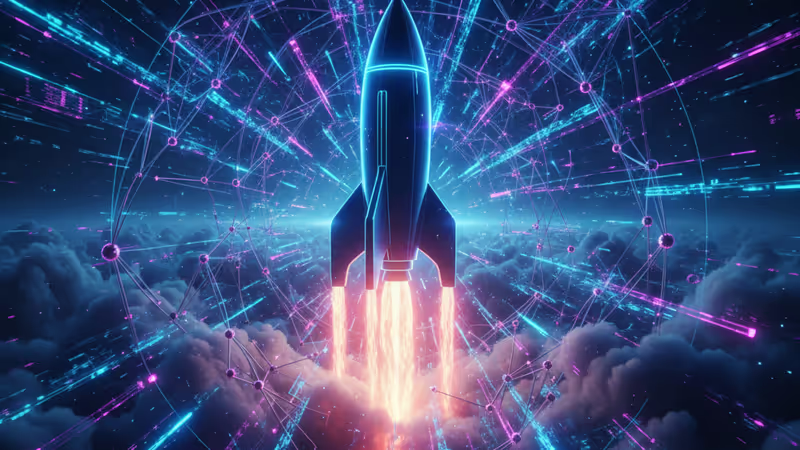
China's Long March 12A Reaches Orbit on Debut, But Reusable Booster Fails Landing
China's new Long March 12A rocket, a competitor to SpaceX's Falcon 9, successfully reached orbit on its debut flight but failed in its primary reusability test as the booster crashed.
It was a spectacular success, followed by a supersonic failure. China's new Long March 12A rocket, designed for reuse to compete with SpaceX's Falcon 9, successfully soared into low-Earth orbit on its first flight. The mission's critical second act, however, didn't stick the landing, with the first-stage booster crashing back to Earth.
A Tale of Two Outcomes
The rocket lifted off from the Jiuquan Satellite Launch Center in northwestern China at 9:00 pm EST on Monday (02:00 UTC Tuesday), according to official reports. The vehicle is roughly the same height and diameter as SpaceX's workhorse, the Falcon 9.
Less than 10 minutes later, the methane-fueled first stage booster came hurtling back through the atmosphere. It failed to complete a critical braking burn needed to slow down for a controlled landing near the Gobi Desert. Instead, it impacted a remote region about 200 miles downrange.
Accelerating the Space Race
This was the second time this month that a Chinese rocket designed for reuse has made its debut flight. While the booster recovery failed, simply reaching orbit is a significant achievement, defying the questionable odds that often burden new launch vehicles. The event underscores the aggressive pace of China's reusable rocket development program.
本内容由AI根据原文进行摘要和分析。我们力求准确,但可能存在错误,建议核实原文。
相关文章
中國新型可重複使用火箭「長征12A號」首次發射成功進入軌道,但其第一節推進器未能成功著陸回收。此事件凸顯了中國在追趕SpaceX的道路上仍面臨技術挑戰。
在與SpaceX的激烈競爭中領導聯合發射聯盟(ULA)超過十年後,執行長托里·布魯諾突然宣布辭職。其任內雖成功推出火神火箭,但公司仍面臨市佔率下滑的挑戰。
波音Starliner首次載人任務因推進器故障與氦氣洩漏等嚴重問題,導致兩名NASA太空人受困國際太空站長達九個月,最終須由SpaceX的飛龍號太空艙接回地球。
SpaceX的勁敵聯合發射聯盟(ULA)執行長托里·布魯諾在位12年後宣布辭職。在新一代「火神」火箭剛投入使用之際,此番人事變動將如何影響白熱化的全球太空競賽格局?本文深入分析。
中國新型可重複使用火箭「長征12A號」首次發射成功進入軌道,但其第一節推進器未能成功著陸回收。此事件凸顯了中國在追趕SpaceX的道路上仍面臨技術挑戰。
在與SpaceX的激烈競爭中領導聯合發射聯盟(ULA)超過十年後,執行長托里·布魯諾突然宣布辭職。其任內雖成功推出火神火箭,但公司仍面臨市佔率下滑的挑戰。
波音Starliner首次載人任務因推進器故障與氦氣洩漏等嚴重問題,導致兩名NASA太空人受困國際太空站長達九個月,最終須由SpaceX的飛龍號太空艙接回地球。
SpaceX的勁敵聯合發射聯盟(ULA)執行長托里·布魯諾在位12年後宣布辭職。在新一代「火神」火箭剛投入使用之際,此番人事變動將如何影響白熱化的全球太空競賽格局?本文深入分析。