

BNY's Radical AI Gambit: Why Arming 20,000 Employees with AI is More Than Just a Tech Upgrade
BNY is enabling 20,000 employees to build AI agents with OpenAI. Our analysis reveals why this is a radical shift in enterprise AI strategy, not just another tech rollout.
The Lede: This Isn't About AI, It's About a New Operating Model
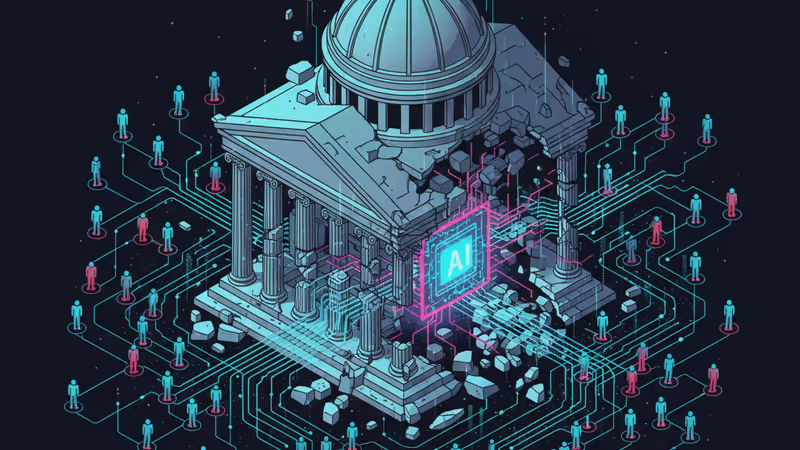
While most headlines focus on which new AI model is the most powerful, BNY Mellon, one of the world's oldest and most conservative financial institutions, is quietly executing a far more radical strategy. By empowering over 20,000 employees to build their own AI agents using OpenAI technology via an internal platform called 'Eliza', BNY isn't just adopting AI—it's betting its future on a decentralized, employee-led innovation model. For executives in any legacy industry, this is a critical signal: the era of top-down, centralized AI projects is over. The real revolution is in turning your entire workforce into an AI-enabled army.
Why It Matters: The Shift from AI Tools to an AI-Native Enterprise
BNY's move is significant because it sidesteps the traditional, sluggish IT procurement cycle. Instead of buying a handful of monolithic AI solutions, they've built a platform that democratizes AI creation. This has profound second-order effects that most are overlooking:
- Competitive Moat: While competitors are busy vetting vendors, BNY is potentially solving thousands of niche, high-value problems at the business unit level. The cumulative effect of these micro-optimizations—from a portfolio manager automating sentiment analysis to an operations clerk streamlining trade settlements—creates a competitive moat built on operational efficiency, not just a single piece of tech.
- Talent Magnet: In the war for talent, providing employees with cutting-edge tools to augment their own expertise is a powerful differentiator. This signals a culture of trust and innovation, making BNY a more attractive destination for the next generation of finance professionals who expect AI to be part of their toolkit.
- The Real Bottleneck: This strategy acknowledges a core truth about enterprise AI: the bottleneck isn't the technology, it's identifying the right business problems. By empowering the people closest to the problems, BNY is creating a direct pipeline from business need to AI solution.
The Analysis: A High-Wire Act of Governance and Empowerment
From Centralized IT to a Decentralized AI Force
For decades, technology adoption in finance has been a top-down mandate. A central IT department selects, vets, and deploys software with an iron fist to ensure security and compliance. BNY's approach turns this model on its head. It’s a calculated risk that mirrors the 'citizen developer' movement that swept through enterprises with low-code platforms, but with exponentially higher stakes. The core bet is that the value unlocked by domain experts building their own tools will outweigh the immense governance challenges.
The Eliza Platform: The Unsung Hero
The brief mention of the 'Eliza' platform is the most critical detail. This is not simply a wrapper around an OpenAI API. To make this work in a highly regulated bank, Eliza must be an incredibly sophisticated 'AI governance-as-a-service' platform. Our analysis suggests it likely handles several critical functions:
- Data Guardrails: Preventing agents from accessing non-permissioned client data or PII.
- Compliance Sandboxing: Ensuring employee-built agents operate within strict regulatory boundaries (e.g., not generating unapproved financial advice).
- Audit & Logging: Creating an immutable record of every query and output for regulatory scrutiny.
- Model Management: Abstracting the complexity of the underlying LLMs (likely a mix of public and fine-tuned models) so employees can focus on the business logic.
The real IP here isn't access to OpenAI; it's the enterprise-grade control layer that makes its use safe and scalable.
PRISM Insight: The Playbook for Legacy Industries
What we're witnessing is the emergence of a new playbook for digital transformation in legacy sectors. The old model was about buying 'digital solutions'. The new model is about building a 'digital factory' where employees themselves are the builders. BNY's Eliza is that factory floor.
For Investors: The companies to watch are not just the AI model makers, but the firms providing the picks and shovels for this revolution—the AI governance, security, and observability platforms that make strategies like BNY's possible. Any company enabling the safe, decentralized deployment of AI inside an enterprise is sitting on a goldmine.
For Executives: The question is no longer "Which AI tool should we buy?" It is "What platform do we need to build to empower our employees to solve their own problems with AI?" This requires a fundamental shift in mindset from risk-aversion to risk-management, and a deep investment in employee upskilling. The BNY experiment, if successful, proves that even the most conservative institutions can make this leap.
PRISM's Take
BNY Mellon's strategy is a high-risk, high-reward gambit that could redefine what it means to be an AI-powered enterprise. It is a profound bet on human capital, augmented by intelligent platforms. While the compliance and governance hurdles are immense, the potential upside is creating a hyper-efficient, continuously-optimizing organization that is impossible to replicate by simply buying off-the-shelf software. This isn't just a bank using AI; this is a blueprint for how legacy giants can harness decentralized innovation to not only survive, but thrive in the age of AI. The entire financial and enterprise tech world should be watching very, very closely.
相关文章
BBVA為12萬名員工導入ChatGPT Enterprise,不只是技術升級,更是引爆金融AI軍備競賽的信號彈。我們的獨家分析揭示其對產業格局的深遠影響。

紐約梅隆銀行正透過其Eliza平台,賦予超過2萬名員工使用OpenAI的能力。PRISM深度分析此舉如何重塑金融業競爭格局、投資價值與企業AI的未來。

OpenAI支持的Chai Discovery以13億美元估值融資1.3億美元。PRISM深度分析這筆交易如何引爆「生成式生物學」革命,及其對投資者和製藥產業的真正意義。

GPT-5.2的發布預示著AI產業從「模型軍備競賽」轉向「生態系持久戰」。PRISM深度分析其對OpenAI、競爭對手及企業用戶的戰略意義。