
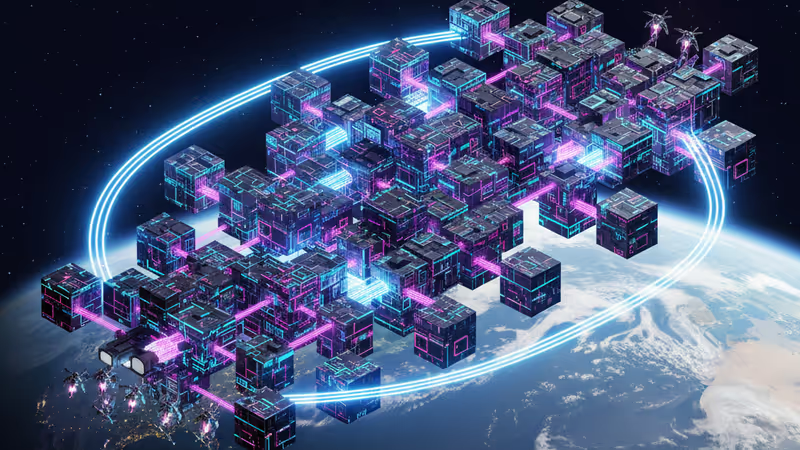
Beyond the Cloud: The Trillion-Dollar Race to Build AI Data Centers in Space
AI's insatiable energy demand is pushing data centers off-planet. Discover the trillion-dollar race to build orbital infrastructure and its impact on investors.
The Lede: AI's Growth is Breaking Earth's Limits
The insatiable energy demand of the AI revolution is on a collision course with the physical limits of our planet. With proposals for gigawatt-scale data centers now on the table for 2025—a scale that strains local power grids and ecosystems—Big Tech is looking for an escape valve. The solution, once the realm of science fiction, is becoming a strategic imperative: moving the cloud, quite literally, beyond the clouds and into Earth's orbit.
Why It Matters: A New Infrastructure Paradigm
This isn't just about finding more space for servers. It represents a fundamental shift in how we conceive of global infrastructure. By moving the most power-intensive computations off-planet, companies can bypass terrestrial constraints on energy, water, and land. The second-order effects are staggering:
- Decoupling AI from Local Grids: Orbital data centers, powered by unfettered solar energy, could alleviate the growing pressure on national power grids, potentially stabilizing electricity costs for consumers even as AI demand skyrockets.
- The Next Geopolitical High Ground: The nation or corporation that controls the first orbital hyperscaler will possess an unprecedented strategic asset, moving the US-China tech rivalry into a new, unregulated domain.
- A New Asset Class for Investors: This creates a new frontier for investment, not just in AI, but in the entire space-industrial supply chain, from launch providers to in-orbit robotics.
The Analysis: From Fantasy to Feasibility
The Gigawatt Problem: Earth's In-Built Bottleneck
The source's mention of six gigawatt-scale data center proposals for 2025 isn't just a statistic; it's a warning shot. A single gigawatt can power a medium-sized city. The public and political backlash against these energy-hungry, water-guzzling facilities is already growing. For AI companies in a "frenzied pursuit of profitability," hitting these terrestrial walls isn't a distant risk—it's an immediate threat to their growth trajectory. The current model of building bigger data centers on Earth is fundamentally unsustainable at the pace AI requires.
A Decades-Old Dream Meets New-Space Economics
The idea of space-based infrastructure isn't new; visionaries have discussed space-based solar power and manufacturing since the 1970s. The fatal flaw was always launch cost. What's changed? Reusable rockets. Companies like SpaceX have slashed the cost-per-kilogram to orbit, transforming the economic equation. A concept that was once economically laughable is now being seriously modeled in corporate boardrooms. The unprecedented demand from the AI boom provides the final ingredient: a multi-trillion dollar market incentive to overcome the immense engineering challenges.
PRISM Insight: The New Space-AI Investment Thesis
For investors, the direct play isn't necessarily the company building the orbital data center, but the 'picks and shovels' that will make it possible. The emerging Space-AI ecosystem will be built on three pillars:
- Launch & Logistics: Reliable, high-cadence launch providers are the foundation. Beyond just getting to orbit, a new category of in-space logistics and transportation will be required for assembly and maintenance.
- Energy & Cooling: The primary advantage of space is limitless solar power. This necessitates manufacturing vast, hyper-efficient solar arrays. Cooling, a major cost on Earth, becomes a thermal engineering challenge of radiating heat into the vacuum of space. Companies specializing in advanced thermal management systems will be critical.
- Robotics & Communication: Human maintenance is not an option. A new generation of autonomous, radiation-hardened robotics will be needed for repairs and upgrades. Furthermore, high-bandwidth laser communication links will be essential to beam data back to Earth with minimal latency.
The market is shifting from viewing space as a domain for exploration and communication satellites to seeing it as the ultimate industrial park for Earth's most demanding computational needs.
PRISM's Take: The Race for Orbital Supremacy Has Begun
The move to put data centers in space is the logical, perhaps inevitable, endpoint of two exponential trends: AI's compute demand and the falling cost of space access. This is no longer a matter of 'if', but 'when' and 'who'. While the technical hurdles remain immense, the strategic and economic drivers are now too powerful to ignore. The race to build the first orbital hyperscaler will be the next great battleground for technological supremacy, fundamentally reshaping the economics of AI and the balance of power on Earth for the century to come.
相关文章

美光財報揭示AI硬體新浪潮。深度分析為何高頻寬記憶體(HBM)是繼Nvidia後的新戰場,以及投資者應關注的「GPU+」生態系機會。

Oracle百億美元AI資料中心計畫遇阻,揭示了AI基礎設施競賽背後的高昂資本與債務風險。這對Nvidia等科技股意味著什麼?

《魔法壞女巫》導演朱浩偉揭示成功秘訣。分析他如何結合病毒式行銷與人性化創意,在AI時代重新定義大片,為影視產業提供新藍圖。
美國參議員針對AI公司的數據中心展開調查,揭示其如何推高當地電價達267%。這不僅是監管警訊,更是AI產業永續發展的關鍵挑戰。