

BBVA's OpenAI Gambit: Why Its 120,000-Employee AI Rollout Is a Warning Shot to Global Finance
BBVA's deal to give 120,000 employees ChatGPT isn't a pilot—it's a radical bet on an AI-native future. Our analysis on why it changes everything for banking.
The Lede: This Isn't About a Chatbot
Spanish banking giant BBVA is deploying ChatGPT Enterprise to all 120,000 of its employees. While many will dismiss this as another corporate AI pilot, they are missing the seismic shift this represents. This isn't about automating a helpdesk; it's a multi-year, all-in bet on fundamentally re-architecting a global bank to be 'AI-native.' For every executive in finance and tech, this move transforms enterprise AI from a theoretical advantage into an urgent competitive necessity.
Why It Matters: The End of the AI 'Pilot Program' Era
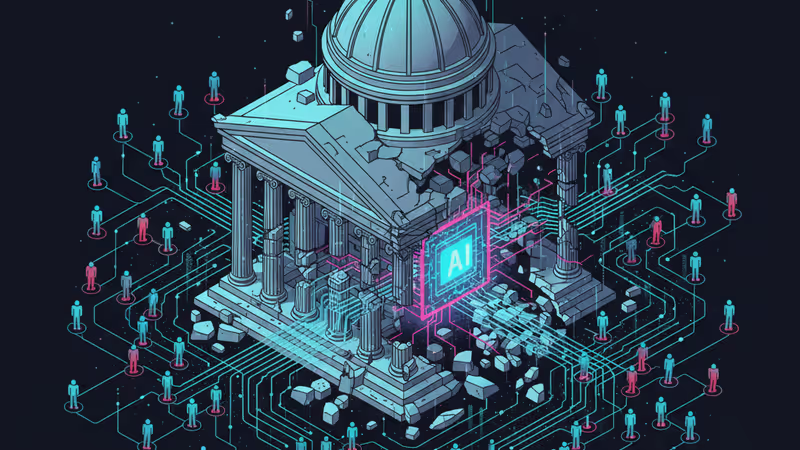
For years, banks have dabbled in AI with siloed projects in fraud detection or algorithmic trading. BBVA's enterprise-wide deal with OpenAI signals the end of that cautious era. The new benchmark for competition is not whether you use AI, but how deeply and pervasively it's integrated into every single function—from marketing copy and code generation to risk analysis and client communications. This move pressures every competitor, from JPMorgan Chase to regional credit unions, to answer a difficult question: what is your enterprise-wide AI strategy? Those without a clear answer are now officially behind.
The second-order effect is a talent and culture war. BBVA isn't just buying software; it's investing in creating an AI-fluent workforce at scale. The new competitive moat in banking may no longer be just assets under management, but the collective ability of its employees to leverage AI for productivity and innovation.
The Analysis: Rewiring the Bank's Central Nervous System
From Tool to Operating System
Historically, bank technology adoption has been about acquiring specific tools for specific problems. BBVA's approach treats generative AI as a new foundational layer—an operating system for intelligence. The stated goal to "co-develop AI solutions" with OpenAI is critical. This is not an off-the-shelf software purchase. It's a strategic partnership to build proprietary capabilities on top of a world-class AI model. This creates a powerful flywheel: BBVA's vast, proprietary financial data and workflows can be used to fine-tune models for specific banking tasks, creating bespoke solutions that rivals cannot easily replicate.
The Trillion-Dollar Productivity Question
The core challenge for BBVA is transforming access into output. Giving 120,000 employees a powerful tool is one thing; teaching them how to fundamentally change their workflows to extract value is another. Success will depend on three factors:
- Training & Adoption: Moving beyond simple prompts to sophisticated, role-specific use cases.
- Risk Management: Implementing guardrails for data privacy, client confidentiality, and model 'hallucinations' in a highly regulated environment.
- Measuring ROI: How do you quantify the value of a better-written client email or a faster-drafted risk report? BBVA's ability to measure and articulate this will create the blueprint for the entire industry.
The Ripple Effect on the Tech Ecosystem
This deal sends a clear message to the B2B tech world: enterprise buyers, particularly in regulated industries, are looking for strategic partners, not just vendors. OpenAI won this deal not just on model performance, but likely on its commitment to enterprise-grade security, scalability, and a willingness to co-create. Fintechs and enterprise software companies that cannot offer this level of partnership and deep integration will find themselves selling commoditized, point solutions in a market that now demands a platform-level shift.
PRISM Insight: The Real Battleground is Internal
Industry Implication: The focus of digital transformation in banking has now officially shifted from mobile apps and websites to internal operations and employee augmentation. While fintechs have unbundled the customer-facing side of banking, the winner of the next decade will be the institution that successfully unbundles its own internal complexity using AI. BBVA's move is a direct assault on the operational inefficiency that plagues most legacy banks. If they can streamline internal processes—from compliance checks to software development—by even 10-15%, the efficiency gains will be massive and flow directly to the bottom line.
Investment Angle: The value chain for this new 'AI-native' enterprise stack is being built now. Investors should look beyond the large language model providers. The real opportunities may lie in the picks-and-shovels companies that enable this transition: specialized data security and governance platforms for AI, enterprise-grade model management and observability tools, and corporate training platforms focused on AI fluency. BBVA's commitment signals a multi-year, multi-billion dollar spending cycle in this supporting infrastructure.
PRISM's Take
BBVA's partnership with OpenAI is the most significant strategic move in banking this year. It re-frames enterprise AI from an IT project into a core business strategy, and from a cost-saving tool to a revenue-generating capability. The greatest risk for BBVA is not the technology failing, but the corporate culture resisting the change required to exploit it. This is a live, high-stakes experiment in organizational transformation. Success will provide a blueprint for every major corporation in the world. Failure will serve as a cautionary tale. Either way, the entire financial industry has just been put on notice. The era of AI experimentation is over; the race for AI-native dominance has begun.
相关文章
BBVA為12萬名員工導入ChatGPT Enterprise,不只是技術升級,更是引爆金融AI軍備競賽的信號彈。我們的獨家分析揭示其對產業格局的深遠影響。

紐約梅隆銀行正透過其Eliza平台,賦予超過2萬名員工使用OpenAI的能力。PRISM深度分析此舉如何重塑金融業競爭格局、投資價值與企業AI的未來。

OpenAI支持的Chai Discovery以13億美元估值融資1.3億美元。PRISM深度分析這筆交易如何引爆「生成式生物學」革命,及其對投資者和製藥產業的真正意義。

GPT-5.2的發布預示著AI產業從「模型軍備競賽」轉向「生態系持久戰」。PRISM深度分析其對OpenAI、競爭對手及企業用戶的戰略意義。