
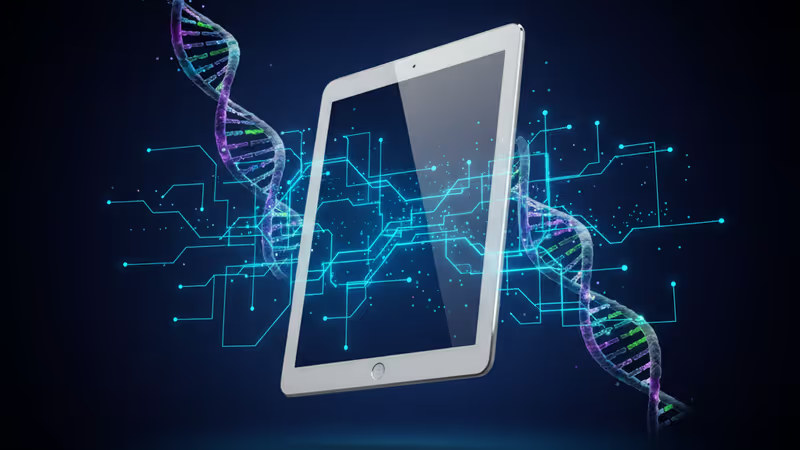
AlphaFold at 5: Google DeepMind's 'AI Co-scientist' is Now Debating Hypotheses to Simulate a Human Cell
Five years after its debut, Google DeepMind's AlphaFold is evolving from a protein structure predictor into an 'AI co-scientist.' Built on Gemini 2.0, it's generating hypotheses and tackling the grand challenge of simulating a human cell.
Is the next Nobel Prize winner going to be an AI? Five years after its debut, AlphaFold, the AI system from Google DeepMind, is graduating from predicting protein structures to becoming an 'AI co-scientist' that generates and debates its own hypotheses. It’s a transition that poses a fundamental question about the future of scientific discovery itself.
The 5-Year Journey: Charting the Protein Universe
Since its arrival in November 2020, AlphaFold has been credited with solving one of modern science's grand challenges: protein folding. Its work contributed to a Nobel Prize in Chemistry and culminated in a massive database containing over 200 million predicted structures. This resource is now used by nearly 3.5 million researchers in 190 countries. The latest version, AlphaFold 3, has expanded its capabilities to predict interactions involving DNA, RNA, and drugs.
The Rise of the AI Scientist: Gemini 2.0 Generating Hypotheses
In an interview with WIRED, Pushmeet Kohli, DeepMind's VP of research, said the next step is the 'AI co-scientist.' It's a multi-agent system built on Gemini 2.0 that acts as a virtual collaborator, designed to identify research gaps, generate hypotheses, and suggest experiments. The system works by having multiple Gemini models debate and critique each other's ideas.
Researchers at Imperial College reportedly used the system to study how certain viruses hijack bacteria, opening new paths for tackling antimicrobial resistance. "With AI helping more on the 'how' part, scientists will have more freedom to focus on the 'what'," Kohli explained, emphasizing a new partnership between humans and machines.
The Next 5-Year Goal: Simulating a Human Cell
AlphaFold's long-term goal is even more ambitious: creating the first accurate simulation of a complete human cell. "What genuinely excites me is understanding how cells function as complete systems," Kohli stated, explaining that the first step is to understand the cell's nucleus and how genetic code is read and expressed.
If successful, simulating cells could transform medicine and biology. It would allow scientists to test drug candidates computationally, understand diseases at a fundamental level, and design personalized treatments. This appears to be the bridge DeepMind is building—from computational predictions to real-world therapies that help patients.
本内容由AI根据原文进行摘要和分析。我们力求准确,但可能存在错误,建议核实原文。
相关文章
從Google到OpenAI,AI程式碼代理人能自動開發軟體、除錯。本文深入解析其核心技術LLM的運作原理、潛在風險,以及開發者如何善用這項新工具。

蘋果為實踐種族平等,斥資近3000萬美元在底特律設立開發者學院。然而高昂成本背後,畢業生就業率與前景卻引發質疑。本文深入剖析此計畫的成效、挑戰與未來。

AI購物代理掀起1兆美元商機,電商龍頭亞馬遜面臨兩難。當競爭對手如沃爾瑪、Shopify選擇合作時,亞馬遜則以封鎖及自研工具應戰。本文深入分析其防守策略與未來佈局。
AlphaFold問世五年,Google DeepMind揭示其下一步計畫:從蛋白質結構預測,到打造能提出假說的「AI科學家」,並以模擬完整人類細胞為終極目標。
從Google到OpenAI,AI程式碼代理人能自動開發軟體、除錯。本文深入解析其核心技術LLM的運作原理、潛在風險,以及開發者如何善用這項新工具。
蘋果為實踐種族平等,斥資近3000萬美元在底特律設立開發者學院。然而高昂成本背後,畢業生就業率與前景卻引發質疑。本文深入剖析此計畫的成效、挑戰與未來。
AI購物代理掀起1兆美元商機,電商龍頭亞馬遜面臨兩難。當競爭對手如沃爾瑪、Shopify選擇合作時,亞馬遜則以封鎖及自研工具應戰。本文深入分析其防守策略與未來佈局。
AlphaFold問世五年,Google DeepMind揭示其下一步計畫:從蛋白質結構預測,到打造能提出假說的「AI科學家」,並以模擬完整人類細胞為終極目標。