
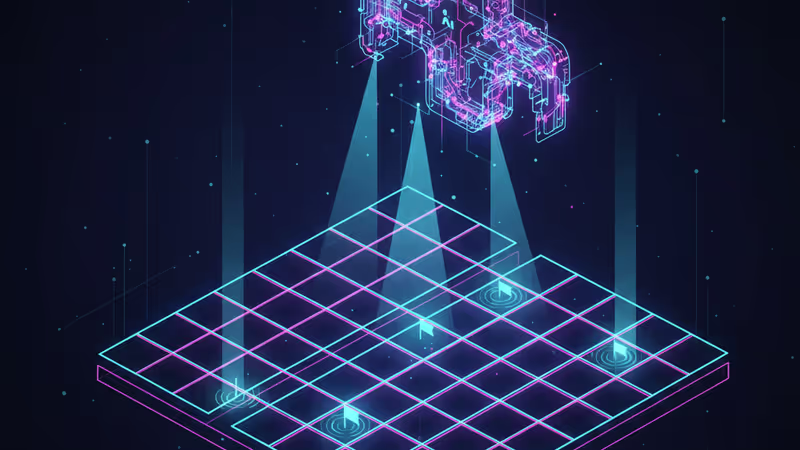
AI vs. Minesweeper: The Real Test for Autonomous Coders and the Future of Software
We tested AI on the classic game Minesweeper. Our analysis reveals the true capabilities and critical flaws of modern AI in the future of software development.
AI vs. Minesweeper: A Classic Game Reveals a Hard Truth About Software's Future
The Lede: Beyond the Hype
Forget the demos of AI agents building entire apps in minutes. The true measure of AI's readiness to revolutionize the multi-trillion-dollar software industry lies in its ability to handle mundane, logic-intensive tasks with precision. By tasking today's top AI models with recreating the classic game Minesweeper—a deceptively simple exercise in logic, state management, and user interface—we gain a clear, unhyped signal of their true capabilities. This isn't about gaming; it's a critical stress test for the future of developer productivity and the very nature of how we build technology.
Why It Matters: The Productivity Paradox
The debate over AI coding assistants is polarizing for a reason. While they promise unprecedented speed, they also introduce a new, insidious form of technical debt. An AI can generate a thousand lines of code in seconds, but a single, subtle logical flaw—like miscalculating adjacent mines in a grid—can take a human developer hours to find and fix. This creates a productivity paradox:
- Velocity vs. Veracity: Teams may move faster initially, but spend disproportionately more time on debugging and quality assurance, erasing early gains.
- The Trust Deficit: When an AI fails on a well-defined problem, it erodes developer trust, leading to abandonment of the tool or inefficient, line-by-line human oversight.
- Second-Order Effects: Widespread use of flawed AI-generated code could lead to a future where software is more brittle, less secure, and harder to maintain, impacting everything from enterprise systems to consumer apps.
The Analysis: From Autocomplete to Agent
The evolution of AI coding tools has been rapid. We've moved from syntax-aware autocomplete to generative assistants like GitHub Copilot, which excel at pattern matching and boilerplate code. The current frontier is agentic AI—systems designed to understand a goal, break it down into steps, and execute a plan. Minesweeper is the perfect crucible for testing this leap.
Unlike simply pulling existing Minesweeper clones from a training dataset, a robust test introduces a novel constraint or feature. This 'curveball' forces the AI to move beyond regurgitation and into genuine problem-solving. It's the difference between a student who memorized an essay and one who can analyze a new prompt and construct a cogent argument. Early results from these tests show that while models are becoming remarkably fluent in writing code, they still struggle with the core components of human engineering:
- System State: Consistently tracking the state of every tile (hidden, revealed, flagged) is a challenge.
- Edge Cases: Handling user clicks on the first move, or correctly clearing adjacent empty squares, often trips up the models.
- Abstract Reasoning: Implementing the 'novel curveball' requires adapting known patterns to a new problem, a hallmark of senior-level engineering that remains largely a human domain.
PRISM Insight: The Emerging 'AI-QA' Stack
The critical bottleneck for AI in software development is not code generation, but code verification. This signals a massive investment and startup opportunity in the AI Quality Assurance (AI-QA) stack. The value won't just accrue to the creators of foundation models, but to the companies that build the essential guardrails around them. Look for explosive growth in tools and platforms that specialize in:
- Automated testing of AI-generated code.
- Formal verification to mathematically prove code correctness.
- AI-powered debugging assistants that can identify and explain flaws in other AIs' code.
The future of software development isn't just an AI writing code; it's a system of AIs writing, testing, and correcting code in a continuous loop, overseen by a human architect.
PRISM's Take: The Augmented Developer is the New Reality
The era of the fully autonomous AI developer remains on the horizon. We are firmly in the age of the Augmented Developer. Today's AI models are best viewed as incredibly powerful, fast, and occasionally brilliant junior partners who require constant supervision. They can accelerate development, but cannot yet be trusted with final authority.
The most valuable engineering skill is no longer writing perfect, line-by-line code. It's the ability to provide a crystal-clear problem specification, architect a robust system, and then act as a meticulous, discerning editor for your AI partner's output. The mantra for every CTO and developer is now clear: Trust, but verify. The teams that master this human-AI collaboration will be the ones who build the future.
相关文章
AI編碼能力實測,透過經典遊戲《踩地雷》挑戰頂尖LLM。分析顯示,AI仍困於「最後一哩路」,人類開發者的價值正從寫程式轉向系統設計與AI協作。
Riot Games要求玩家更新BIOS以對抗作弊,將反作弊戰爭擴展至硬體韌體層級。這場升級的戰爭對PC遊戲的未來意味著什麼?PRISM深度解析。
LG智慧電視更新後強制安裝微軟Copilot引發爭議。這不僅是軟體問題,更是科技巨頭爭奪客廳主導權的戰爭。PRISM深度分析。
任天堂為Switch 2推出低成本卡帶,旨在解決實體收藏與發行商成本之間的矛盾。此舉將如何重塑遊戲實體市場的未來?