
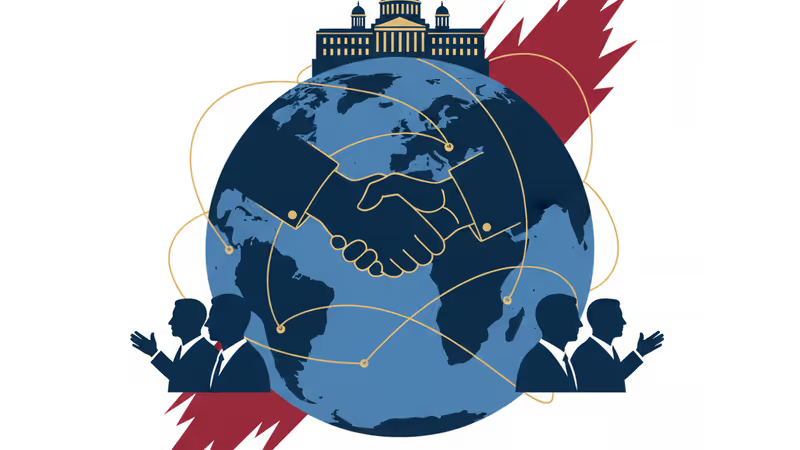
Yemen's Endgame: Houthi's UN Hostage Strategy Signals Geopolitical Defiance
The Houthi detention of UN staff in Yemen is a strategic move, challenging global order and paralyzing humanitarian aid. An analysis of the new geopolitical reality.
The Lede: Beyond the Headlines
The escalating detention of United Nations staff by Yemen's Houthi movement, now totaling 69 local personnel, is far more than a deepening humanitarian crisis. For global executives and policymakers, this is a calculated stress test of international governance and a stark signal of a new, fragmented geopolitical reality. The Houthis are not just arresting aid workers; they are deliberately crippling the international system's ability to operate within their territory, effectively holding millions of civilians and the UN itself as leverage.
Why It Matters: The Systemic Shockwaves
This systematic targeting of UN personnel triggers several critical second-order effects that extend far beyond Yemen's borders:
- Paralysis of Aid Delivery: With operations deemed "untenable," the world's worst humanitarian crisis is set to become exponentially worse. This creates a vacuum that can fuel further instability, radicalization, and mass displacement, impacting regional stability and potentially European migration patterns.
- Erosion of Diplomatic Immunity: The principle that allows international bodies to operate in conflict zones is being dismantled. This sets a dangerous precedent for other non-state actors and authoritarian regimes, signaling that UN staff and international NGO workers are now fair game, increasing risk and operational costs for all global organizations.
- A New Model of Asymmetric Leverage: The Houthis are demonstrating how a determined non-state actor can use low-cost, high-impact tactics—from detaining local staff to disrupting Red Sea shipping—to exert disproportionate influence on global powers and international institutions.
The Analysis: Yemen's Fractured chessboard
To understand this move, we must see Yemen not as a simple two-sided civil war, but as a fractured state with at least three major power blocs. The Houthis, controlling the populous northwest, are evolving from a domestic insurgency into a de facto state actor with a foreign policy. Their accusations of spying, linked to the Gaza conflict, are a political tool to legitimize their actions domestically and align themselves with Iran's regional "Axis of Resistance."
Simultaneously, the Southern Transitional Council (STC), backed by the UAE, is consolidating control in the south, further marginalizing the internationally-recognized, Saudi-backed government. The Houthi's crackdown on the UN is a power play on this complex board. By demonstrating they can render the primary international body impotent, they assert their absolute sovereignty and show potential mediators—like Oman—and rivals—like Saudi Arabia—that any future for Yemen runs through them, on their terms.
This is a direct challenge to the post-WWII framework where global bodies could, in theory, operate above local conflicts. The Houthis are rejecting this framework entirely, treating the UN not as a neutral arbiter but as an entity to be controlled or expelled.
PRISM Insight: The Decay of Global Systems & Rise of 'Geopolitical Resilience'
The crisis in Yemen is a microcosm of a larger trend: the degradation of globalized systems and the institutions that govern them. For decades, businesses and organizations have operated on the assumption of a rules-based international order, protected by norms like diplomatic immunity. That assumption is now a liability.
This signals a critical need for organizations to develop 'geopolitical resilience.' This moves beyond traditional risk management. It means building supply chains that can withstand the weaponization of trade routes, developing communication networks that are not reliant on fragile local infrastructure, and using satellite intelligence and AI-driven predictive analytics to monitor 'ungoverned spaces' where international norms no longer apply. The failure of the UN in Sanaa is a leading indicator of systemic risk for any multinational operation.
PRISM's Take: The Post-Interventionist Era
The detention of UN staff is not merely a tactic; it's a declaration that the era of uncontested humanitarian access and international oversight is over in Houthi-controlled Yemen. We are witnessing the hardening of a quasi-state that answers to no external authority. The international community's response has been limited to condemnation, revealing its lack of leverage against an actor willing to weaponize a humanitarian catastrophe.
This forces a grim recalibration. Future engagement with entities like the Houthis will be less about appealing to international law and more about hard-nosed, transactional diplomacy. For the 19.5 million Yemenis in need, this shift means the lifeline they depend on is being severed not by a lack of funds, but by a fundamental breakdown in the global consensus that made such aid possible in the first place.
관련 기사
대만이 중국의 기습 공격에 대비해 분산형 지휘체계로 전환합니다. 우크라이나 전쟁의 교훈이 대만 해협의 지정학적 구도를 어떻게 바꾸는지 분석합니다.

미국의 시리아 IS 보복 공습은 단순한 군사 작전을 넘어, 트럼프 행정부와 시리아 신정부의 새로운 협력 관계를 알리는 지정학적 변곡점입니다.
트럼프 행정부가 브라운대 총기난사 사건을 계기로 다양성 비자 추첨 프로그램을 전격 중단했습니다. 이 결정의 지정학적 파장과 미국의 미래에 미칠 영향을 심층 분석합니다.
2025년 말, 우크라이나 전쟁은 교착 상태에 빠졌습니다. 서방의 장기 지원과 푸틴의 강경 발언 속에서 종전 협상의 핵심 쟁점과 지정학적 함의를 분석합니다.