
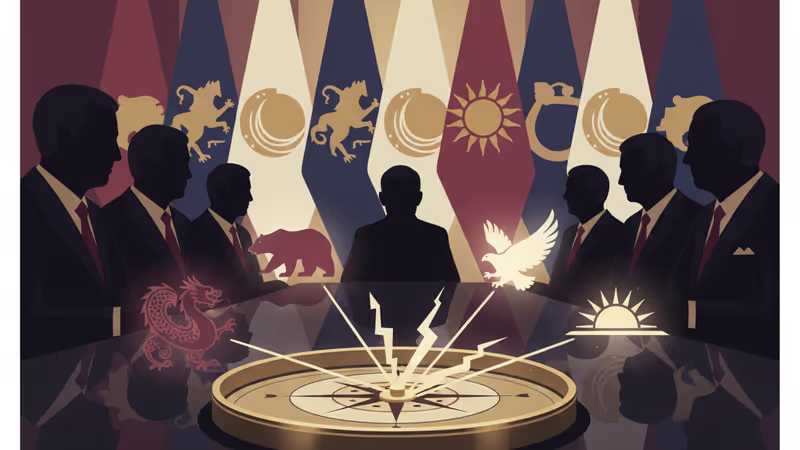
America's Global Stance on Trial: Is 'America First' Weakening the United States?
Amid fierce debate over 'America First,' US foreign policy is at a critical juncture. An analysis of the multifaceted challenges, from tensions with China to evolving alliances.
US Foreign Policy at a Crossroads
American foreign policy is undergoing a period of intense scrutiny, facing fundamental questions from allies and adversaries alike. From its tense relationship with China to its plans for Gaza and engagement in Africa, Washington's strategic direction is being challenged on multiple fronts. At the heart of this debate lies the principle of 'America First'—an approach that forces a re-evaluation of the nation's traditional role as a global leader.
Context: The 'America First' Doctrine
Popularized during the Trump administration, 'America First' prioritizes national interests and bilateral deals over multilateral agreements. This policy has reshaped America's relationships with its allies, its stance on international trade, and its approach to global conflicts, creating ripples throughout the international order.
The Central Question: A Stronger or Weaker America?
The most pressing debate is whether the 'America First' posture ultimately strengthens or weakens the United States. Proponents argue it liberates the U.S. from costly foreign entanglements and unfair trade deals, allowing it to focus on domestic prosperity. Declarations that the US economy is in a “golden age” reflect this confidence, though whether the average American agrees is a crucial domestic political question, highlighted by recent local elections that some saw as a “wake-up call.”
Critics, however, contend that this approach erodes the decades-old alliance system that has long formed the bedrock of American power and influence. An unpredictable U.S. foreign policy could push allies to seek greater strategic autonomy, potentially leaving a vacuum on the world stage that competitors are eager to fill.
The China-US Relationship: A Fragile Truce
Nowhere are the stakes of U.S. foreign policy clearer than in its relationship with China. The current dynamic is often described as being “somewhere between a ceasefire and a truce.” While direct conflict is being carefully managed, core issues—technological supremacy, trade imbalances, and Taiwan's status—remain unresolved. How the U.S. navigates its alliances will be critical in shaping a unified front in this defining geopolitical competition.
Global Hotspots and Shifting Alliances
The policy is also being tested in volatile regions. There's significant skepticism about whether the U.S. plan for Gaza can succeed, a question that directly impacts its credibility as a mediator in the Middle East. Meanwhile, traditional partners like Saudi Arabia are visibly doubling down on and recalibrating their relations with Washington, signaling a more multipolar world where nations hedge their bets.
In Africa, Rwandan President Paul Kagame's observation that he has “never seen this much attention” to ending a conflict on the continent suggests that the focus of great powers is shifting. It raises the question of whether new players are stepping in as the U.S. re-evaluates its global commitments.
PRISM Insight: Navigating a Multipolar World
The challenges facing the U.S. are not isolated incidents but symptoms of a broader shift from a unipolar to a multipolar global order. 'America First' was one response to this changing landscape, but its long-term consequences are still unfolding. Looking ahead, the U.S. faces a stark choice: continue down a path of transactional unilateralism or reinvest in the alliances and multilateral institutions that defined its post-war leadership. This decision will not only shape global politics for decades but will also determine the future of technology standards, supply chains, and the world economy.
관련 기사

프랑스 대통령 관저 엘리제궁에서 식기 책임자 등 3명이 국보급 식기를 훔친 혐의로 재판에 넘겨졌다. 이번 사건은 루브르 박물관 도난 이후 또다시 제기된 프랑스 국가 문화유산 보안 문제를 조명한다.

전라남도 나주 오리농장에서 고병원성 조류인플루엔자(AI)가 발생, 올겨울 16번째 확진 사례로 기록됐다. 방역 당국은 긴급 방역과 함께 지역 내 200여 농가에 대한 전수조사에 착수했다.
개혁신당 이준석 대표가 김건희 전 영부인과 연루된 2022년 보궐선거 공천 개입 의혹으로 12월 21일 특검에 출석해 약 10시간 동안 조사를 받았다. 이 대표는 혐의를 부인하고 있다.

스웨덴 당국이 EU 제재 대상인 러시아 화물선 '아들러호'를 조사 중이다. 엔진 고장으로 스웨덴 영해에 정박한 이 선박은 과거 무기 운송 혐의를 받은 바 있다.