
Washington's Afrikaner Gambit: Ceding Africa to China for Domestic Politics
A US-South Africa diplomatic clash over Afrikaner refugees is more than a spat. It's a strategic shift ceding influence to rivals and creating new risks.
The Lede: Why This Diplomatic Firestorm Matters to You
A diplomatic clash between Washington and Pretoria over the relocation of white Afrikaner farmers is rapidly escalating. But this is far more than a routine foreign policy dispute. For global executives and investors, this episode is a critical signal: US foreign policy is increasingly being dictated by domestic culture wars, creating profound and unpredictable geopolitical risk. The decision to antagonize a key African power like South Africa over a niche political issue demonstrates a strategic pivot that prioritizes short-term domestic messaging over long-term influence, with significant consequences for global trade, alliances, and the competitive landscape across the African continent.
Why It Matters: The Second-Order Effects
The immediate fallout—expelled envoys and harsh rhetoric—masks deeper, more structural shifts. This isn't just about diplomatic protocol; it's about the deliberate erosion of a strategic partnership, creating a vacuum that America's rivals are eager to fill.
- Heightened Political Risk: US and multinational corporations operating in South Africa and the wider region now face an unstable political environment. The threat of "severe consequences" from Washington could trigger retaliatory measures from Pretoria, impacting everything from regulatory approvals to supply chain logistics.
- Ceding Strategic Ground: By alienating South Africa—a G20 member and the continent's most industrialized economy—the US is effectively sidelining itself. This self-imposed isolation pushes key African nations closer to China and Russia, who offer partnership and investment without ideological preconditions.
- Weaponization of Humanitarian Policy: The Trump administration's focus on Afrikaner refugees, while slashing overall refugee admittances to historic lows, transforms humanitarian aid into a political tool. This selective approach undermines US credibility and signals to the world that American foreign policy is driven by an ethno-nationalist agenda, not universal values.
The Analysis: Ideology Overrides Strategy
This conflict is the culmination of a years-long campaign by the Trump administration, which has embraced a narrative of white farmer persecution in South Africa—a claim widely disputed within South Africa, including by some Afrikaner community leaders. This narrative resonates strongly with segments of the administration's political base, making it a valuable domestic talking point.
However, elevating this issue to the primary pillar of US-South Africa policy represents a profound strategic miscalculation. The Ramaphosa government has consistently refuted the claims, viewing them as a gross misrepresentation of the country's complex land reform issues and an infringement on its sovereignty. Washington’s actions, such as boycotting the Johannesburg G20 and now using improperly documented personnel for refugee processing, are seen not as diplomatic pressure but as deliberate provocation.
From Pretoria's perspective, this is a clear violation of diplomatic norms. For Washington, it appears to be a calculated decision to trade a decades-old strategic partnership for domestic political points. This transactional approach to foreign policy leaves no room for nuance or long-term alliance building, treating a regional power as a pawn in an American political game.
PRISM Insight: The Digital and Mineral Vacuum
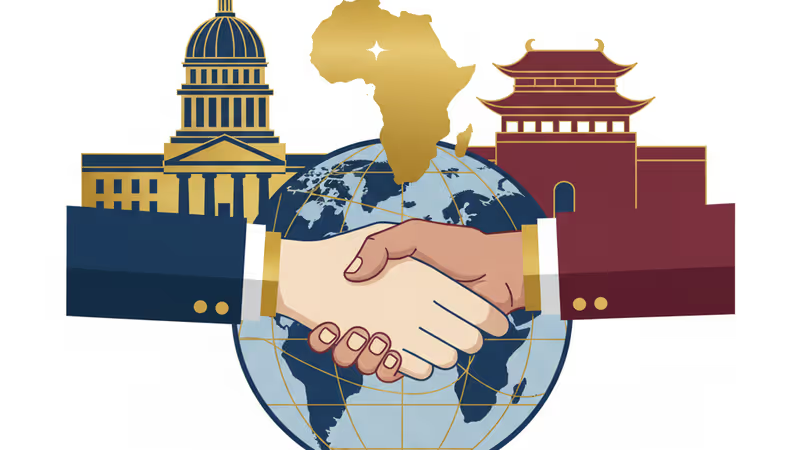
The ultimate beneficiary of this diplomatic self-immolation is Beijing. As the US creates distance, China solidifies its position as Africa's primary partner. This isn't just about building bridges and stadiums; it's about embedding Chinese technology and standards across the continent.
Expect China to accelerate its initiatives:
- Digital Silk Road: With the US seen as an unreliable and hostile partner, African nations will be more inclined to adopt Chinese-backed 5G infrastructure (like Huawei's), smart city solutions, and fintech platforms.
- Critical Minerals Access: Southern Africa is rich in minerals essential for the green energy and tech revolutions (cobalt, platinum, manganese). As the US disengages, China will lock down preferential access and long-term supply contracts, securing its dominance in the 21st-century global supply chain.
For US tech and investment firms, the playing field in one of the world's highest-growth regions is becoming increasingly tilted. Access and influence are being ceded not by market forces, but by unforced political errors made in Washington.
PRISM's Take: A Strategic Own-Goal
The confrontation with South Africa is a textbook example of ideology triumphing over interest. By sacrificing a crucial relationship for a domestic political narrative, the Trump administration is actively diminishing American influence and power. The long-term cost of this gambit is staggering: a weakened position in Africa, a strategic advantage handed to China, and a reputation as an erratic and unreliable global partner.
This is not a demonstration of strength. It is the loud, public announcement of a strategic retreat from a continent that will be central to the global economy for the next century. The consequences will be felt long after the current news cycle fades, reshaping the geopolitical map in favor of America's chief competitor.
관련 기사

반유대주의와 이슬람혐오가 어떻게 정치적 '희생양' 전략으로 사용되며, 디지털 미디어가 이를 어떻게 증폭시키는지 심층 분석합니다. 지정학적 영향과 해법을 모색합니다.

푸틴이 우크라이나 영토 양보를 압박하며 평화 협상의 공을 넘겼습니다. 미국의 중재 노력이 강화되는 가운데, 그의 발언이 갖는 지정학적 함의를 분석합니다.
미국 브라운대 총격 사건으로 수십 년간 유지된 그린카드 로터리가 중단됐습니다. 단순한 정책 변화를 넘어 미국 이민 패러다임과 글로벌 인재 전쟁에 미칠 심층적 영향을 분석합니다.

EU가 러시아 동결자산을 사용하지 않고 우크라이나에 대규모 무이자 대출을 제공합니다. 이는 단순한 원조를 넘어, EU의 전략적 자율성과 지정학적 리더십을 보여주는 결정입니다.