
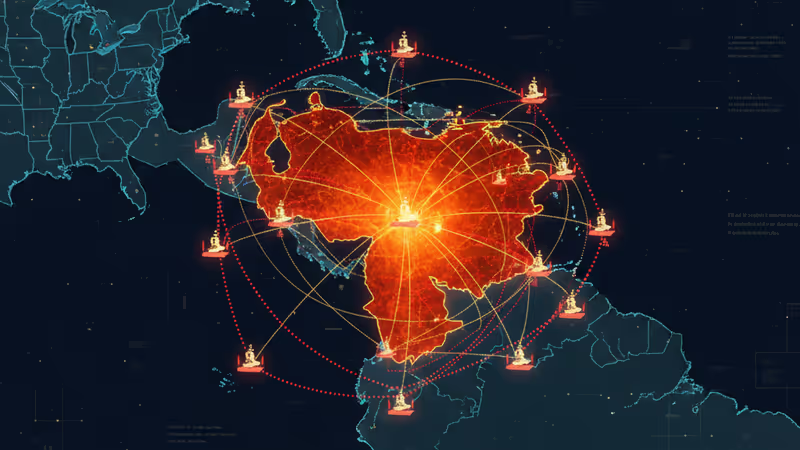
Venezuela Blockade: US Plays High-Stakes Energy Game Under Cover of Drug War
US sanctions and a naval blockade on Venezuela signal a dangerous escalation. Is this a drug war or a high-stakes resource grab for the world's largest oil reserves?
The Lede: Beyond Sanctions to a Kinetic Standoff
Washington's latest sanctions on Venezuelan officials are not the real story. The deployment of a full naval blockade and kinetic military action represents a critical escalation in a years-long pressure campaign. For global executives, this transforms a contained political crisis into a live geopolitical event with immediate, tangible impacts on energy prices, maritime security, and supply chain stability. The US is signaling a shift from economic coercion to direct physical containment, and the fallout will extend far beyond Caracas.
Why It Matters: The Second-Order Effects
The strategic implications of walling off the world's largest proven oil reserves are profound, creating systemic risk across multiple sectors:
- Energy Market Volatility: While Venezuelan production is crippled, a US-enforced blockade introduces a massive geopolitical risk premium to global oil prices. It creates a precedent for interdicting energy shipments, forcing major importers like China and India to reassess supply security and accelerate their transition to alternative energy sources.
- Maritime Choke Point: The Caribbean is a critical artery for global trade. US military operations, regardless of justification, create a high-risk zone. Expect shipping insurance premiums to skyrocket, forcing logistical rerouting and raising costs for any company operating in the Western Hemisphere.
- Geopolitical Fault Line: This action directly challenges Venezuelan allies, primarily Russia and China. Their response will define the next phase of great-power competition. We could see retaliatory measures in other global hotspots, from the South China Sea to Eastern Europe, as they test US resolve.
The Analysis: A Resource War in Disguise
Washington’s official narrative, centered on combating narco-trafficking, provides a convenient but thin veil for a much larger strategic objective: controlling the fate of Venezuela’s oil. The focus of military action—seizing tankers and blockading ports—is aimed squarely at the state's economic lifeline, not drug-running speedboats. This represents a dangerous evolution of the Monroe Doctrine for the 21st century.
Historically, US “maximum pressure” campaigns (e.g., Iran, North Korea) have relied on financial and economic strangulation. The Venezuelan strategy now integrates direct, sustained military force outside of a formal declaration of war. This hybrid model aims to collapse the Maduro regime by severing its final ties to the global economy. However, it's a high-stakes gamble. Forcing a confrontation could either trigger a swift regime change or, more likely, entrench Maduro by fueling a nationalist backlash against foreign aggression, creating a protracted and destabilizing crisis on America's doorstep.
From an international perspective, the move is deeply divisive. While some regional neighbors may quietly welcome pressure on Maduro, the precedent of a unilateral US blockade erodes principles of national sovereignty and freedom of navigation. It forces nations to choose sides, potentially fracturing regional alliances and undermining the international legal order.
PRISM Insight: The Tech-Fueled Blockade & Investment Shockwaves
This is a conflict defined by next-generation technology. The blockade's effectiveness relies on a network of satellite surveillance, AI-powered vessel tracking to defeat GPS spoofing, and unmanned aerial drones for persistent maritime patrol. It's a real-world testbed for a new era of tech-enabled economic warfare.
For investors, the implications are clear:
- Short-Term Gains: Defense contractors specializing in maritime surveillance and aerospace technology, along with oil and gas majors outside the conflict zone, stand to benefit from the induced market volatility and military spending.
- Long-Term Shift: This level of geopolitical risk makes the case for energy independence undeniable. Expect accelerated capital flows into renewable energy infrastructure, battery storage, and domestic energy production as a hedge against state-sponsored supply disruptions. The risk premium on fossil fuels has fundamentally increased.
PRISM's Take: The Point of No Return
The Trump administration has crossed a strategic Rubicon. By moving from sanctions to a blockade, it has made a peaceful, negotiated outcome in Venezuela nearly impossible. The counternarcotics justification is a diplomatic fig leaf for a full-spectrum dominance play aimed at precipitating regime collapse and asserting control over a pivotal energy asset. The core question is no longer whether the Maduro government can survive, but whether the ensuing chaos will trigger a wider regional conflict and permanently reshape the global energy landscape. Washington is betting it can manage the fallout; the world is about to find out if that bet is a wise one.
관련 기사

터닝포인트 USA의 JD 밴스 2028년 대선 후보 지지는 단순한 선언을 넘어, MAGA 운동의 미래와 공화당 내 권력 투쟁의 시작을 알리는 신호탄입니다.

2년간의 전쟁으로 폐허가 된 가자지구 대학이 다시 문을 열었습니다. 이는 단순한 수업 재개를 넘어, '교육 학살'에 맞서 미래를 지키려는 처절한 투쟁의 시작입니다.

트럼프 재선 가능성에 유럽, 아프리카 등 전 세계가 독자 생존 전략을 모색하고 있습니다. 글로벌 지정학의 거대한 전환점과 시장에 미칠 영향을 분석합니다.

이란이 이스라엘 모사드 스파이 혐의로 27세 청년을 처형했다. 이는 전쟁 이후 내부 통제를 강화하고 외부 세력에 경고를 보내는 지정학적 행보의 시작이다.