

Trump's Second Term: Why 2025 Foreign Policy Is a 'Significant Departure', Say Analysts
Analysts note a 'significant departure' in President Trump's foreign policy during the first year of his second term. PRISM explores what this 2025 strategic shift means for key global relationships with NATO and China.
The first year of President Donald Trump's second term has been marked by a foreign policy that represents a "significant departure" from his first, surprising many global observers. According to a December 22, 2025, report from NPR, analysts note that the administration's approach to international relations in 2025 has diverged in unexpected ways from the playbook seen between 2017 and 2021.
From 'America First' to a New Pragmatism?
The core of the surprise appears to stem from a recalibration of the 'America First' doctrine. While Trump's first term was defined by skepticism towards long-standing alliances like NATO and withdrawal from international agreements, the second term has shown a different, more nuanced approach. Analysts cited by news outlets suggest this could be due to a new team of advisors, a changed geopolitical landscape, or a strategic calculation that a less disruptive stance could yield better results for U.S. interests.
First-Term Flashback: Key policies from Trump's first term included withdrawing the U.S. from the Trans-Pacific Partnership (TPP) trade deal, the Paris Agreement on climate change, and the Iran nuclear deal.
Key Arenas of Change
While specific policy details are still unfolding, two areas are frequently cited as examples of this departure:
- NATO and European Alliances: Contrary to the persistent threats of withdrawal from his first term, the administration's engagement with NATO in 2025 has reportedly been more constructive, focusing on burden-sharing but within the existing framework. This has eased anxieties among European allies.
- China Relations: The focus seems to have shifted from an all-out trade war to a more selective, strategic competition. Analysts point to a potential move towards building coalitions to counter China's influence in specific technological and military domains, a departure from the broad-based tariff approach of the past.
Unpredictability Remains the Constant
Despite these shifts, observers caution that the president's transactional and often personal approach to diplomacy remains a core feature. The 'departure' may be more a change in tactics than a fundamental change in worldview. For allies and adversaries alike, the key challenge remains navigating a U.S. foreign policy that, while different from the past, is still largely unpredictable.
This evolution suggests Trump's foreign policy is less ideological and more situational. The 'America First' principle isn't being abandoned but redefined—not as isolationism, but as a form of pragmatic nationalism that will use alliances and multilateral tools when they serve a specific, transactional purpose. The surprise isn't a reversal, but an expansion of the toolkit.
본 콘텐츠는 AI가 원문 기사를 기반으로 요약 및 분석한 것입니다. 정확성을 위해 노력하지만 오류가 있을 수 있으며, 원문 확인을 권장합니다.
관련 기사

우크라이나 전장에서 서방의 첨단 무기 지원 확대와 러시아의 전술 핵무기 훈련 대응이 국제 안보 지형에 미치는 영향을 분석합니다. 지정학적 맥락, 전문가 관점, 투자 시장의 변화를 심층적으로 다룹니다.

트럼프 재선 가능성에 유럽, 아프리카 등 전 세계가 독자 생존 전략을 모색하고 있습니다. 글로벌 지정학의 거대한 전환점과 시장에 미칠 영향을 분석합니다.
블라디미르 푸틴 러시아 대통령이 '존중'을 조건으로 전쟁 종식을 언급했습니다. PRISM이 이 발언의 지정학적 함의와 서방을 향한 메시지를 심층 분석합니다.
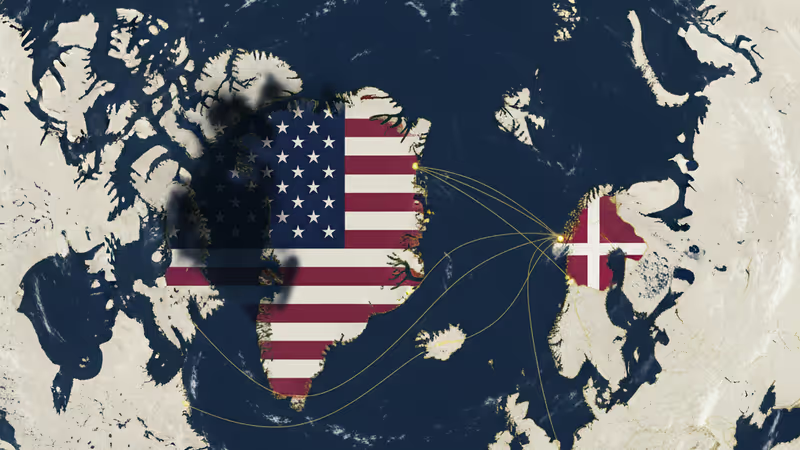
도널드 트럼프 미국 대통령이 그린란드를 '미국의 일부'로 만들겠다며 특사를 임명해 덴마크, 그린란드, EU의 강력한 반발을 사고 있다. 트럼프는 국가안보를 명분으로 내세웠다.