
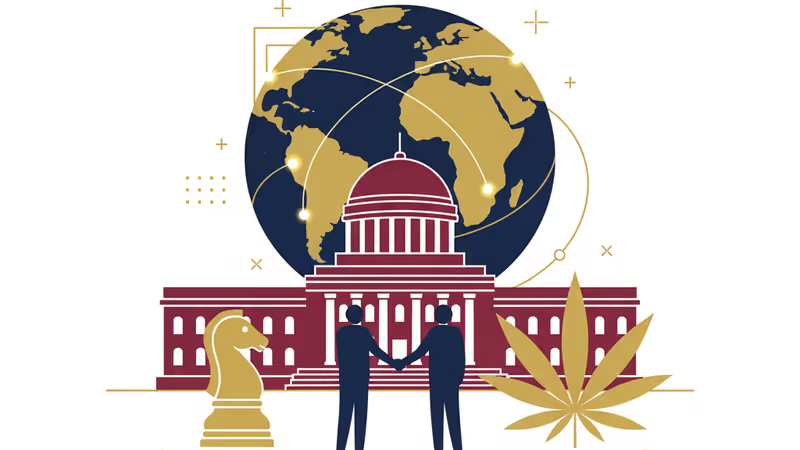
Trump's Cannabis Gambit: A Political Ploy with Trillion-Dollar Consequences
Trump's move to reclassify cannabis isn't just about drug policy. It's a calculated political gambit set to unlock Wall Street capital and reshape global markets.
Trump's Cannabis Gambit: A Political Ploy with Trillion-Dollar Consequences
The Lede: Beyond the Headlines
President Trump's expected executive order to reclassify cannabis is not a mere drug policy footnote; it's a seismic event poised to unlock billions in capital, disrupt global markets, and serve as a strategic gambit in a high-stakes election year. While headlines focus on the shift from Schedule I to Schedule III, the real story is the federal government's first major step toward legitimizing a multi-billion-dollar industry it has officially shunned for over 50 years. For global investors and policymakers, the signal is clear: the US is finally aligning federal policy with economic and social reality.
Why It Matters: The Second-Order Effects
This policy shift triggers a cascade of economic and political consequences that extend far beyond American dispensaries.
- Unlocking Wall Street: The single most critical impact is the potential nullification of IRS tax code 280E for state-legal cannabis businesses. This punitive rule currently bars them from deducting standard business expenses, crippling profitability. Reclassification would instantly normalize their finances, making them attractive to institutional investors, private equity, and mainstream banking.
- The Research Greenlight: Moving to Schedule III acknowledges accepted medical use, demolishing decades-old barriers to large-scale, FDA-approved clinical research. This invites Big Pharma, which has been cautiously observing, to enter the market through R&D, partnerships, and acquisitions.
- A Strategic Political Wedge: By using an executive order, Trump attempts to outmaneuver the Biden administration's slower regulatory process, framing himself as a decisive leader. This move is calculated to appeal to a broad coalition of voters—from libertarians and young progressives to business-minded conservatives—while forcing a difficult debate within his own party.
The Analysis: A Global Power Play
For half a century, America's “War on Drugs” and its classification of cannabis as a substance with no medical value shaped global policy through international treaties. This reclassification signals a fundamental reversal. While not full legalization, it represents the most significant pivot in US federal drug policy since the Controlled Substances Act of 1970. Trump's potential action is a direct response to the untenable friction between federal prohibition and state-level legalization, a legal paradox that has created a chaotic patchwork of regulations and stifled a major American industry.
Geopolitically, the US is playing catch-up. Nations like Canada and Germany have already established federally legal markets. This American shift will accelerate the global trend toward liberalization and create pressure to reform international drug conventions. It forces a conversation among G7 nations about how to regulate and tax a legitimate global commodity, manage international banking compliance, and establish trade standards for a product that is moving rapidly from the black market to the stock market.
PRISM Insight: The Tech & Investment Thesis
The rescheduling of cannabis is the starting gun for the industrialization of the cannabinoid economy. We anticipate three key waves of technological and investment activity:
1. Pharma & Biotech Convergence: Major pharmaceutical players will move from observation to acquisition, targeting biotech firms with promising cannabinoid-based drug discovery platforms. The focus will shift from wellness products to patented, FDA-approved therapeutics for neurology, oncology, and pain management.
2. Agri-Tech & Supply Chain Optimization: With interstate and eventually international commerce on the horizon, the race is on for scalable, consistent cultivation. Expect heavy investment in AI-driven crop management, genomic strain mapping, and blockchain-based 'seed-to-sale' tracking for regulatory compliance.
3. Fintech & Regtech Integration: The industry's biggest bottleneck—banking—will begin to ease. This creates a massive market for sophisticated fintech solutions that can handle high-risk compliance, B2B payments, and consumer transactions, finally integrating the cannabis economy into the mainstream financial system.
PRISM's Take: Pragmatism Over Ideology
This move is less a profile in courage and more a pragmatic recognition of reality. Trump's action, while clearly politically motivated, imposes a degree of federal logic on an industry operating in a legal gray zone. It is an act of regulatory arbitrage that solves a problem the bureaucracy couldn't, fitting his 'dealmaker' persona. For global observers, the key takeaway is not about the virtues of cannabis, but about the immense power of federal reclassification to legitimize an industry overnight. The 'green rush' has been a regional story for a decade; it's about to go federal, and then global.
관련 기사
예멘 후티 반군의 UN 직원 69명 억류 사태의 지정학적 함의와 인도주의 위기 심화 분석. 후티의 전략과 글로벌 파급효과를 심층 진단합니다.

이스라엘 교도소 내 팔레스타인 수감자 성고문 의혹을 심층 분석합니다. UN 경고, 지정학적 함의, 그리고 정보 전쟁의 새로운 양상을 짚어봅니다.

미 법무부의 제프리 엡스타인 파일 대량 공개. 단순한 문서 공개를 넘어, 글로벌 엘리트의 책임과 사법 시스템의 투명성을 시험하는 분수령이 될 것인가? 심층 분석.

물리적 영토를 잃은 ISIS가 어떻게 아프리카와 아시아에서 부활하고 있는가? 지정학적 공백과 신기술이 만들어낸 새로운 위협을 심층 분석합니다.