
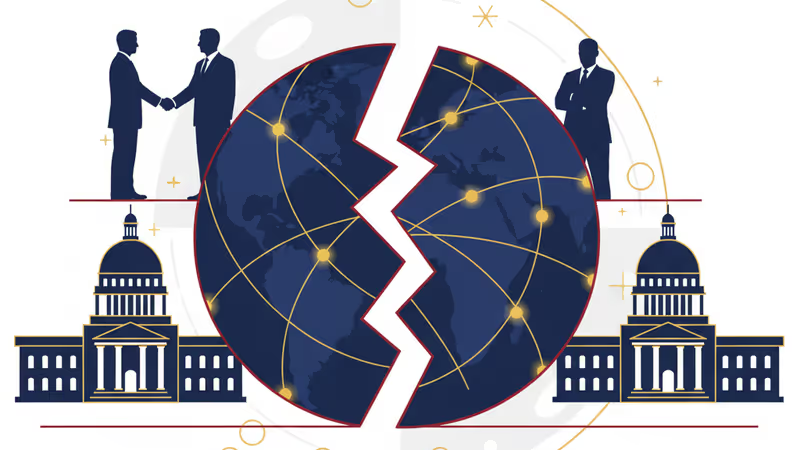
TikTok's US Sale Is More Than a Deal—It's the Blueprint for a Divided Digital World
The forced sale of TikTok's US operations sets a dangerous precedent, heralding a new era of 'data nationalism' and a fragmented global internet. Analysis.
The Lede: The Digital Iron Curtain Descends
The forced sale of TikTok's US operations to an American consortium is not merely the resolution of a corporate standoff; it is a foundational event in the fracturing of the global internet. For business leaders and policymakers, this deal is the playbook for a new era of ‘data nationalism.’ It signals that a platform's country of origin is now as critical as its technology, effectively drawing new digital borders along geopolitical fault lines. This is the moment the theoretical ‘splinternet’ becomes a practical, high-stakes reality.
Why It Matters: The Ripple Effects of a Forced Divestiture
The implications of this state-brokered deal extend far beyond one social media app, establishing precedents that will reshape the global technology landscape.
- For the Tech Industry: A chilling precedent is now set. Any foreign-owned tech company with a significant US user base—from e-commerce giants like Temu and Shein to future innovators—is now on notice. The price of market access may be corporate dismemberment. This forces a strategic rethink of global expansion, prioritizing geopolitical alignment over seamless market entry.
- For Global Business: The era of operating a single, unified global platform is ending. Businesses must now plan for a balkanized digital ecosystem where data residency, ownership structures, and even algorithms are subject to national security reviews. This introduces immense regulatory complexity and cost.
- For US-China Relations: Washington has demonstrated its willingness to use national security arguments to force the sale of a major commercial asset. Beijing will view this not as a security measure, but as strategic economic warfare. The question is not if, but how, China will retaliate against US firms like Apple, Tesla, or Qualcomm, which have deep dependencies on the Chinese market.
The Analysis: From Open Networks to Digital Blocs
This outcome is the culmination of a years-long, bipartisan pivot in US policy. What began under the Trump administration as a targeted action has now been codified into a repeatable legal framework under the Biden administration. The core argument—that an application controlled by a company based in a strategic rival's territory (like China) poses an unacceptable risk of data harvesting and propaganda—has decisively won the day in Washington.
A Tale of Two Internets
For decades, the world has operated under two competing models of internet governance:
- The Open Model: Championed by the US, it prioritized the free flow of information and commerce across borders with minimal government intervention.
- The Sovereign Model: Perfected by China, it uses tools like the ‘Great Firewall’ to exercise strict state control over the domestic digital sphere.
With the TikTok divestiture, the US has effectively created a third model: Forced Digital Localization. It doesn't block the service, but rather seizes control of its domestic operation, co-opting the platform while neutralizing the perceived foreign threat. This is a profound strategic shift. The US is no longer just defending the open internet; it is now adopting the tools of its rivals to create its own digitally-controlled sphere of influence.
From a European perspective, this represents a stark divergence from the EU’s approach. Brussels has favored regulation over divestment, using frameworks like the Digital Services Act (DSA) to govern platform behavior regardless of origin. Global tech firms are now caught between three competing philosophies: America's forced localization, China's state control, and Europe's regulatory supervision.
PRISM Insight: The Rise of the 'Geopolitical Tech Stack'
The defining tech trend emerging from this event is the 'Geopolitical Tech Stack.' Companies will no longer build one product for the world. Instead, they will be forced to engineer platforms with partitioned architectures from day one. This includes:
- Localized Codebases: Separate, auditable algorithms for different geopolitical blocs.
- Data Silos: Strict data residency protocols ensuring US user data never leaves a US-controlled environment.
- Fragmented Ownership: Complex joint ventures and country-specific corporate structures becoming the norm.
For investors, the key takeaway is the need to price in geopolitical risk as a primary factor. A company's valuation may now be capped by its ability to navigate this new, fragmented reality. The big winners will be the enablers of this fragmentation: cloud providers offering robust regional solutions (AWS, Azure, Google Cloud) and the cybersecurity firms tasked with policing these new digital borders.
PRISM's Take: The Cost of Security
The TikTok deal marks the end of an era of techno-globalization. While driven by legitimate national security concerns, the long-term cost of this strategy will be a less innovative, more fractured, and ultimately less efficient global digital economy. The internet's promise was its ability to connect humanity and collapse distance. This move, however necessary in the eyes of policymakers, deliberately rebuilds those walls in the digital realm. Global leaders must now operate under the assumption that the digital world is no longer a single, interconnected commons, but a contested territory divided into spheres of influence. The most critical question is no longer 'what can your technology do?', but 'where does your technology come from?'
관련 기사

노르웨이의 친환경 풍력발전이 원주민 사미족의 삶을 위협합니다. 기후 대응과 인권이 충돌하는 '녹색 전환의 딜레마'와 ESG 리스크를 심층 분석합니다.

미군의 태평양 해상 선박 타격으로 사망자가 100명을 넘어섰습니다. 마약 소탕을 명분으로 내세운 이 작전이 베네수엘라를 겨냥한 지정학적 압박이자 국제법을 위협하는 위험한 선례가 되는 이유를 심층 분석합니다.

EU가 900억 유로 규모의 우크라이나 지원안에 합의했습니다. 러시아 동결자산 대신 공동부채를 택한 결정의 지정학적, 경제적 함의를 심층 분석합니다.

EU가 우크라이나에 900억 유로 대출을 결정했습니다. 러시아 동결 자산 활용이 무산된 배경과 지정학적 셈법, 글로벌 금융 시장에 미칠 영향을 심층 분석합니다.