
The Virality Formula: How an 'Annoying Song' Index Reveals the Future of the Attention Economy
A new study ranking 'annoying' songs isn't just a pop culture list—it's a blueprint for engineering viral content in the age of AI and algorithms.
The Lede: Beyond the Earworm
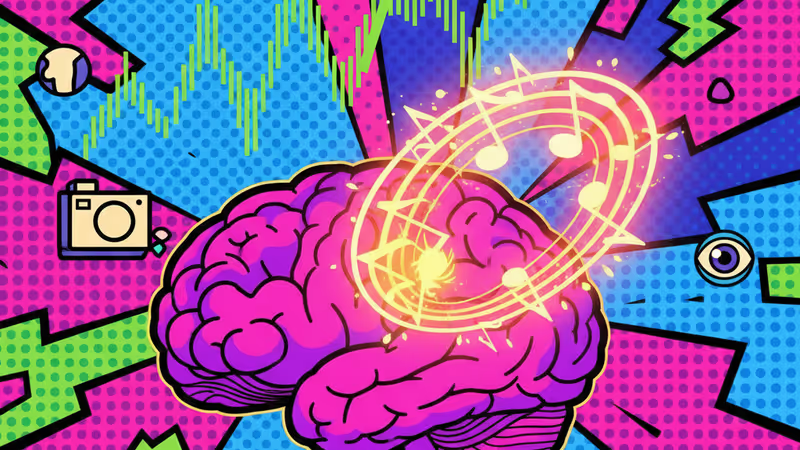
A recent study quantifying the “most annoying songs” of the year is more than just clickbait for pop culture debate. For the strategic leader, it’s a critical signal. This “annoyingness index,” which deconstructs tracks by artists like Sabrina Carpenter and Lady Gaga based on repetition, shrillness, and simplicity, isn’t just measuring taste—it’s reverse-engineering the sonic formula for hijacking human attention. This data provides a blueprint for what succeeds in an algorithm-driven, short-form video world. It’s a case study in the weaponization of sound for commercial dominance.
Why It Matters: The Algorithm is the New A&R
The implications of codifying 'annoyingness' extend far beyond Spotify playlists. This is about the fundamental shift in how creative products are developed and monetized.
- Product-Market Fit for Sound: The music industry's A&R (Artists and Repertoire) process is rapidly moving from gut-feel talent scouting to data-driven engineering. The metrics in this index—repetitive hooks, simple harmonics, lyrical filler—are the core features of a sound optimized not for a 3-minute radio single, but for a 15-second, infinitely-loopable TikTok clip. The “product” is the earworm, and the “market” is the algorithm.
- Sonic Branding Redefined: For marketers, this is a playbook. The same principles that make a song like Fanomel’s “Dame Un Grrr” both irritating and unforgettable can be applied to advertising jingles, app notification sounds, and brand anthems. The goal is no longer just brand recall; it's neural residency.
The Analysis: From Jingles to Neural Hijacking
The concept of the earworm is not new. From the earliest radio jingles to the meticulously crafted Muzak of the 20th century, brands have always understood the power of repetitive, simple audio. What has changed is the scale, speed, and feedback loop. The SeatPick study codifies what was once an art into a science.
The four key factors—repetition, shrillness, harmonic dullness, and lyrical filler—are not markers of “bad” music. They are features optimized for a specific environment. In the cacophony of a social feed, a harmonically complex song is noise. A simple, bright, repetitive loop, however, cuts through. It acts like the bells and whistles of a slot machine: designed to trigger a primal, immediate cognitive response and encourage repeat engagement. Songs like Carpenter’s “Sugar Talking” aren't just topping charts; they are winning a neuro-cognitive war for a sliver of your attention, and they are winning it by design.
PRISM Insight: The Coming Wave of Generative Audio
This 'annoyingness index' is a primitive training dataset for the next frontier: AI-driven content generation. The true investment opportunity isn't in finding the next pop star, but in the platforms that can engineer virality on demand.
Expect a surge in 'Sonic AI' startups that use psychoacoustics and machine learning to generate millions of audio clips optimized for these viral metrics. They will offer services that can create the perfect, algorithmically-favored sound for a TikTok campaign, a video game reward, or a brand's sonic logo. The aural landscape of our digital world will be increasingly populated by sounds not composed by humans for emotional resonance, but generated by machines for maximum cognitive stickiness. This is the future of sonic UX, and it will be ruthlessly efficient.
PRISM's Take: Annoying is a Feature, Not a Bug
It’s easy to dismiss this study as a frivolous ranking of pop songs. That is a strategic error. The data reveals that in the modern attention economy, the line between “catchy” and “annoying” has collapsed into irrelevance. The only metric that matters is memorability and shareability.
The artists topping these lists, whether intentionally or not, are masters of algorithmic appeasement. Their music is a near-perfectly engineered product for the dominant distribution channel of our era. To call it “annoying” is to miss the point entirely. It is a testament to its brutal effectiveness. This isn't just the sound of modern music; it's the sound of attention itself being quantified, packaged, and sold.
관련 기사
SNS 속 완벽한 케이크와 웃픈 실패작. 이 밈 현상은 단순한 유머를 넘어, 디지털 시대의 기대치 인플레이션과 정신 건강에 대한 중요한 질문을 던집니다.

사소해 보이는 디자인 실패가 브랜드 충성도를 파괴하고 기업의 미래를 위협합니다. 자동차 터치스크린부터 떼기 힘든 스티커까지, UX 재앙의 진짜 의미를 분석합니다.
대퇴사 시대, '남의 직장' 사진 열풍은 단순한 구경거리가 아닙니다. 일의 경험화, 직업의 콘텐츠화라는 미래 트렌드를 분석합니다.
레딧에서 화제가 된 중고 쇼핑(쓰리프팅) 열풍. 단순한 절약을 넘어 지속가능성, 개성 표현, 새로운 리커머스 시장의 부상을 분석합니다.