
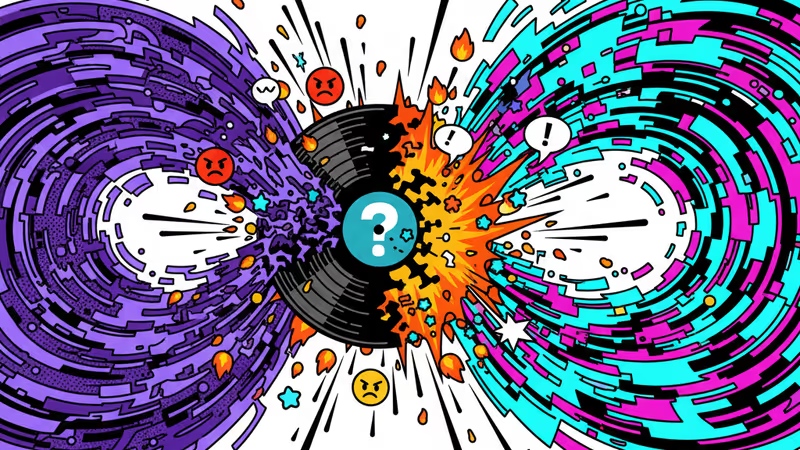
The 'Secret Song' Theory: How a Single Indie Track Ignited a Firestorm Between BTS and aespa Fandoms
A deep dive into how a single indie song fueled massive dating rumors between BTS's Jungkook and aespa's Winter, and what it reveals about K-pop fan culture.
The Internet's Newest Obsession: Decoding Jungkook and Winter's Playlist
In the hyper-analyzed world of K-pop, silence is rarely just silence—and a coincidence is never just a coincidence. That's the lesson learned this week as a dating rumor between two of the industry's biggest stars, BTS’s Jungkook and aespa’s Winter, erupted from a simmer to a boil over one seemingly innocent song choice, leaving fandoms in a state of frustrated chaos.
What Just Happened? The Timeline of a Viral Theory
For weeks, online forums have been buzzing with whispers of a potential romance. But the theory remained in the realm of fan fiction until two key events, just ten days apart, provided what speculators are calling undeniable 'receipts'.
- December 6: During a fan signing event, aespa's Winter is asked what song she’d like to sing. Her choice? "Till The End Of Time" by The Black Skirts, a beloved but relatively non-mainstream Korean indie-rock band.
- December 15: During a livestream, BTS's Jungkook spontaneously plays the exact same song for his millions of viewers.
The connection was made almost instantly. For fans already on high alert, this wasn't a coincidence; it was a signal. The fact that the song isn't a chart-topping hit made the link feel more deliberate, more intimate—and for many, more infuriating. With both idols' agencies, HYBE and SM Entertainment, maintaining a strict 'no comment' policy, the information vacuum has been filled by a tidal wave of fan debate.
The Best Reactions: A Fandom Divided
The digital fallout has been a masterclass in modern fan culture, splitting communities into detectives, defenders, and the deeply annoyed. Here’s a curated look at the conversation blowing up online.
The Digital Detectives 🕵️
This camp is treating the situation like a true-crime podcast, connecting dots with forensic precision.
"The song isn't the point. It's the TIMING. He waited just long enough for her comment to be public but not so long that it was forgotten. This is calculated." — A popular fan forum comment.
"Okay, but The Black Skirts' lyrics are all about fated love and finding your one person. If you're going to send a message, this is how you do it. Poetic and deniable." — A widely shared tweet analysis.
The Frustrated Fans 😤
For many, the issue isn't the potential relationship, but the perceived public teasing, which they see as disrespectful to the fans who support their careers.
"If you're going to date, just date. Why play these games? It feels like they're making a joke out of the fans who pay their bills. It's just annoying." — A sentiment echoed across multiple platforms.
"Can they just not be idols for five minutes? This 'lovestagram' culture is exhausting. We're here for the music, not to play detective in their personal lives." — An exasperated user on social media.
The Defenders & Skeptics 🤔
This group is urging caution, calling the entire theory a massive reach built on nothing but coincidence.
"It's a good song. Is it illegal for two people to have good taste? Everyone needs to log off and touch some grass. This is getting insane." — A top reply to a speculative thread.
"Blaming them for 'fueling' rumors is ridiculous. They can't censor their entire lives and music tastes because a few fans might connect imaginary dots. Let them live." — A user defending the idols' freedom.
Cultural Context: Why This Is More Than Just a Rumor
To an outsider, this might seem like a storm in a teacup. But in the world of K-pop, it touches on a few deep-seated cultural dynamics.
First is the concept of the 'Lovestagram'—a term for fans scrutinizing idols' social media for subtle hints of a relationship, like matching accessories or visiting the same café. This song-sharing incident is a textbook example, elevated to a new level due to the artists' global profiles.
Second, it highlights the complex parasocial relationship between idols and fans. In an industry where idols are marketed as accessible and devoted to their fanbase, public dating can feel like a breach of that unspoken contract to some, leading to feelings of betrayal or frustration.
Finally, the agencies' silence is a strategic, if risky, move. A denial can add fuel to the fire ('they're just trying to cover it up!'), but silence creates a void that fans will fill with their own, often more dramatic, narratives.
PRISM Insight: The Anatomy of a K-Pop Conspiracy
This incident is a perfect case study in the mechanics of modern digital folklore. It's not just about a rumor; it's about how a narrative is constructed and propagated in real-time by a global, decentralized community. The 'secret song' theory went viral because it had the perfect ingredients: A-list subjects, concrete 'evidence' (the song choices), a distribution network (social media), and a crucial information vacuum (agency silence).
What makes this moment unique is the nature of the fan frustration. The anger isn't solely directed at the possibility of a relationship, but at the perceived gamification of that relationship. By dropping hints that are subtle enough to be denied but obvious enough to be found, it can feel to some fans like they are being played with—turned from supporters into unwilling participants in a public scavenger hunt. Whether intentional or not, this dynamic blurs the line between a private life and public performance, and it's a tension at the very heart of 21st-century celebrity culture.
관련 기사
BTS 정국의 인스타그램 셀카 한 장이 전 세계 K팝 팬덤을 뒤흔들었습니다. 단순한 사진이 아닌, '에스파화' 밈과 4세대 아이돌 문화의 상징이 된 이유를 분석합니다.
욕설이 통증을 줄이고 근력을 향상시킨다는 사실을 아시나요? 과학적 원리와 헬스, 바이오해킹에 미칠 영향을 심층 분석합니다.
라이프 해킹 열풍의 의미는? 바나나 껍질 까는 법부터 호흡법까지, 일상을 최적화하려는 트렌드가 만드는 새로운 비즈니스 기회와 기술의 미래를 분석합니다.
디즈니가 팝펑크, 컨트리 등 다양한 장르의 커버 앨범을 내는 이유. 단순한 리메이크를 넘어 IP의 생명을 연장하는 디즈니의 비즈니스 전략을 분석합니다.