
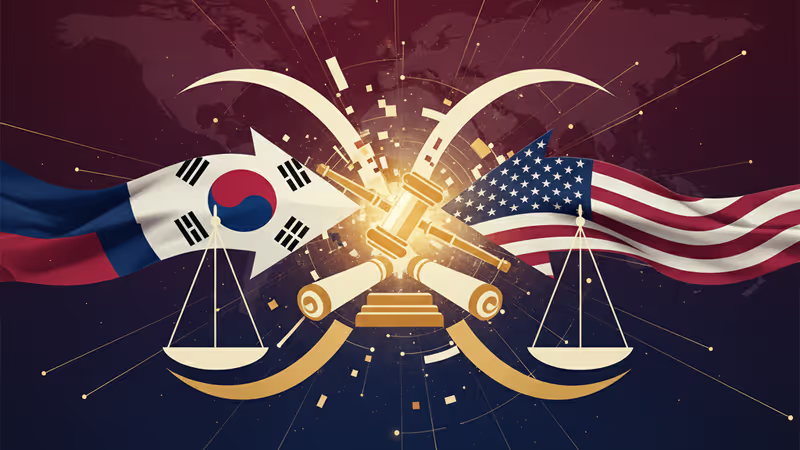
Seoul's Two Voices: Internal Rift Deepens Over North Korea Policy in Lee Jae-myung's Government
President Lee Jae-myung's backing of the Unification Ministry's role in North Korea policy is fueling a conflict between 'self-reliance' and 'pro-alliance' factions within Seoul, with major implications for the U.S. alliance amid growing U.S.-China tensions.
One hand reaffirms the U.S. alliance while the other pushes for autonomy. President Lee Jae-myung's recent endorsement of the Ministry of Unification has exposed a deep-seated rift within South Korea's foreign policy establishment, pitting the 'self-reliance faction' (Ja-Ju-Pa) against the 'pro-alliance camp' (Dong-Maeng-Pa). Amid intensifying U.S.-China strategic competition, the internal disarray over Seoul's diplomatic direction appears to be growing.
President Backs Unification Ministry, Sidelines Foreign Ministry
The conflict came to a head on December 19 at a joint policy briefing in Seoul. President Lee stated, "South Korea must act with patience and do its utmost to reduce hostility between the two Koreas," adding that this role "is one the Ministry of Unification must play." The remarks were widely seen as handing the reins of North Korea policy to the 'self-reliance faction' centered around the ministry.
This followed an incident that highlighted the interministerial friction. On December 16, Vice Minister for Diplomatic Strategy and Intelligence Jeong Yeon-doo met with acting U.S. Ambassador Kevin Kim to coordinate North Korea policy, but the Unification Ministry declined to participate. Instead, it held a separate policy briefing for foreign diplomats, a move that reportedly surprised and dismayed some U.S. officials.
Déjà Vu: A Two-Decade Conflict Revived
The discord between the self-reliance and pro-alliance factions is not new, dating back to the Roh Moo-hyun administration (2003-08). At that time, a progressive, pro-autonomy faction centered around the National Security Council (NSC) and Unification Ministry clashed with a conservative, pro-alliance faction led by the Foreign Ministry and Defense Ministry. In a striking echo of the past, key figures from that era are back in power: Lee Jong-seok, a central figure of the self-reliance camp, now heads the National Intelligence Service, while Wi Sung-lac of the pro-alliance camp is the National Security Adviser.
Then, as now, the core disagreement was the approach to Pyongyang. The pro-autonomy faction argued that improving inter-Korean relations would advance denuclearization, while the pro-alliance camp insisted that sanctions and pressure were necessary to bring North Korea to the table. Today, Unification Minister Chung Dong-young and Foreign Minister Cho Hyun are seen as representing these opposing views.
High Stakes Amid External Pressures
This internal division comes at a particularly sensitive time, as President Lee recently declared that South Korea can no longer rely on its traditional "security with the U.S., economy with China" policy, known as "Ahn Mi-kyung-joong." The declaration followed a stark warning from U.S. Secretary of Defense Pete Hegseth at the Shangri-La Dialogue on May 31, where he cautioned countries against pursuing economic ties with China and defense cooperation with the United States simultaneously. As Washington's pressure mounts, a divided message from Seoul risks undermining the credibility of its foreign policy.
본 콘텐츠는 AI가 원문 기사를 기반으로 요약 및 분석한 것입니다. 정확성을 위해 노력하지만 오류가 있을 수 있으며, 원문 확인을 권장합니다.
관련 기사

북한 김정은 위원장이 남한의 핵잠수함 계획을 비판하며 8,700톤급 신형 핵추진 잠수함 건조 현장을 공개했다. 이는 한반도와 동북아의 군비 경쟁을 심화시킬 수 있다.

조선중앙통신(KCNA) 보도에 따르면 김정은 위원장이 핵추진 잠수함 건조 현장을 시찰했다. 이 주장이 사실일 경우, 북한의 핵전력 고도화와 함께 동북아 안보 지형에 중대한 변화가 예상된다.
방글라데시 제1야당 BNP가 17년간 망명 생활을 한 타리크 라만 대표 대행의 귀환을 앞두고 최대 500만 명 규모의 환영 행사를 준비 중이다. 그의 귀국은 2월 총선을 앞두고 방글라데시 정국의 중대 변수가 될 전망이다.
도널드 트럼프 미국 대통령의 지지를 받은 나스리 아스푸라 후보가 온두라스 대선에서 0.8%p 차이로 신승했다. 개표 지연과 부정선거 논란 속에 정치적 갈등이 격화되고 있다.
북한 김정은 위원장이 남한의 핵잠수함 계획을 비판하며 8,700톤급 신형 핵추진 잠수함 건조 현장을 공개했다. 이는 한반도와 동북아의 군비 경쟁을 심화시킬 수 있다.
조선중앙통신(KCNA) 보도에 따르면 김정은 위원장이 핵추진 잠수함 건조 현장을 시찰했다. 이 주장이 사실일 경우, 북한의 핵전력 고도화와 함께 동북아 안보 지형에 중대한 변화가 예상된다.
방글라데시 제1야당 BNP가 17년간 망명 생활을 한 타리크 라만 대표 대행의 귀환을 앞두고 최대 500만 명 규모의 환영 행사를 준비 중이다. 그의 귀국은 2월 총선을 앞두고 방글라데시 정국의 중대 변수가 될 전망이다.
도널드 트럼프 미국 대통령의 지지를 받은 나스리 아스푸라 후보가 온두라스 대선에서 0.8%p 차이로 신승했다. 개표 지연과 부정선거 논란 속에 정치적 갈등이 격화되고 있다.