
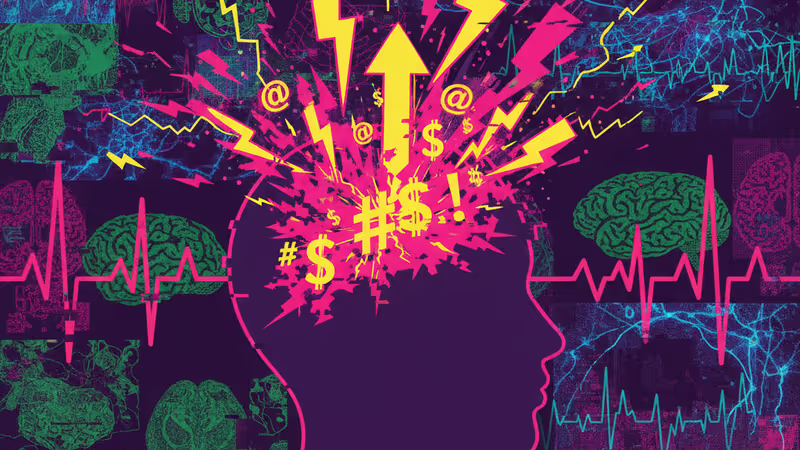
The Profanity Protocol: How Swearing Is a Biohack for Peak Performance
Science confirms swearing boosts strength. PRISM analyzes why this matters for biohacking, AI, and the future of human performance technology.
The Lede: This Isn't About Rudeness, It's About Root Access
Forget nootropics and expensive wearables for a moment. New research confirms a startlingly low-tech method for boosting physical output: swearing. While it seems trivial, for any leader obsessed with human potential, this is a critical insight. It demonstrates that the human brain has a built-in, voice-activated 'override mode' that bypasses our standard cognitive governors. Understanding this 'profanity protocol' is less about foul language and more about unlocking the latent capabilities hardwired into our own biology.
Why It Matters: From the Gym to the UI
The immediate implications are clear for sports and physical training, but the second-order effects are where the real value lies. This isn't just a quirk of psychology; it's a blueprint for designing more effective human-machine interfaces and performance-enhancement systems.
- The 'Activated' Self: The fitness tech industry is moving beyond passive tracking (Quantified Self) toward active intervention (Activated Self). Imagine a Peloton or Tonal workout that strategically prompts for a 'primal yell' or a 'power word' during a peak effort. This research provides the neurological basis for turning catharsis into a measurable performance feature.
- Affective Computing: This finding is a goldmine for developers of AI and voice assistants. A system that recognizes the user's frustration (e.g., swearing at a non-responsive UI) could interpret it not just as negative sentiment, but as a cue that the user is in a state of high cognitive load and requires a different, more direct intervention. Swearing becomes a valuable data point for adaptive interfaces.
- Corporate Training & Simulation: High-stress training simulations for surgeons, pilots, or financial traders could incorporate this understanding. Allowing for, and even analyzing, these emotional, verbal releases could provide deeper insights into an individual's stress response and decision-making under extreme pressure.
The Analysis: Bypassing the Prefrontal Gatekeeper
Historically, human development has been a story of the prefrontal cortex—our brain's CEO—gaining control over the older, more reactive limbic system. Social norms, politeness, and long-term planning are all executive functions. Swearing, it turns out, is a temporary coup. It's a limbic-driven vocalization that short-circuits the prefrontal cortex's constant social filtering.
This creates a state of 'transient hypofrontality'—a brief dialing-down of the analytical brain—which reduces inhibition and pain perception. In a competitive landscape where companies spend billions on incremental gains through technology, this research highlights a powerful, organic, and entirely free performance enhancer. The true competition isn't between two athletes, but between an individual's potential and the self-imposed neurological limits they operate under. Swearing is simply a key to momentarily unlock that governor.
PRISM Insight: Invest in Emotional Bandwidth
The key tech trend this illuminates is the move toward systems with greater 'emotional bandwidth.' For decades, we've communicated with machines through rigid, logical commands. This research proves the power of the illogical, the emotional, the primal. The next frontier for AI, robotics, and software isn't just about understanding the words we say, but the psycho-emotional state from which they originate.
Investment should focus on technologies that facilitate this—advanced voice analysis that detects stress, frustration, and determination, not just phonemes. Look to startups building empathetic AI companions, next-gen mental wellness platforms, and bio-integrated feedback systems. The ROI is in creating technology that partners with the whole human, not just the polite, logical part we present to the world.
PRISM's Take: Make Swearing a Feature, Not a Bug
The notion of cursing to get stronger feels like a joke, but it's a profound demonstration of the mind-body connection. It reveals that our brains are programmed with legacy 'cheats' that can be activated under specific conditions. The biggest takeaway is that peak human performance isn't always achieved through calm, deliberate, and logical effort. Sometimes, it's unlocked by a raw, unfiltered emotional surge.
For the innovators building our future, the lesson is clear: stop designing for the idealized, perfectly rational user. The most robust and effective systems of the future will be those that understand and even leverage the full, messy, and occasionally profane spectrum of human experience. The day you can curse at your smart-home device and have it respond with, "Understood. Engaging maximum effort mode," will be the day our technology truly starts to understand us.
관련 기사

도쿄에서 발생한 일가족 사망 사건의 이면을 분석합니다. 단순한 비극을 넘어 일본 사회의 고립된 육아, 정신 건강 위기 등 구조적 문제를 심층 진단합니다.

보스턴 블루 미드시즌 피날레의 충격적인 결말을 깊이 분석합니다. 실버 가문의 붕괴가 단순한 플롯 트위스트를 넘어 우리 사회의 정의와 미디어 산업에 던지는 의미를 파헤칩니다.
저스틴 비버와 헤일리 비버의 평범한 데이트 사진 한 장에 숨겨진 고도의 PR 전략과 수백만 달러 가치의 브랜드 제국에 대한 심층 분석.
기후 변화 시대, AI 기상 예측이 연말 여행의 성패를 좌우합니다. 단순 날씨 확인을 넘어, 터뷸런스 예측, 도로 결빙 분석 등 '웨더 테크'를 활용한 생존 전략을 분석합니다.