
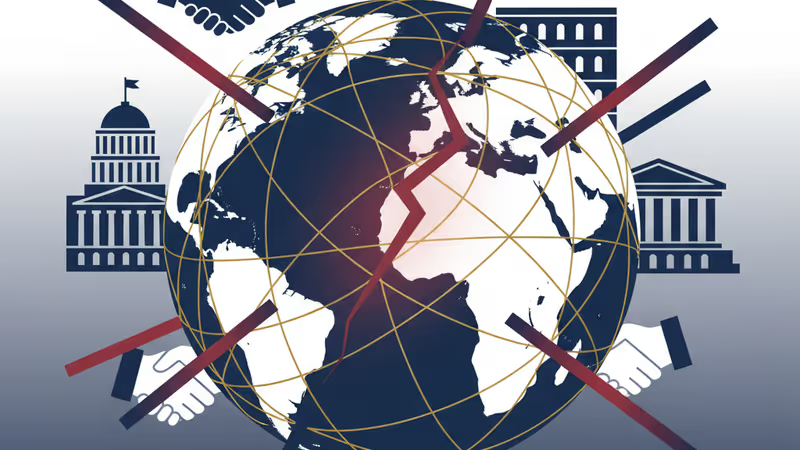
The Pretext Doctrine: How One Tragedy Is Fueling a War on U.S. Global Talent
PRISM analyzes how the Brown University shooting is being used by the Trump administration to dismantle the diversity visa, signaling a major shift in U.S. policy.
The Lede: A Policy Triggered
In the aftermath of a tragic shooting at Brown University, the Trump administration has moved to dismantle the U.S. Diversity Visa Lottery, citing the attacker's entry through the program. For global executives and strategists, this is more than a security response; it's the crystallization of the 'Pretext Doctrine'—a predictable pattern where isolated, high-profile incidents are leveraged to enact sweeping, pre-planned changes to U.S. immigration policy. This creates a new level of strategic uncertainty for global talent, investment, and diplomacy.
Why It Matters: The Ripple Effects of a Closing Door
The immediate suspension of a 35-year-old immigration program has second-order effects that extend far beyond border control. This is not about the 55,000 visas annually; it's about the signals being sent to the world.
- Global Talent Pool Shrinks: The move telegraphs a message of unpredictability to the world's best and brightest. For tech firms, research universities, and innovative industries reliant on foreign talent, this escalates the risk of basing critical human capital in the U.S.
- Diplomatic Friction Points: The diversity visa has been a key, if small, pillar of U.S. soft power, particularly in African and Eastern European nations. Its removal will be viewed as a slight, potentially straining relationships and pushing these nations to seek stronger ties with competitors like China.
- Policy by Crisis Becomes Norm: By linking a specific crime to a broad immigration category, the administration normalizes a reactive and volatile approach to policymaking. This makes long-term planning for any U.S.-based international operation inherently more difficult.
The Analysis: From Bipartisan Bridge to Political Wedge
The Diversity Visa program was created by the bipartisan Immigration Act of 1990 to diversify the pool of immigrants beyond the handful of countries that dominated U.S. immigration. Its function was to strengthen cultural and economic ties with a wider array of nations. For three decades, it stood as a symbol of America's unique global appeal.
The Trump administration, both in its first and current term, has reframed the program's purpose from 'diversity' to 'randomness,' arguing it allows entry without prioritizing skills or security. The Brown University tragedy provided the perfect catalyst to act on this long-held ideological opposition. While the administration frames the shutdown as a necessary national security measure, critics, including the American Immigration Council, argue it's a convenient pretext to advance a broader, more restrictive immigration agenda. This playbook was seen just a month prior, when an attack by an Afghan national was used to justify a halt on all Afghan immigration applications and an expansion of the travel ban.
From a global viewpoint, this tactic is seen as a deliberate pivot. Instead of debating the merits of an entire immigration system, the debate is narrowed to a single, emotionally charged event, making nuanced opposition difficult. For allies and adversaries alike, it signals that any U.S. immigration pathway can be abruptly severed based on the actions of one individual.
PRISM Insight: The 'Digital Wall' and Capital Flight
This policy shift has profound implications for the tech and investment landscape. The political move to restrict physical entry is mirrored by a rush to build a 'digital wall.' Expect accelerated investment and government contracts for technologies focused on:
- Algorithmic Vetting: AI-driven systems to screen visa applicants based on massive datasets, including social media, with inherent risks of bias.
- Biometric Tracking: Expanded use of biometrics for all non-citizens within the U.S.
For investors, the key takeaway is rising 'sovereign risk' for talent. Venture capital and private equity will increasingly view founders on temporary visas as a liability. This will make countries with stable, points-based immigration systems like Canada, the UK, and Australia more attractive hubs for innovation, potentially siphoning both talent and capital away from Silicon Valley.
PRISM's Take: Strategy in an Age of Unpredictability
The suspension of the Diversity Visa program is a textbook example of the Pretext Doctrine in action. It is a highly effective political maneuver that uses public fear following a tragedy to implement a long-desired ideological goal. It is less a reflection of a specific security failure than a fundamental reshaping of America's posture toward the world—from one of global attraction to one of nationalist defense.
For business leaders and policymakers, the lesson is clear: U.S. policy in this era is not just subject to change, but is designed to be volatile. The 'black swan' event involving a foreign national has become a predictable trigger for sweeping policy change. The strategic imperative is no longer just to navigate the U.S. system, but to build global talent pipelines and operational contingencies that are resilient to its increasing unpredictability.
관련 기사

대만이 중국의 기습 공격에 대비해 분산형 지휘체계로 전환합니다. 우크라이나 전쟁의 교훈이 대만 해협의 지정학적 구도를 어떻게 바꾸는지 분석합니다.

미국의 시리아 IS 보복 공습은 단순한 군사 작전을 넘어, 트럼프 행정부와 시리아 신정부의 새로운 협력 관계를 알리는 지정학적 변곡점입니다.

트럼프 행정부가 브라운대 총기난사 사건을 계기로 다양성 비자 추첨 프로그램을 전격 중단했습니다. 이 결정의 지정학적 파장과 미국의 미래에 미칠 영향을 심층 분석합니다.

2025년 말, 우크라이나 전쟁은 교착 상태에 빠졌습니다. 서방의 장기 지원과 푸틴의 강경 발언 속에서 종전 협상의 핵심 쟁점과 지정학적 함의를 분석합니다.