
The Miami Gambit: Why the Next Phase of Middle East Diplomacy Is Happening in Florida
US-led talks on the Gaza deal move to Miami, involving Qatar, Egypt, and Turkiye. PRISM analyzes the geopolitical and economic implications of this tactical shift.
The Lede: A High-Stakes Meeting Far From Home
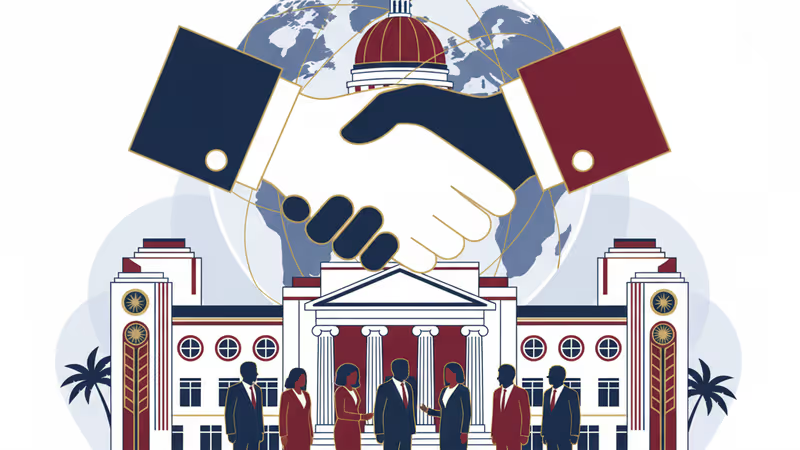
While the world's attention remains fixed on the battlegrounds of the Middle East, the next critical move in the high-stakes diplomatic chess game is quietly unfolding in an unexpected arena: Miami. US envoy Steve Witkoff is convening senior officials from Qatar, Egypt, and Turkiye not in a traditional capital like Doha or Cairo, but in a Florida conference room. For global executives and investors, this is more than a geographical curiosity. It signals a tactical reset in a conflict that directly impacts global supply chains, energy markets, and international stability. Understanding this shift is critical to anticipating the next wave of geopolitical risk and opportunity.
Why It Matters: The Global Ripple Effect
A meeting in Miami may seem distant from the core of the conflict, but its outcome has direct, tangible consequences for the global economy. The second-order effects extend far beyond the region:
- Supply Chain Stability: The conflict's expansion into the Red Sea has forced major shipping lines to reroute around Africa, increasing costs and transit times. A breakthrough in these talks could be the first step toward de-escalating maritime tensions and stabilizing a critical artery of global trade. Failure means continued disruption and inflationary pressure.
- Energy Market Volatility: The Middle East's stability is inextricably linked to global energy prices. Diplomatic progress can calm jittery oil markets, while a breakdown could fuel speculation and price spikes, impacting everything from transport costs to manufacturing.
- Geopolitical Realignment: The inclusion of Turkiye alongside established mediators Qatar and Egypt is a significant development. It acknowledges Ankara’s influence with key parties and showcases a pragmatic US approach to leveraging a wider network of intermediaries. This subtly redraws the map of regional power brokers.
The Analysis: Deconstructing the 'Miami Gambit'
The decision to host these delicate negotiations in Miami is a calculated one, reflecting a multi-layered strategy aimed at breaking a persistent deadlock. Three factors are at play:
A Neutral, Controlled Environment
By moving the talks thousands of miles from the Middle East, the US is attempting to insulate negotiators from the intense domestic political pressures and media scrutiny of their home capitals. A neutral venue like Miami can foster more candid, less performative discussions, creating a space where difficult compromises can be explored away from the public glare. It is a classic diplomatic tactic to change the environment to change the dynamic.
Shifting the Power Dynamic
Hosting on US soil subtly reasserts American leadership in the mediation process. While Qatar and Egypt have been indispensable interlocutors, this move brings the process firmly onto the US's home turf. It may also be a pragmatic choice tied to the envoy, real estate developer Steve Witkoff, leveraging his own base of operations to drive a more business-like, results-oriented negotiation style.
Broadening the Coalition of Mediators
The formal inclusion of Turkiye is a key strategic shift. While Qatar holds financial leverage and hosts Hamas's political office, and Egypt controls the critical Rafah border crossing, Turkiye offers a different channel of influence and communication. This multi-pronged approach signals that Washington is willing to engage a diverse set of regional powers, even those with whom it has complex relationships, to achieve a breakthrough.
PRISM Insight: The Investment & Tech Angle
The outcome of these talks will create clear winners and losers in specific technology and investment sectors. A lasting ceasefire would pivot market focus from conflict to reconstruction. This opens up massive opportunities in infrastructure technology, including smart city planning, 5G network deployment, and resilient energy grids. Conversely, a continued stalemate will fuel further investment in defense technology, particularly in AI-driven surveillance, drone/counter-drone systems, and cybersecurity for critical infrastructure. For global corporations, the volatility underscores the growing necessity of AI-powered geopolitical risk platforms to model supply chain vulnerabilities and forecast market shocks with greater accuracy.
PRISM's Take: A Change of Scenery Isn't a Change of Facts
The 'Miami Gambit' is a shrewd attempt by the US to reset the diplomatic chessboard. Changing the venue, widening the circle of mediators, and altering the negotiation dynamics are all logical steps to break the current impasse. It is a signal that traditional methods have stalled and fresh thinking is required.
However, a change of scenery does not erase the fundamental, deep-seated disagreements between the primary combatants. The success of this initiative will depend entirely on whether the core political positions have evolved. The true test is not whether a deal can be brokered in the quiet of a Miami hotel, but whether it can survive contact with the harsh political realities in the Middle East. For global leaders, the key indicator will be the substance of any announcement. Vague commitments signal a fragile truce, while a detailed, phased plan could mark a genuine turning point for the region and the global economy.
관련 기사

우크라이나 쿠피안스크 전투는 단순한 영토 분쟁이 아니다. 러시아의 공식 발표와 전장의 현실이 충돌하며, 정보 전쟁의 새로운 국면을 보여준다.
싱가포르 해협에 출몰한 '그림자 선단'의 급증. 서방 제재의 한계와 새로운 지정학적 리스크, 글로벌 공급망에 미치는 영향을 심층 분석합니다.

중국 자본의 미크로네시아 활주로 재건이 미중 갈등의 새 뇌관으로 부상했습니다. 태평양 지정학적 균형과 미국의 안보 딜레마를 심층 분석합니다.

EU의 1050억 달러 우크라이나 지원은 단순 원조를 넘어선 지정학적 베팅입니다. 장기 경제 전쟁의 서막과 글로벌 시장에 미칠 영향을 심층 분석합니다.