
The Miami Gambit: Russia's Odesa Strikes Test a Faltering Western Alliance
As Russia bombards Odesa's port, the 'Miami Talks' reveal a major US policy shift. Our analysis breaks down the geopolitical and economic fallout.
The Lede: Kinetic Diplomacy
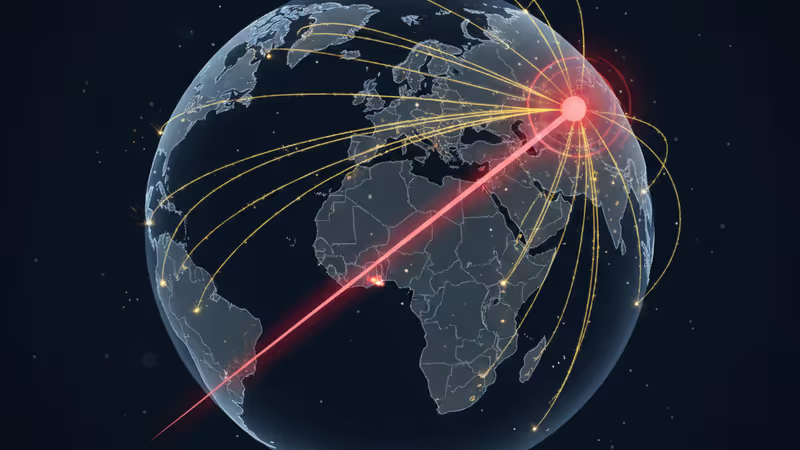
As Russian missiles rain down on Odesa's critical port infrastructure, high-stakes negotiations are underway in Miami. For global executives and policymakers, this is more than a tragic headline; it's a live demonstration of 'kinetic diplomacy.' Russia is using force to dictate the terms of peace, betting that a war-weary United States, whose Secretary of State now openly calls the conflict “not our war,” is losing its resolve. The outcome of this gambit will not only decide Ukraine's fate but also redraw the map of American influence and global supply chain stability for the next decade.
Why It Matters: The Ripple Effects of a Port Under Siege
The escalation in Odesa and Ukraine's retaliatory strikes deep into Russian territory are creating cascading second-order effects that extend far beyond the battlefield:
- Global Food & Logistics: Odesa is a primary artery for Ukrainian grain exports. These systematic attacks are a strategic effort to strangle Ukraine's economy and leverage global food security as a bargaining chip. Companies reliant on Black Sea shipping routes face escalating insurance premiums and operational risks.
- Energy Market Volatility: Ukraine's unprecedented drone strike on a Lukoil rig in the Caspian Sea marks a significant expansion of the conflict's economic front. It signals that no Russian energy asset is truly safe, introducing a new layer of risk for energy markets and investors in Russian-linked entities.
- A Fracturing Alliance: The declared American pivot, voiced by Secretary of State Rubio and reinforced by the presence of Trump-era envoys, places immense pressure on European allies. It forces a critical question: Can Europe sustain Ukraine's defense and manage a hostile Russia without unwavering American leadership? The answer will define the future of NATO and European strategic autonomy.
The Analysis: The 'Fight and Talk' Doctrine in a Multipolar World
We are witnessing a classic, albeit brutal, 'fight and talk' strategy. By intensifying its assault on Odesa—a symbol of Ukrainian resilience and its window to the world economy—Moscow aims to enter the Miami negotiations from a position of maximum leverage. The message is clear: the cost of continued resistance will be the complete destruction of Ukraine's economic capacity. This is a cruel calculus designed to force Kyiv into concessions it would otherwise never make.
Simultaneously, Ukraine is demonstrating its own evolution. The strikes on a Kilo-class submarine and Caspian oil infrastructure are not mere acts of revenge. They are calculated demonstrations of a burgeoning asymmetrical capability, engineered to impose direct, painful costs on the Russian state far from the frontlines. Kyiv's strategy is to prove to both Moscow and Washington that it is not a passive victim but a potent actor capable of independently escalating and widening the conflict, making a clean American exit impossible.
The backdrop to this military chess match is the palpable shift in Washington. After nearly four years of war, the rhetoric has changed. The phrase “not our war” is a seismic event in diplomatic language. It signals to Russia that American strategic patience is finite and to Europe that the era of a U.S.-funded security blanket is ending. This forces every party to reassess the long-term viability of their current positions, making a negotiated, and likely painful, settlement appear more inevitable.
PRISM Insight: The Proliferation of Asymmetric Warfare Tech
The defining technological trend of this conflict's later stage is the democratization of long-range precision strike capabilities. Ukraine's ability to hit a specific oil rig in the Caspian Sea with drones showcases a new reality: relatively low-cost, autonomous systems can now hold multi-billion-dollar strategic assets at risk from hundreds of miles away. For investors and the defense industry, this confirms that the future of warfare lies in networks of intelligent, disposable systems, not just exquisite, expensive platforms. The key investment areas are now in counter-drone technology, AI-powered targeting, and resilient, decentralized infrastructure that can withstand such precision attacks.
PRISM's Take: An Unstable Peace is on the Horizon
The violence in Odesa and the negotiations in Miami are two sides of the same coin, forging the contours of a post-war settlement. This will not be a clean victory for either side. Instead, we are likely heading towards an unstable, frozen conflict shaped by a retreating America. Russia is escalating now because it senses a window of opportunity to lock in its gains before a settlement is imposed. Ukraine is escalating to ensure its sovereignty isn't completely bargained away. The key takeaway is that the 'peace' being discussed in Miami is not about restoring the past, but about defining a new, more dangerous European security equilibrium where regional powers must fend for themselves with less American oversight. The fighting will likely stop, but the conflict will simply move into a new, colder phase.
관련 기사

트럼프 전 대통령이 뉴욕 주지사 경선에서 브루스 블레이크먼을 지지하며 공화당 내부 역학 관계와 'MAGA'의 미래 전략에 대한 심층 분석을 제공합니다.

글로벌 지정학적 긴장, 인도주의 위기, 사회적 불안정 속에서 인간 안보의 미래를 분석합니다. PRISM이 제시하는 이 상호 연결된 세계의 도전과 기술, 투자의 관계.

미국 외교 정책에 대한 글로벌 비판과 진보적 목소리의 부상이 국제 관계의 새로운 지형도를 그립니다. 베네수엘라, 아이티, 팔레스타인 이슈를 중심으로 분석합니다.

제프리 엡스타인 파일 공개, 새 정보 부재로 투명성 논란 가열. 유력 인사 연루 의혹과 사법 시스템의 신뢰 문제 분석.