
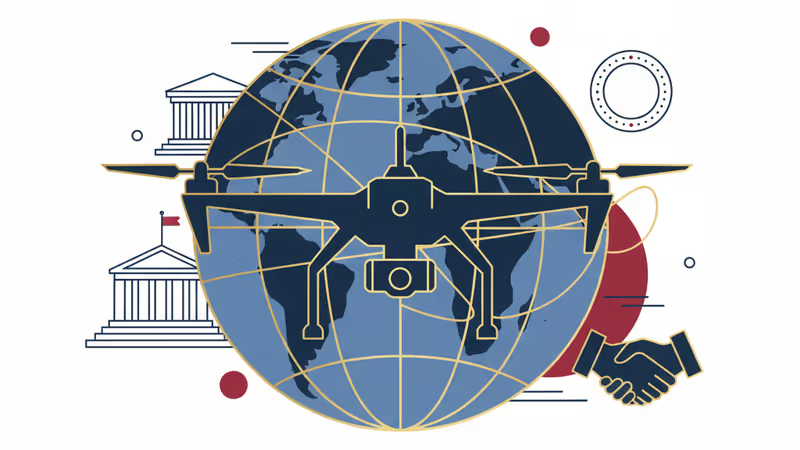
The 'Made in China' Warhead: How Beijing's Supply Chain is Fueling a New Era of Drone Warfare
China's supply of drone components to Russia is not just aiding the war in Ukraine; it's creating a new, scalable blueprint for asymmetric global conflict.
The Lede: A New Blueprint for Conflict
The skies over Ukraine are not just a battlefield; they are a live-fire laboratory for a new model of global conflict. At the heart of this transformation is a vast, semi-covert supply chain originating in China, providing the critical components that allow Russia to mass-produce cheap, effective, and increasingly sophisticated attack drones. This isn't merely about one country helping another. This is the beta test for a new doctrine of warfare—one that leverages globalized supply chains to wage cost-effective, attritional campaigns that bypass traditional sanctions and challenge Western military-industrial supremacy. For any global executive, this signals a profound shift where geopolitical risk is no longer confined to state-on-state conflict but is embedded within the very fabric of commercial technology and logistics.
Why It Matters: The Geopolitical Fallout
The strategic implications extend far beyond the current frontlines. The Russia-China drone axis establishes a dangerous precedent with significant second-order effects:
- The Weaponization of Commerce: The use of dual-use components—commercially available electronics, engines, and navigation modules—makes sanctions enforcement a nightmare. It creates a playbook for sanctioned states to sustain military campaigns by exploiting the porous nature of global trade, turning civilian supply chains into instruments of war.
- Asymmetric Warfare on a Budget: A single Russian-made Geran-2 drone, packed with Chinese parts, costs an estimated $20,000 to $50,000. The air defense missiles used to intercept it can cost upwards of $500,000. This deliberate exploitation of cost asymmetry is designed to exhaust the financial and material resources of Ukraine and its Western backers, proving that military dominance can be challenged through scale and cost-efficiency, not just technological superiority.
- Proliferation as a Strategy: This model is replicable. The knowledge and components flowing from China to Russia and Iran could easily be transferred to other actors, such as North Korea. This creates the potential for a global network of states capable of producing and deploying drone arsenals, fundamentally altering regional power balances from the Middle East to the Korean Peninsula.
The Analysis: Beijing's Game of Plausible Deniability
Russia's drone program has evolved dramatically. What began with direct imports of Iran's Shahed-136 has morphed into a domestic industrial operation in facilities like Alabuga. This transition was only possible due to a steady and unrestricted flow of Chinese technology. While Beijing officially denies providing lethal aid, the reality on the ground—and in the wreckage of downed drones—tells a different story. Ukrainian intelligence has identified a host of Chinese components, from engines to flight controllers, in the latest Geran models. Some reports even point to direct co-development of new variants.
This strategy allows China to maintain a veneer of neutrality while achieving key strategic objectives. By supplying sub-systems rather than finished weapons, Beijing avoids the direct diplomatic and economic consequences of arming Russia. Simultaneously, it deepens Moscow's dependency, gains invaluable data on the performance of its technology against NATO-supplied systems, and actively degrades the military-industrial capacity of the United States and its allies. For the West, this presents a formidable challenge. Sanctioning a handful of state-owned defense firms is one thing; policing tens of thousands of private electronics manufacturers is a near-impossible game of whack-a-mole that exposes the core vulnerability of a globalized tech ecosystem.
PRISM Insight: The New Defense-Tech Paradigm
This shift from exquisite, high-cost military platforms to disposable, mass-produced systems heralds a new investment cycle in the defense and technology sectors. The key trend is the move towards "good enough" military hardware. The Geran drone isn't a stealth bomber, but its effectiveness lies in its scalability and affordability. This will force a pivot in Western military R&D and procurement, prioritizing cost and volume alongside performance.
Consequently, the market for Counter-Unmanned Aircraft Systems (C-UAS) is set for exponential growth. Investment will pour into everything from sophisticated electronic warfare and jamming solutions to directed energy weapons and low-cost kinetic interceptors. Furthermore, this crisis underscores that supply chain resilience is now a paramount national security issue. Expect significant government and private sector investment in on-shoring or "friend-shoring" the production of critical components like microelectronics, GPS modules, and specialized materials to mitigate dependence on strategic rivals.
PRISM's Take: The Real Battle is in the Supply Chain
The war in Ukraine is demonstrating that the future of conflict may be decided not by the most advanced fighter jet, but by the most resilient and adaptable supply chain. The China-Russia drone partnership is more than an alliance of convenience; it is a live-fire experiment testing a new form of asymmetric warfare that is cheap, scalable, and difficult to counter with traditional military power.
The West's response cannot be limited to sending more air defense missiles to Kyiv. It requires a fundamental rethinking of economic statecraft, industrial policy, and the intersection of commercial technology and national security. The true frontline in this emerging conflict isn't in the trenches of Donbas, but in the semiconductor fabs, logistics hubs, and regulatory bodies that govern the global flow of technology. Winning there will be the defining geopolitical challenge of the next decade.
관련 기사

예멘 후티 반군의 UN 직원 69명 억류 사태의 지정학적 함의와 인도주의 위기 심화 분석. 후티의 전략과 글로벌 파급효과를 심층 진단합니다.

이스라엘 교도소 내 팔레스타인 수감자 성고문 의혹을 심층 분석합니다. UN 경고, 지정학적 함의, 그리고 정보 전쟁의 새로운 양상을 짚어봅니다.

미 법무부의 제프리 엡스타인 파일 대량 공개. 단순한 문서 공개를 넘어, 글로벌 엘리트의 책임과 사법 시스템의 투명성을 시험하는 분수령이 될 것인가? 심층 분석.

물리적 영토를 잃은 ISIS가 어떻게 아프리카와 아시아에서 부활하고 있는가? 지정학적 공백과 신기술이 만들어낸 새로운 위협을 심층 분석합니다.