
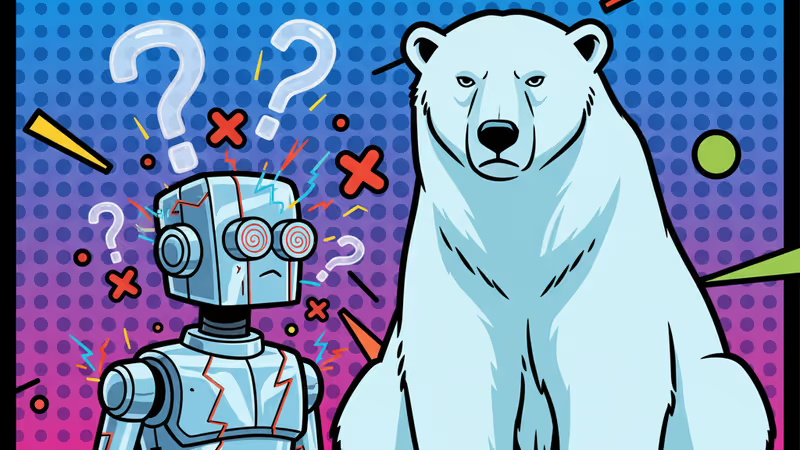
The 'Ice Bear' Problem: How a Viral Meme Exposes AI's Biggest Flaw
A viral Instagram account's literal translations reveal the critical 'translation gap' that AI struggles with. Here's why it matters for global business.
The Lede: The High Cost of Literal Translation
A viral Instagram account illustrating the absurdity of literally translated Norwegian—turning a polar bear into an "ice bear" and squid into an "ink squirt"—is more than just a source of humor. For any executive overseeing global expansion, it’s a critical data point. It reveals the ‘cultural uncanny valley’ where even the most sophisticated AI translation models fail, creating brand risk and alienating markets. This isn’t a meme; it’s a masterclass in the limits of algorithms and the enduring value of human nuance.
Why It Matters: Beyond Words to Market Resonance
In the race to scale globally, companies are increasingly reliant on AI-driven localization for everything from user interfaces to marketing campaigns. The implicit promise is speed and cost-efficiency. However, the "ice bear" problem demonstrates the catastrophic flaw in this strategy: a failure to translate *meaning*, not just words.
- Brand Dilution: A clunky or nonsensical translation makes a brand appear cheap, out of touch, and untrustworthy. It erodes customer confidence before a product is even used.
- Failed Marketing Spend: Campaigns built on machine-translated slogans can backfire spectacularly, becoming objects of ridicule rather than drivers of adoption. The ROI on such efforts is negative.
- Product Friction: When user interface (UI) and support documentation are literally translated, it creates confusion and frustration, leading to higher churn rates and support ticket volumes.
The second-order effect is a strategic disadvantage. While one company relies on a generic AI, a competitor investing in deep cultural localization—a process known as transcreation—builds a genuine, emotional connection with the user base, creating a powerful competitive moat.
The Analysis: The Ghost in the Machine Translation
The Norwegian language, like many Germanic languages, frequently uses highly logical and descriptive compound words. "Isbjørn" (ice bear) and "blekksprut" (ink squirt) are not incorrect; they are the literal, etymological building blocks. An AI can parse this structure flawlessly. What it cannot grasp is the idiomatic and cultural consensus that establishes "polar bear" and "squid" as the correct terms in English.
This challenge is a microcosm of a much larger issue for Large Language Models (LLMs). While models like GPT-4 have ingested vast amounts of text, they lack lived experience and a true understanding of cultural context. They are masters of syntax and pattern recognition, but they are not participants in culture. This viral account succeeds precisely because it is human; it leverages a native speaker's intuition to highlight the logical, yet absurd, gap between two worldviews. It's a cultural commentary that no algorithm could generate on its own.
PRISM Insight: The Rise of the 'Translation Layer' Stack
The market's blind faith in a fully automated AI translation future is misplaced. The real investment opportunity lies in the emerging ‘translation layer’ technology stack that augments, rather than replaces, human expertise. We are seeing the rise of platforms that operate on a Human-in-the-Loop (HITL) model, using AI for the 80% heavy lifting of initial translation, but integrating human experts for the critical 20%—nuance, idiom, humor, and cultural validation.
Forward-thinking investors should be looking at startups that are building these hybrid systems. The value is not in the core AI model, which is becoming a commodity, but in the sophisticated workflow software that seamlessly blends machine scale with human insight. This is the new frontier of SaaS for global business, a market that will grow exponentially as more companies push into international markets.
PRISM's Take: Hire a Poet, Not Just a Processor
The ultimate lesson from the 'ice bear' is that localization is not a technical problem to be solved, but a human relationship to be built. The companies that will dominate the next decade of global commerce will be those who understand this distinction. They will treat their localization budgets not as a cost center for machine processing, but as a strategic investment in cultural intelligence.
The future of effective global communication is not a single, omniscient algorithm. It is a symphony of technology and humanity. For your next market entry, don't just ask what the AI can do. Ask what a native speaker, a local creative, or a poet would do. The answer will be the difference between being understood and truly connecting.
관련 기사
소셜미디어에서 유행하는 'GLP-3'의 정체는? 오젬픽 열풍을 넘어선 웰니스 정보 과잉 시대의 위험과 기회를 PRISM이 심층 분석합니다.
AI가 완벽한 이미지를 생성하는 시대, 왜 우리는 '실패한' 사진에 열광할까요? 진정성과 타이밍의 가치를 통해 콘텐츠의 미래를 분석합니다.
포토샵 없이 스마트폰 2대만으로 현실과 판타지를 결합하는 사진작가. AI 시대에 더욱 빛나는 '아날로그 AR'의 창의성과 미래 콘텐츠 트렌드를 분석합니다.
제니퍼 로렌스가 레오나르도 디카프리오의 연애사를 저격한 순간. 단순한 농담을 넘어 밈, 세대교체, 미디어 전략을 관통하는 심층 분석.