
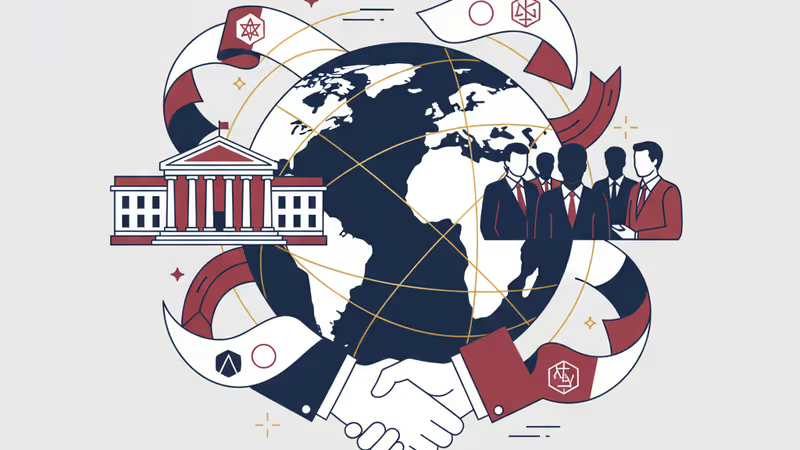
The EU's Moment of Truth: Can Brussels Avert Geopolitical Irrelevance?
EU leaders face a critical summit on Ukraine, China, and trade. Our analysis explores why failure could fracture the bloc and redefine its global role.
The Lede: A Bloc at the Brink
While EU leaders gather this week under banners proclaiming unity, the reality is one of deepening fracture. This is not just another summit; it's a critical test of whether Europe can function as a cohesive geopolitical power in an era of intense competition between the US and China. For executives and investors, the outcome will directly shape the future of global trade, security alliances, and the regulatory landscape for technology and climate policy. The central question is no longer whether the EU has a strategy, but whether it has the political will to execute one.
Why It Matters: The Ripple Effects of Disunity
A failure to achieve consensus on the summit's key agenda items—Ukraine funding, a landmark trade deal with Mercosur, and a unified China strategy—will have significant second-order effects far beyond Brussels:
- Security Vacuum: Inability to agree on funding for Ukraine would signal to both Moscow and Washington that Europe cannot manage its own security, increasing regional instability and placing greater pressure on the transatlantic alliance.
- Economic Retreat: Scuttling the Mercosur trade deal after two decades of negotiation would effectively cede economic influence in South America to other actors, primarily China, and call into question the EU's credibility as a global trade partner.
- Strategic Vulnerability: Without a coherent geoeconomic strategy, the EU remains exposed. It risks being whipsawed between US pressure for decoupling and Chinese economic coercion, leaving European industries caught in the crossfire. This disunity paralyzes the bloc's ability to protect its supply chains and technological sovereignty.
The Analysis: Europe's Strategic Trilemma
The EU is caught in a strategic trilemma, forced to choose between three competing priorities: maintaining its security alliance with the United States, preserving vital economic ties with China, and achieving “strategic autonomy.” Each agenda item at this summit represents a different facet of this fundamental conflict.
Historically, the EU has advanced through crises by “muddling through” with last-minute compromises. However, that model is dangerously slow for the current geopolitical environment. The internal fault lines are widening:
- The East-West Divide: On Russia and China, newer member states in Eastern Europe, with their historical memory of Soviet domination, prioritize security and a hardline stance. In contrast, economic powerhouses like Germany remain hesitant to jeopardize deep-rooted industrial and commercial relationships with Beijing.
- The North-South Divide: On trade and economic policy, fiscally conservative northern states often clash with southern members over industrial subsidies and protectionism. The Mercosur deal, for instance, is a flashpoint, pitting pro-trade nations against countries like France, which seek to protect their powerful agricultural lobbies.
This summit is not about three separate issues. It’s about one core problem: the 27 member states have fundamentally different answers to the question of what Europe’s role in the world should be. Without a shared answer, any policy is built on sand.
PRISM Insight: The Tech & Investment Angle
For the tech sector and global investors, the EU's fragmentation is a primary source of political and regulatory risk. A divided Europe cannot forge a unified digital single market or create a coherent strategy on critical technologies like AI, semiconductors, and data governance. This creates an environment of uncertainty and allows US and Chinese tech giants to exploit regulatory arbitrage between member states.
Investment implications are clear: a fractured outcome signals a more complex, multi-layered risk environment in Europe. Pan-European business strategies become harder to execute as national interests override bloc-level policy. Conversely, any surprise move towards unity on a geoeconomic strategy would likely accelerate the implementation of tools like the anti-coercion instrument and foreign subsidy regulations, creating new compliance challenges for multinational corporations operating in the EU.
PRISM's Take: The End of 'Muddling Through'
The era where the European Union could afford to slowly and painfully inch its way toward consensus is over. The geopolitical clock is ticking faster than the Brussels bureaucracy. This summit will force a choice. While a complete collapse into disarray is unlikely, the most probable outcome is a series of weak compromises that fail to address the underlying strategic rot. This will leave the EU in a state of permanent vulnerability—too integrated to allow its members to act alone, yet too divided to act decisively as a bloc. For the next five years, expect a Europe that reacts to global events rather than shapes them, a reality that investors and policymakers must factor into their strategic calculus.
관련 기사
바샤르 알 아사드 정권 붕괴 1년 후, 시리아는 권력 공백과 지정학적 대리전의 소용돌이에 휘말렸다. 시리아의 미래와 중동 정세에 미칠 영향을 심층 분석한다.
틱톡 미국 사업 매각 딜 심층 분석. 미-중 기술 패권 경쟁과 데이터 주권의 미래를 결정할 지정학적 함의와 글로벌 시장에 미칠 영향을 진단합니다.
미 하원이 공개한 제프리 엡스타인 추가 사진은 단순한 스캔들을 넘어 기술, 정치, 미디어 엘리트들의 어두운 연결 고리를 폭로합니다. 그 지정학적 함의를 분석합니다.
미국의 대만 역대 최대 무기 판매 승인 분석. 단순한 군사 지원을 넘어 대만 '고슴도치' 전략과 미중 기술 패권 경쟁에 미치는 지정학적 함의를 파헤칩니다.