
The Christmas Orange: A Forgotten Lesson in Supply Chains, Scarcity, and the Future of Value
Why is there an orange in your Christmas stocking? The answer is a surprising lesson in technology, supply chains, and the commoditization of luxury goods.
The Lede: More Than Just a Tradition
That orange you find at the bottom of a Christmas stocking isn't just a quaint tradition. It’s a powerful, tangible lesson in global logistics, the commoditization of luxury, and the very nature of perceived value. For any leader navigating today's volatile markets, the story of how a rare, exotic fruit became a stocking-filler is a critical case study in how technology and supply chains can fundamentally disrupt and redefine an entire market.
Why It Matters: The Lifecycle of Luxury
The journey of the orange from a symbol of wealth—a stand-in for St. Nicholas's gold—to a common holiday treat perfectly maps the lifecycle of nearly every disruptive technology or luxury good. What was once scarce, expensive, and aspirational becomes abundant, affordable, and expected. This pattern has profound implications:
- Predicting Commoditization: Understanding this arc helps identify which of today's high-margin products (from specialized AI chips to bespoke software) are destined to become tomorrow's commodities.
- Shifting Value Propositions: As the object itself loses its scarcity value, the value shifts to the experience, the ritual, and the brand built around it. The orange stopped being valuable for its rarity and became valuable for the tradition it represented.
- Supply Chain as a Weapon: The democratization of the orange wasn't magic; it was the result of innovations in refrigerated transport and globalized agriculture. This demonstrates how logistical mastery is a primary driver of market disruption.
The Analysis: From Gold to Grocery
The historical explanations for the Christmas orange are twofold, and their intersection is where the real insight lies. The first is symbolic: the orange represents the bags of gold St. Nicholas gifted to a poor family, a direct metaphor for wealth and generosity.
The second is economic. For centuries, especially in colder climates like England and North America, citrus was an unimaginable luxury. It was a seasonal, difficult-to-transport treasure. During the Great Depression, an orange could be the only gift a child received, its value amplified by extreme scarcity. It was, for all intents and purposes, a form of gold.
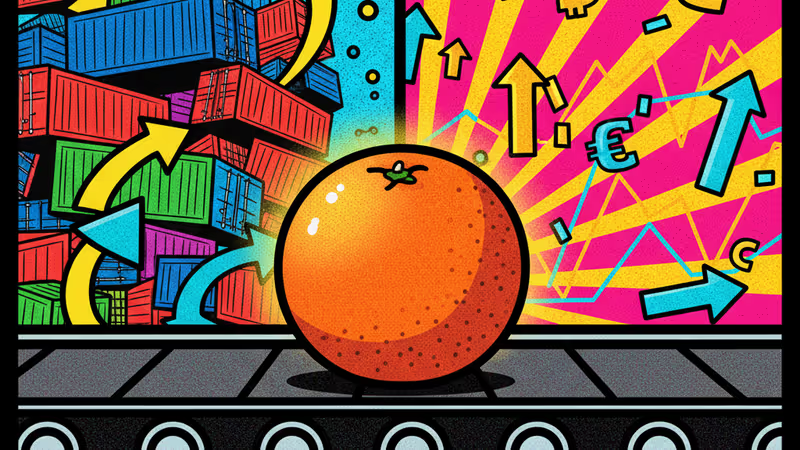
So what changed? Technology. The development of refrigerated shipping containers and continent-spanning railways in the late 19th and early 20th centuries collapsed the barriers of distance and season. A technological disruption in logistics transformed a luxury good into a household staple. The very forces that made the orange rare and valuable were systematically dismantled by innovation, leaving only the symbolic meaning behind.
PRISM Insight: Identifying the Next 'Orange'
The critical question for investors and strategists is: What is the 'orange' of the 21st century? We are witnessing the same commoditization cycle happening at an accelerated pace in the digital realm.
- Generative AI: A few years ago, access to powerful Large Language Models was a scarce resource, limited to a few major labs. Today, through APIs and open-source models, that power is becoming a commodity. The value is no longer in having the model, but in the unique applications and experiences built on top of it.
- Data Storage: The cost per gigabyte has been in freefall for decades. Owning massive data infrastructure is no longer the moat it once was. The value has shifted to the intelligence and insights extracted from that data.
- Genetic Sequencing: The cost to sequence a human genome has plummeted from billions to a few hundred dollars. The scarcity has shifted from the raw data to the actionable, personalized health insights derived from it.
The investment implication is clear: Don't invest in selling the 'orange'. Invest in the platforms, rituals, and services that create meaning and utility once the 'orange' is cheap and ubiquitous for everyone.
PRISM's Take: Abundance Is The New Scarcity
The story of the Christmas orange is the story of modern capitalism in miniature. It teaches us that technological progress is inherently deflationary, relentlessly turning scarcity into abundance. In such a world, the most enduring value doesn't lie in the object itself, but in the human connection and meaning we build around it. The tradition—the act of giving, sharing, and remembering—outlasted the economic rarity of the fruit. As we navigate an era of unprecedented technological abundance, the greatest opportunities will be found not in creating the next scarce object, but in architecting the next meaningful tradition.
관련 기사

욕설이 통증을 줄이고 근력을 향상시킨다는 사실을 아시나요? 과학적 원리와 헬스, 바이오해킹에 미칠 영향을 심층 분석합니다.
라이프 해킹 열풍의 의미는? 바나나 껍질 까는 법부터 호흡법까지, 일상을 최적화하려는 트렌드가 만드는 새로운 비즈니스 기회와 기술의 미래를 분석합니다.

디즈니가 팝펑크, 컨트리 등 다양한 장르의 커버 앨범을 내는 이유. 단순한 리메이크를 넘어 IP의 생명을 연장하는 디즈니의 비즈니스 전략을 분석합니다.

영국 GB 뉴스의 메건 마클 관련 가짜뉴스 사태를 통해 본 미디어의 위기. 분노를 수익으로 바꾸는 '미디어 전쟁'이 저널리즘의 미래에 미치는 영향을 분석합니다.