
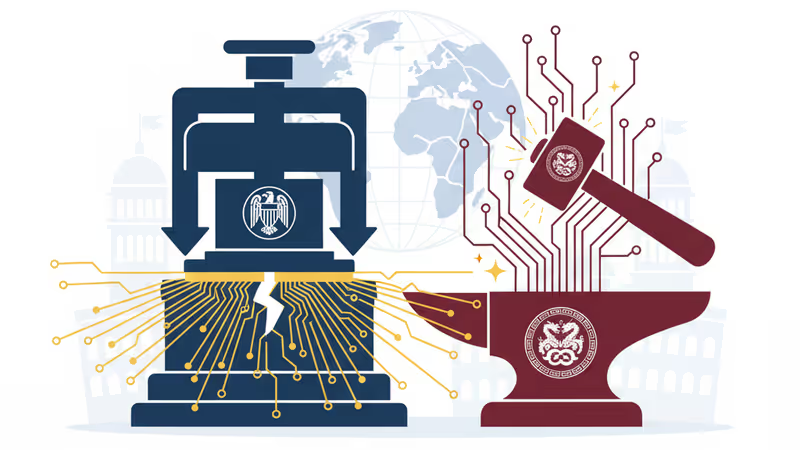
The Chip War's Paradox: Is America's Chokehold Forging China's Tech Independence?
US chip policy whiplash is accelerating China's tech independence. For global leaders, this isn't just a risk—it's the new strategic reality of a fractured world.
The Lede: Beyond the Headlines
While Washington debates the future of its tech restrictions on China, with former President Trump signaling a potential reversal, a more significant trend is already in motion. Beijing is executing a full-court press to achieve semiconductor self-sufficiency, fueled by the very sanctions designed to cripple it. For global executives and investors, the key takeaway is not the political whim of the day, but the permanent strategic realignment of the global tech landscape. The era of a single, integrated semiconductor supply chain is over; navigating its fractured future is now a primary business imperative.
Why It Matters: The Ripple Effects of a Tech Cold War
The strategic tug-of-war over semiconductors—the bedrock of the modern economy—creates cascading effects that extend far beyond Silicon Valley and Shenzhen:
- Supply Chain Bifurcation: Companies are being forced to plan for two distinct tech ecosystems: one aligned with the West, the other with China. A potential loosening of US restrictions offers a deceptive short-term reprieve but doesn't alter this long-term trajectory. It merely introduces a new layer of volatility, making strategic capital allocation more fraught with political risk.
- Weaponization of 'Mature' Tech: While the West focuses on cutting-edge 3nm chips, China is pouring unprecedented state capital into dominating mature-node semiconductors (28nm and above). These are the workhorse chips for the automotive, industrial, and consumer electronics sectors. A Chinese-dominated market could lead to price dumping, creating new dependencies for Western industries that have offshored this production.
- Allied Indecision: The inconsistency of US policy places key allies like the Netherlands (home to ASML), Japan, and South Korea in a precarious position. They are caught between pressure from Washington and the economic reality of the massive Chinese market, leading to a patchwork of compliance and creating loopholes that undermine the West's collective strategy.
The Analysis: A Self-Fulfilling Prophecy
The United States' strategy, initiated under Trump and continued by Biden, was to use its dominance in key chokepoint technologies—chip design software (EDA), manufacturing equipment, and intellectual property—to slow China's technological and military ascent. The logic was clear: deny China access to the tools needed for advanced AI, supercomputing, and next-generation weaponry.
However, this strategy has had a powerful, albeit unintended, consequence. It has galvanized a nationalistic drive within China, eliminating internal debate and focusing the full power of the state on a single goal: breaking the Western chokehold. The emergence of a 7nm chip from China's SMIC for Huawei's Mate 60 Pro, while likely costly and difficult to scale, was a potent symbol of this determination. It proved that while sanctions can slow progress, they cannot entirely stop it.
From Beijing's perspective, the US has demonstrated that it is an unreliable partner willing to weaponize the tech supply chain for geopolitical ends. Therefore, achieving self-sufficiency is no longer just an economic goal; it is a matter of national security and sovereignty. Any future easing of sanctions from Washington will be viewed not as a gesture of goodwill, but as a temporary tactic, reinforcing the imperative to de-Americanize China's tech stack.
PRISM Insight: The New Investment Calculus
For investors and corporate strategists, the focus must shift from predicting policy shifts to building resilience. The primary trend is not the oscillating severity of US sanctions, but the permanent state of tech competition. This creates a new set of investment theses:
- Redundancy Over Efficiency: The 'just-in-time' global supply chain is giving way to a 'just-in-case' model. This means new opportunities for semiconductor manufacturing and packaging in politically stable, allied nations (e.g., India, Mexico, Vietnam) and for companies that provide supply chain verification and security.
- The 'Pick and Shovel' Play: Regardless of who wins the race for chip supremacy, the demand for raw materials, specialized chemicals, and manufacturing components will soar. Investing in the foundational elements of the semiconductor industry offers a way to benefit from the overall trend of duplication and onshoring without betting on a single national champion.
PRISM's Take: An Inescapable New Reality
The central paradox of the Chip War is that the West's most powerful weapon—export controls—is simultaneously the most effective catalyst for its long-term strategic failure. By attempting to freeze China's capabilities, the US has inadvertently created the political will in Beijing to endure immense short-term pain for the long-term prize of technological independence.
A potential change in US administrative policy is a tactical subplot, not a change in the story's ending. The global tech industry has fundamentally fractured. For business leaders, the challenge is no longer about managing cyclical downturns but about navigating a world defined by geopolitical fault lines. Agility, geographic diversification, and a deep understanding of political risk are no longer competitive advantages; they are survival requirements.
관련 기사

중국 자본의 미크로네시아 활주로 재건이 미중 갈등의 새 뇌관으로 부상했습니다. 태평양 지정학적 균형과 미국의 안보 딜레마를 심층 분석합니다.

EU의 1050억 달러 우크라이나 지원은 단순 원조를 넘어선 지정학적 베팅입니다. 장기 경제 전쟁의 서막과 글로벌 시장에 미칠 영향을 심층 분석합니다.

미국, 카타르, 이집트, 튀르키예가 마이애미에서 비밀 회동을 갖습니다. 교착 상태인 가자지구 휴전 협상의 돌파구와 중동의 미래 질서를 분석합니다.

제프리 엡스타인 관련 법원 문서 공개가 미국 대선을 넘어 전 세계 권력 지형에 미칠 파장을 심층 분석합니다. 단순 스캔들을 넘어선 지정학적 함의를 확인하세요.