
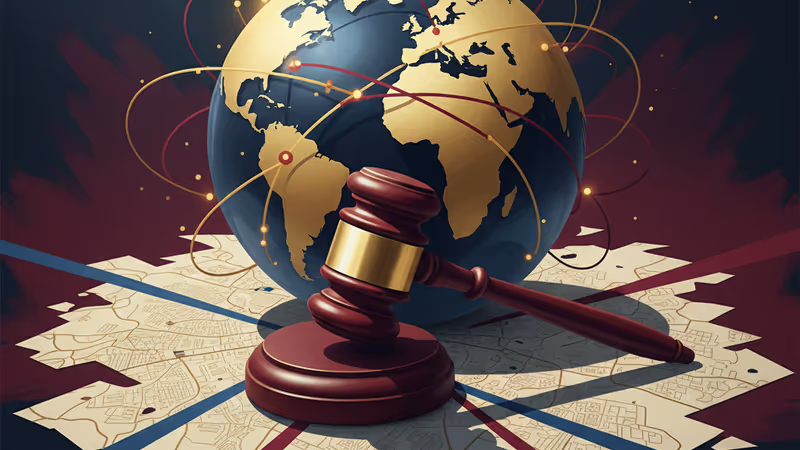
U.S. Supreme Court Rejects Trump's Bid to Deploy Military in Chicago Area
The U.S. Supreme Court declined to let President Donald Trump deploy National Guard troops to the Chicago area, upholding a lower court's block on the controversial move.
The U.S. Supreme Court has dealt a blow to President Donald Trump's expanding use of military forces for domestic purposes. On Tuesday, the justices refused to allow the deployment of National Guard troops to the Chicago area, temporarily halting a controversial policy that critics have called an effort to punish political adversaries in Democratic-led jurisdictions.
A Tale of Two Protests: 'Lawless' or 'Largely Peaceful'?
The dispute centers on starkly different portrayals of protests against the administration's aggressive immigration enforcement. According to Reuters, the Trump administration has described Democratic-led cities as crime-ravaged and plagued by violent protests, arguing that troops are necessary to protect federal property. In contrast, Illinois and Chicago officials contend these claims are a false pretext for an abuse of presidential power, stating the demonstrations have been limited, largely peaceful, and manageable by local law enforcement.
A National Guard deployment would 'only add fuel to the fire.'
Lower Courts Set the Stage
The Supreme Court's decision leaves in place a lower court's order. On October 9, U.S. District Judge April Perry temporarily blocked the move to federalize 300Illinois National Guard troops and bring in units from Texas. Judge Perry found no evidence of a rebellion and faulted the administration for "equating protests with riots." That ruling was upheld by the 7th U.S. Circuit Court of Appeals. A similar legal battle unfolded in Portland, Oregon, where a federal judge permanently blocked a planned deployment on November 7.
본 콘텐츠는 AI가 원문 기사를 기반으로 요약 및 분석한 것입니다. 정확성을 위해 노력하지만 오류가 있을 수 있으며, 원문 확인을 권장합니다.
관련 기사
미국 법무부가 제프리 엡스타인 관련 100만 건 이상의 문서를 추가로 발견했다고 발표했다. 피해자 보호를 위한 검토 및 편집 작업에 수 주가 소요될 전망이며, 이는 트럼프 대통령이 서명한 정보공개법에 따른 조치다.

2025년 파키스탄은 인도와의 군사 충돌 이후 국제 무대에 화려하게 복귀했지만, 고질적인 국내 정치·경제 불안은 여전하다. 기회와 위기 사이에서 파키스탄이 마주한 4가지 전환점을 분석한다.

중국의 '판다 외교'가 일본, 프랑스와의 관계 변화를 어떻게 반영하는지 분석한다. 단순한 동물 교류를 넘어, 시진핑 정부의 정교한 외교 전략의 일면을 보여준다.
2026년 미네소타 주지사 선거에서 공화당이 3선에 도전하는 팀 월즈 주지사를 꺾을 기회를 맞았으나, 도널드 트럼프의 분열적 언사와 마이크 린델의 출마 가능성이 변수로 작용하고 있다.
미국 법무부가 제프리 엡스타인 관련 100만 건 이상의 문서를 추가로 발견했다고 발표했다. 피해자 보호를 위한 검토 및 편집 작업에 수 주가 소요될 전망이며, 이는 트럼프 대통령이 서명한 정보공개법에 따른 조치다.
2025년 파키스탄은 인도와의 군사 충돌 이후 국제 무대에 화려하게 복귀했지만, 고질적인 국내 정치·경제 불안은 여전하다. 기회와 위기 사이에서 파키스탄이 마주한 4가지 전환점을 분석한다.
중국의 '판다 외교'가 일본, 프랑스와의 관계 변화를 어떻게 반영하는지 분석한다. 단순한 동물 교류를 넘어, 시진핑 정부의 정교한 외교 전략의 일면을 보여준다.
2026년 미네소타 주지사 선거에서 공화당이 3선에 도전하는 팀 월즈 주지사를 꺾을 기회를 맞았으나, 도널드 트럼프의 분열적 언사와 마이크 린델의 출마 가능성이 변수로 작용하고 있다.