
South Korea's New Diplomat: Why a Gamer's Meeting with the PM is a Global Power Play
South Korean PM's meeting with e-sports star Faker signals a major shift, elevating gaming into a key pillar of national strategy and global soft power.
The Lede: Beyond the Photo Op
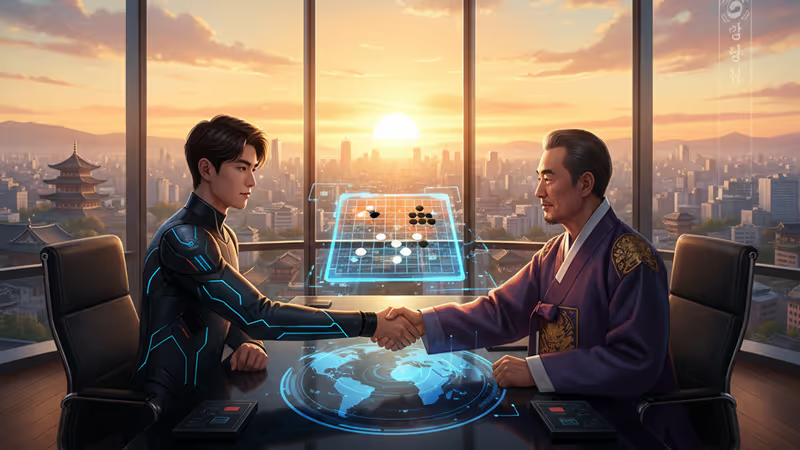
When a head of state meets a national icon, it’s usually standard political theater. But when South Korean Prime Minister Kim Min-seok sat down with Lee "Faker" Sang-hyeok, the world's most dominant e-sports athlete, it signaled something far more significant. This wasn't just a celebrity handshake; it was the formal anointment of e-sports as a core pillar of South Korea's national strategy, placing digital competition on par with semiconductors and K-pop as a key export and instrument of global influence.
Why It Matters: From Subculture to Statecraft
For decades, video games occupied a gray area between cultural phenomenon and societal concern. This meeting obliterates that ambiguity. By hosting Faker at his official residence and broadcasting the conversation, the Prime Minister’s office has conferred the highest level of state legitimacy upon the e-sports industry. This has critical second-order effects:
- De-risking Investment: The government's embrace sends a powerful signal to global sponsors, advertisers, and venture capitalists that South Korea's e-sports ecosystem is a stable, state-backed growth industry.
- Setting the Policy Agenda: Faker used the platform not just for pleasantries, but to deliver a sharp critique of the domestic game development industry, warning against a trend of "formulaic games or cash grab games." This places innovation in game IP squarely on the national policy radar.
- Soft Power 3.0: If the first wave of the "Hallyu" (Korean Wave) was K-pop and the second was K-dramas and film, this marks the institutionalization of a third wave: K-game and e-sports.
The Analysis: The Geopolitics of Gaming
This event must be viewed through the lens of regional competition, particularly with China. While Beijing also recognizes the economic potential of gaming, its approach has been erratic, marked by sudden, sweeping regulatory crackdowns that have spooked global investors. China's policies have often treated gaming as a social vice to be controlled, restricting play time for minors and freezing new game approvals for months on end.
In contrast, Seoul is positioning itself as the stable, predictable, and premier global hub for the digital entertainment economy. By elevating a figure like Faker to the level of a national cultural ambassador, South Korea is executing a sophisticated geopolitical strategy. It’s a deliberate move to attract international talent, capital, and tournament hosting rights, cementing its leadership while its chief rival struggles with internal policy contradictions.
However, Faker's candid criticism highlights a crucial vulnerability. South Korea excels at playing games, but is it still the leader in creating them? His warning suggests that without a renewed focus on creative IP development, the country risks becoming a nation of top-tier players competing on foreign-developed platforms—a strategically precarious position.
PRISM Insight: The Two-Track Korean Gaming Market
For investors and executives, the key takeaway is the bifurcation of South Korea's gaming industry. On one track, the e-sports performance sector—teams, leagues, training infrastructure, and media rights—is a mature, blue-chip asset class with clear state support. Global brands can invest here with confidence.
The second track, game development IP, presents a higher-risk, higher-reward scenario. Faker's comments act as both a warning and a potential catalyst. The government has now publicly heard the call to foster more innovative, globally resonant games. A subsequent policy push—whether through tax incentives, R&D grants, or educational reform—could unlock the next multi-billion dollar Korean gaming IP, creating a significant opportunity for early-stage investors who can identify studios moving beyond the "cash grab" model.
PRISM's Take: The Blueprint for Digital Diplomacy
The meeting between Prime Minister Kim and Faker is more than a domestic news item; it's a blueprint for 21st-century statecraft. It demonstrates how a nation can strategically leverage its digital culture for tangible economic and diplomatic gain. While other nations debate the merits of gaming, South Korea is integrating it into its core industrial policy.
This is the maturation of e-sports from a niche pastime into a formal instrument of national power. Seoul is not just playing the game anymore; it's actively shaping the rules of a new arena for global competition. The world's political and business leaders should take note: the next great diplomat may not come from an embassy, but from an esports arena.
관련 기사

미국 '교육 주지사' 모델의 선구자 짐 헌트의 타계. 그의 유산이 어떻게 노스캐롤라이나를 첨단 기술 허브로 바꾸고 미국 정치에 영향을 미쳤는지 심층 분석합니다.

정치 풍자 만평은 단순한 그림이 아닙니다. AI와 소셜미디어 시대, 여론을 움직이는 강력한 무기로서의 역할과 미래를 심층 분석합니다.
중국의 '저고도 경제' 야망이 8000m 불법 드론 비행으로 시험대에 올랐다. 기술 발전과 항공 안전 규제 사이의 충돌이 글로벌 드론 산업에 미칠 영향을 심층 분석한다.

일본은행의 금리 인상과 중앙아시아 외교는 단순한 뉴스가 아니다. 방위비 증강, 우주 개발 경쟁 속에서 일본의 지정학적 대전환을 심층 분석한다.