

South Asia's Tech Straitjacket: Gandhara's Digital Shift Reshapes Regional Power
Gandhara's digital crackdown signals rising political risk in South Asia. Expert analysis of implications for tech, investment, and regional stability.
The Lede: Why Gandhara's Digital Clampdown Matters to You
For global enterprises navigating the complex terrain of emerging markets and intricate supply chains, the recent decree from the government of Gandhara is more than just local news. Ostensibly aimed at bolstering national security, this legislation significantly curtails digital freedoms and expands state surveillance capabilities. This move signals a critical shift in the political risk landscape of a strategically vital South Asian nation, demanding immediate attention from executives concerned with market access, data governance, and long-term regional stability.
Why It Matters: Beyond the Headlines, Second-Order Ripples
Gandhara's tightening grip on its digital space carries profound implications across multiple sectors. For tech companies, it raises serious questions about data privacy, compliance with international standards, and the viability of operating in a market where user data is increasingly accessible to state actors. This could lead to a 'digital Iron Curtain' scenario, where foreign tech firms face pressure to localize data or implement government-mandated backdoors, potentially eroding user trust and market share.
For investors and manufacturers, the crackdown elevates political risk. The erosion of civil liberties and democratic norms often correlates with increased operational uncertainty, currency volatility, and the potential for asset nationalization or forced tech transfer. Supply chains, particularly those reliant on Gandhara's growing tech workforce or its strategic location, face new vulnerabilities. Furthermore, a brain drain of skilled tech professionals, unnerved by restricted freedoms, could stifle local innovation and impact the talent pool available to international firms.
The Analysis: A Region at the Crossroads
Gandhara's digital shift isn't an isolated incident; it's a potent symptom of broader geopolitical currents and internal political pressures. Historically, South Asia has grappled with the delicate balance between state security and individual liberties. This latest move can be viewed through multiple lenses:
- Internal Consolidation: From the government's perspective, this decree is a necessary measure to combat perceived threats – from misinformation campaigns and foreign interference to domestic dissent – particularly following a period of heightened political instability and contested election outcomes. It reflects a growing global trend among certain regimes to exert greater control over information flows and public discourse.
- Regional Power Play: In a region marked by intense strategic competition, Gandhara's actions could set a precedent. Neighboring states, facing similar internal challenges or eyeing greater digital sovereignty, might be tempted to adopt comparable measures, leading to a fragmented regional internet and increased barriers to cross-border digital commerce and communication.
- Geopolitical Balancing Act: Major global powers will be watching closely. While some, like China, might tacitly support or even assist such surveillance infrastructure, Western nations, particularly the EU and US, are likely to raise concerns about human rights and democratic backsliding. This could complicate Gandhara's foreign relations and its ability to attract diverse foreign direct investment. The implications for regional alliances and multilateral cooperation on issues like cyber security are significant.
PRISM Insight: The Investment Landscape and Tech's Double-Edged Sword
This evolving scenario presents a nuanced investment landscape. While the overall political risk premium for Gandhara is likely to rise, creating a deterrent for some, others might see opportunities in specific niches:
- Increased Due Diligence: Investors must now rigorously assess political risk beyond traditional economic indicators, scrutinizing a country's commitment to digital rights and rule of law.
- Local Solutions & Sovereignty: There's a burgeoning market for localized tech solutions that comply with strict national data sovereignty laws. Companies developing 'Made in Gandhara' or 'Made in South Asia' alternatives for critical digital infrastructure could thrive, often with implicit or explicit state backing.
- Surveillance Tech Boom: Paradoxically, the very companies providing advanced surveillance, data analytics, and censorship technologies might find a growing market within Gandhara and potentially, in other like-minded regional states.
- Digital Divide & Education: As state control tightens, the digital divide could widen, creating opportunities for educational tech or offline solutions that bypass state filters, though these would operate in a challenging regulatory environment.
PRISM's Take: Navigating the New Digital Frontier
Gandhara's digital decree is a powerful indicator of a more controlled, less open future for digital economies in parts of South Asia. For executives, the imperative is clear: agility and foresight are paramount. Companies must develop robust risk mitigation strategies, including diversifying investments, localizing data where necessary, and understanding the geopolitical motivations behind such policy shifts.
The long-term success of Gandhara – and indeed, the broader region – will hinge on whether this path leads to genuine stability and inclusive growth, or merely entrenches power at the expense of innovation, human capital, and international integration. The digital iron curtain, if fully drawn, risks isolating Gandhara from the global digital economy, transforming it from a promising growth market into a complex, high-risk operational zone. The coming months will reveal the true balance between security imperatives and the silent costs of stifled digital freedom.
관련 기사

노스캐롤라이나 럼비 부족이 132년 만에 완전한 연방 인정을 받았습니다. 이 역사적인 결정의 배경, 글로벌 지정학적 함의, 그리고 경제 및 기술적 파급효과를 PRISM이 심층 분석합니다.
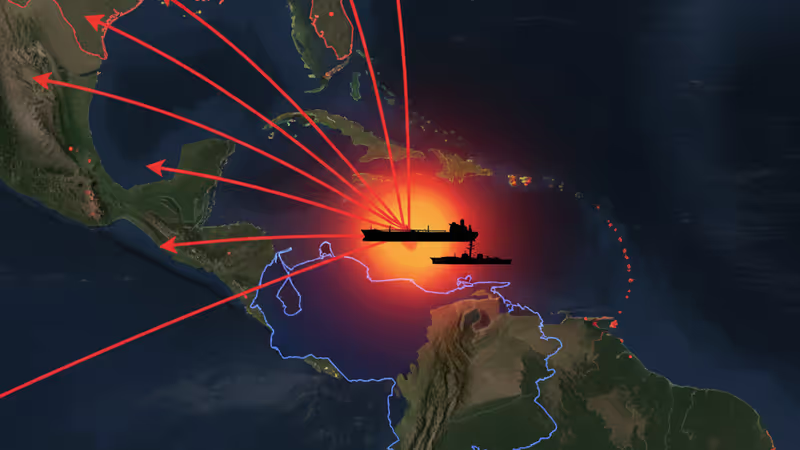
미국의 베네수엘라 유조선 나포가 카리브해 지정학적 긴장을 격화시키며 국제 해상법에 대한 논쟁을 촉발했습니다. PRISM이 이 사건의 배경, 파장, 그리고 미래 해상 감시 및 물류 기술에 미칠 영향을 분석합니다.

우크라이나 전선 격화 속 미국의 3자 회담 제안, 지정학적 함의와 전장 기술, 에너지 안보 및 국제 금융 시스템에 미칠 영향을 PRISM이 심층 분석합니다.

미국과 러시아 특사단이 마이애미에서 우크라이나 전쟁 종식 논의를 재개했습니다. 진전과 이견이 교차하는 가운데, 이 대화가 글로벌 지정학에 미칠 영향을 분석합니다.